
Commercial Success and Market Impact
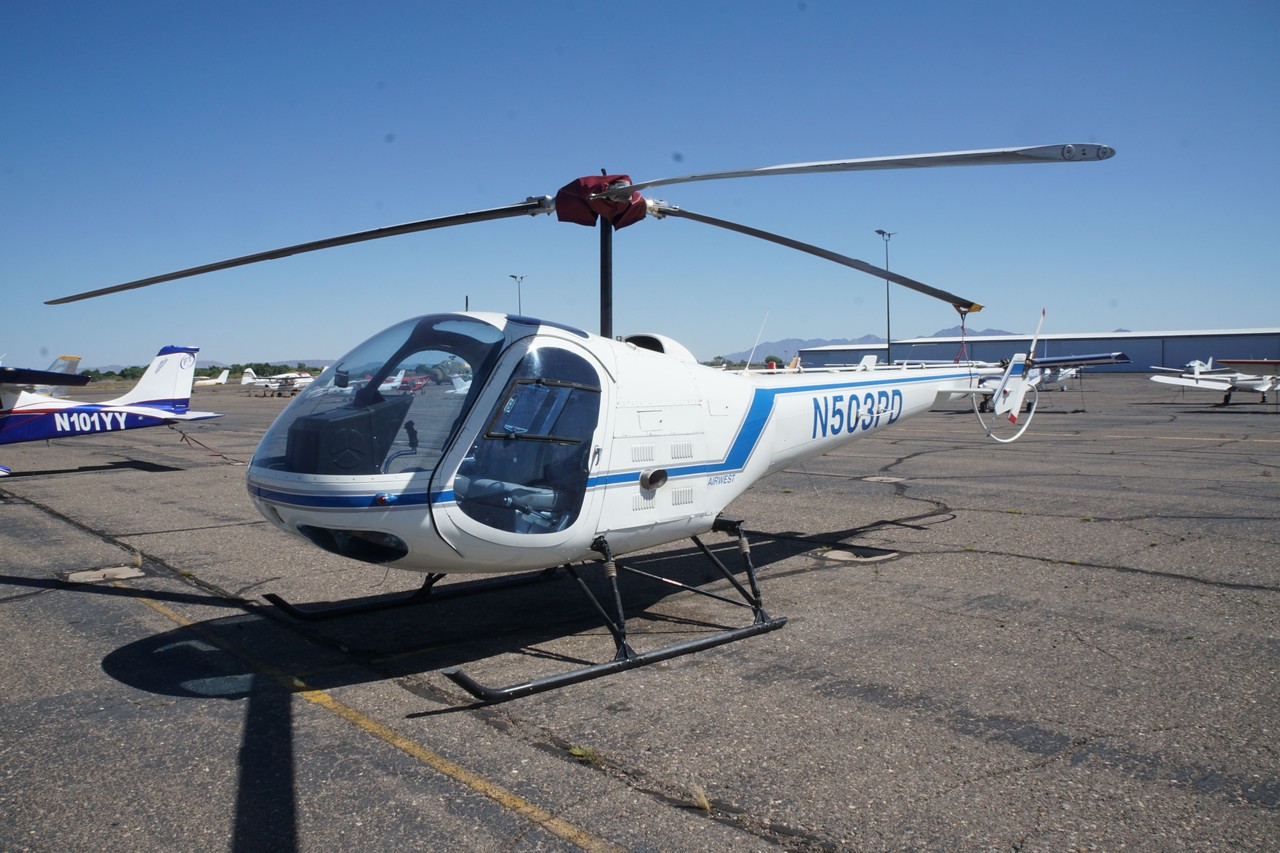
The 280 Shark transformed Enstrom's commercial fortunes, representing a dramatic departure from the company's earlier F-28 design philosophy. Under F. Lee Bailey's ownership beginning in 1971, factory production ramped up to more than 100 helicopters annually, with the 280C variant earning Fortune Magazine's prestigious recognition as one of the year's outstanding designs. The streamlined fuselage design, developed through collaboration between a Boston industrial design firm and Enstrom's engineering team, provided significant aerodynamic improvements over the angular F-28 predecessor.
Production Evolution and Variants
The original 280 Shark achieved immediate production success following its September 1974 certification, with 21 aircraft manufactured before giving way to the improved 280C variant. Certified on December 8, 1975, the 280C incorporated a turbocharged Lycoming HIO-360-E1AD engine while maintaining the same 205-horsepower output. Only six 280C aircraft were built before production shifted to the more successful 280F variant, which received certification in December 1980 and accumulated 132 examples by 1998.
The 280FX represents the current production standard, featuring an upgraded Lycoming HIO-360-F1AD engine producing 225 horsepower. By 2007, Enstrom had manufactured approximately 1,200 aircraft across all F-28 and 280 family variants combined, demonstrating the design's enduring market appeal.
The Manufacturer's Journey
Enstrom Helicopter Corporation traces its origins to 1959 when Rudy Enstrom and Jack Christian established the R.J. Enstrom Corporation in Menominee, Michigan. Christian's vision of bringing aerospace manufacturing to Michigan's economically challenged Upper Peninsula proved prescient, as the company achieved its first FAA certification for the F-28 on April 15, 1965.
The company underwent significant transformation under attorney F. Lee Bailey's ownership beginning in January 1971, when it was renamed Enstrom Helicopter Corporation. Bailey's business acumen and marketing expertise elevated the company's profile, culminating in the 280 Shark's commercial and critical success.
Following decades of various ownership changes, Enstrom declared Chapter 7 bankruptcy in January 2022. Surack Enterprises acquired the company in May 2022, demonstrating continued confidence in the 280 design's viability. The first new production helicopter under Surack ownership flew in January 2023, marking a successful revival of the nearly 50-year-old design.
Engine and Technical Innovation
The 280 Shark's powerplant philosophy centered on proven Lycoming piston engines virtually identical to those powering general aviation fixed-wing aircraft. The original 280 utilized either the HIO-360-C1A or HIO-360-C1B, both air-cooled, horizontally-opposed four-cylinder engines producing 205 horsepower. The 280C variant introduced turbocharging through the HIO-360-E1AD or HIO-360-E1BD engines, maintaining the same power output while improving high-altitude performance.
This engine selection strategy provided significant advantages in maintenance costs and parts availability, as operators could leverage the extensive support network serving the general aviation community. The three-seat configuration optimized the aircraft for commercial operations, training missions, and private transportation.
Operational Service and Global Reach
The 280 Shark found operators across multiple continents, serving various civilian roles from private transportation to commercial operations. Documented operators include Patria Helikopters AB in Sweden from 1980 to 1983, Wilhelm Niemann GmbH in Germany through 2010, and numerous other commercial entities worldwide.
The aircraft's 102-knot cruise speed and 229-nautical-mile range positioned it effectively in the light utility helicopter market, competing against larger manufacturers while offering competitive operating costs and maintenance simplicity.
Safety Challenges and Regulatory Response
The 280 family faced significant scrutiny following a fatal accident on January 26, 2015, when an Enstrom 280FX crashed at Erie, Colorado, after main rotor blade separation killed both occupants. Investigation revealed main rotor spindle failure caused by cracking, prompting the Federal Aviation Administration to issue an Emergency Airworthiness Directive on February 12, 2015.
This directive grounded more than 300 helicopters, requiring magnetic particle inspection to detect spindle cracks in aircraft exceeding 5,000 flight hours, with mandatory replacement if cracking was discovered. The swift regulatory response demonstrated the continued oversight of aging aircraft fleets.
Legacy and Continued Production
Nearly five decades after initial certification, the Enstrom 280 Shark continues active production and service. The 2023 resumption of manufacturing under Surack Enterprises ownership validates the design's enduring market relevance and technical soundness. The aircraft's recognition by Fortune Magazine as exemplary American industrial design reflects its successful synthesis of aesthetic appeal and functional performance, establishing a template that continues serving the light helicopter market today.