
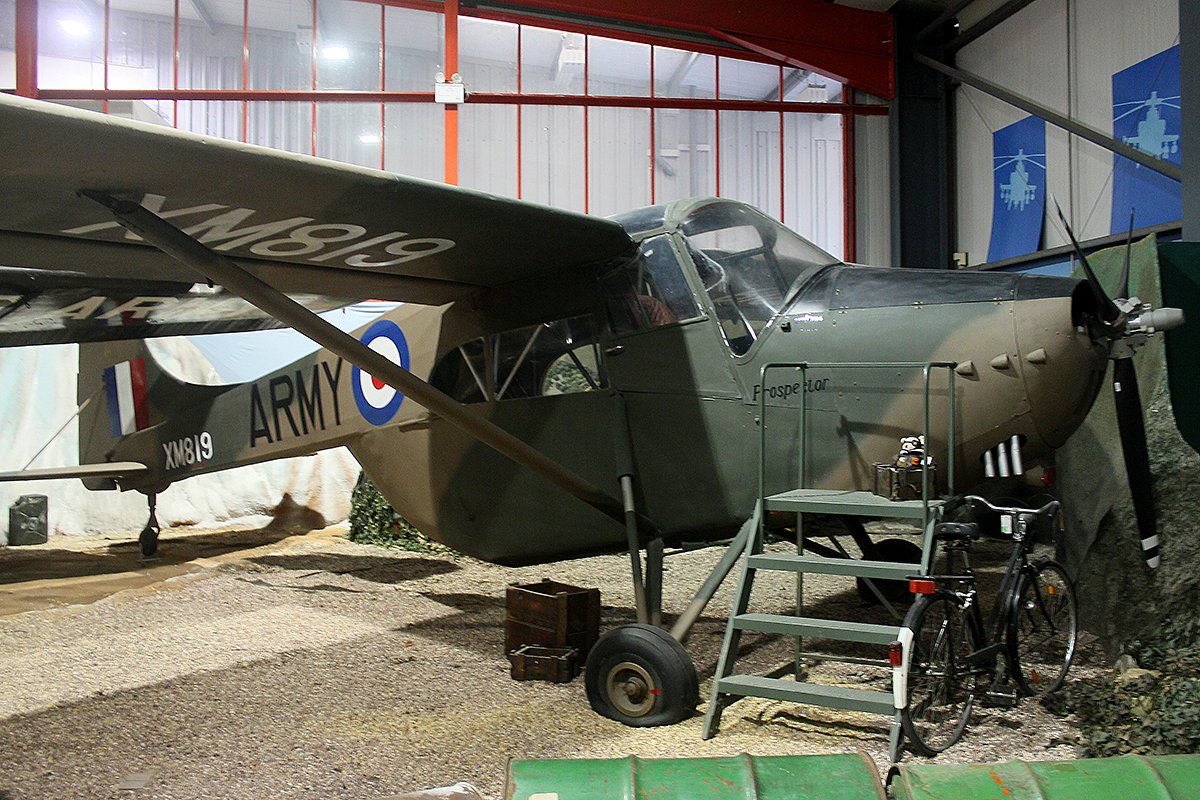
Development and Design
Edgar W. Percival, the noted British aircraft designer and test pilot, conceived the EP-9 during the mid-1950s agricultural aviation boom when operators relied heavily on converted military trainers like the de Havilland Tiger Moth. Percival recognized the need for a purpose-built agricultural aircraft that could handle the demanding requirements of crop-spraying operations more effectively than these makeshift conversions.
The prototype, registered G-AOFU, made its maiden flight on December 21, 1955, at Luton with Percival himself at the controls. The design featured a high-lift wing configuration specifically engineered for low-speed handling characteristics essential in agricultural operations, combined with robust construction capable of withstanding the stresses of rough field operations and chemical exposure.
Production Challenges
Edgar Percival Aircraft Ltd began production in 1956 at their Luton facilities, but the company faced significant financial difficulties that would plague the entire program. By 1958, Percival was forced to sell his shareholding, including all design rights, manufacturing jigs, spare parts, and up to 20 incomplete airframes in various stages of construction, to Samlesbury Engineering Ltd.
Samlesbury Engineering established Lancashire Aircraft Co. Ltd as a subsidiary, initially operating from Squires Gate Aerodrome in Blackpool. The incomplete airframes followed a nomadic path through British airports - first transferred to Squires Gate in 1958, then moved to Samlesbury Aerodrome in early 1960, and finally relocated to Stansted and Lympne airports in July-August 1961 as the company struggled to maintain operations.
Lancashire Aircraft managed to complete only six additional aircraft (construction numbers 41-47) before ceasing EP-9 production entirely in July 1961. The company itself ceased operations by 1964, marking the end of both the aircraft and its manufacturer.
Technical Specifications and Variants
The EP-9 evolved through several engine configurations during its brief production run. The initial aircraft featured 270-horsepower Lycoming O-540 engines, but most production examples received the more powerful 295-horsepower Lycoming GO-480-G1A6, a six-cylinder horizontally opposed piston engine driving a three-blade constant-speed propeller.
The most significant variant was the Prospector II, represented by a single new-build aircraft (construction number 47, registered G-ARDG) that first flew in August 1960. This version featured a 375-410 horsepower Armstrong Siddeley Cheetah 10 radial engine, a reliable seven-cylinder powerplant that had proven itself in pre-war training aircraft like the Miles Magister. One additional aircraft was later converted to Cheetah power in Australia.
Operational Service
Despite its specialized design, the EP-9 found limited commercial success. The primary market was aerial agriculture, with operators scattered across multiple continents. Australia proved to be the most receptive market, with companies like Super Spread Aviation, Airfarm Associates, and Skyspread operating several examples following a successful demonstration tour in 1956 that resulted in four initial orders.
New Zealand operations included Manawatu Aerial Topdressing, which operated ZK-BDP until it was destroyed in a crash on February 19, 1958, killing two occupants. European operators included Ernst Lund KG in Germany and SA Gyrafrique in France, while British operators like Crop Culture and Bahamas Helicopters also acquired examples.
The British Army purchased two aircraft in 1958 for utility trials, representing the type's only military service, though no combat use or specific operational details were recorded.
Commercial Failure and High Accident Rate
The EP-9's commercial failure stemmed primarily from its high purchase price compared to readily available surplus military trainers that could be converted for agricultural use at a fraction of the cost. This economic reality made it difficult for operators to justify the investment in purpose-built aircraft, regardless of their superior design characteristics.
Operational safety proved problematic, with accident records showing 21 losses between 1957 and 1984, resulting in nine fatalities. Most accidents occurred during agricultural operations, reflecting both the inherently dangerous nature of low-level crop-spraying work and the challenging conditions in which these aircraft operated.
Production Legacy
Total production reached exactly 27 aircraft over the program's five-year lifespan. A 28th fuselage (construction number 47) was completed but represented the final Prospector II before production ceased. One additional fuselage remained incomplete when Lancashire Aircraft shut down operations.
By 1984, most EP-9s had been lost to accidents or scrapped, with no examples confirmed as remaining airworthy today. The type's brief production run and limited commercial success meant it left little lasting impact on aviation history, serving primarily as a footnote in the evolution from surplus military aircraft to purpose-built agricultural aviation equipment.
The EP-9 Prospector represents the challenges faced by small aircraft manufacturers in the post-war era, where innovative design and engineering excellence could not overcome economic realities and market resistance to higher-priced specialized equipment.