
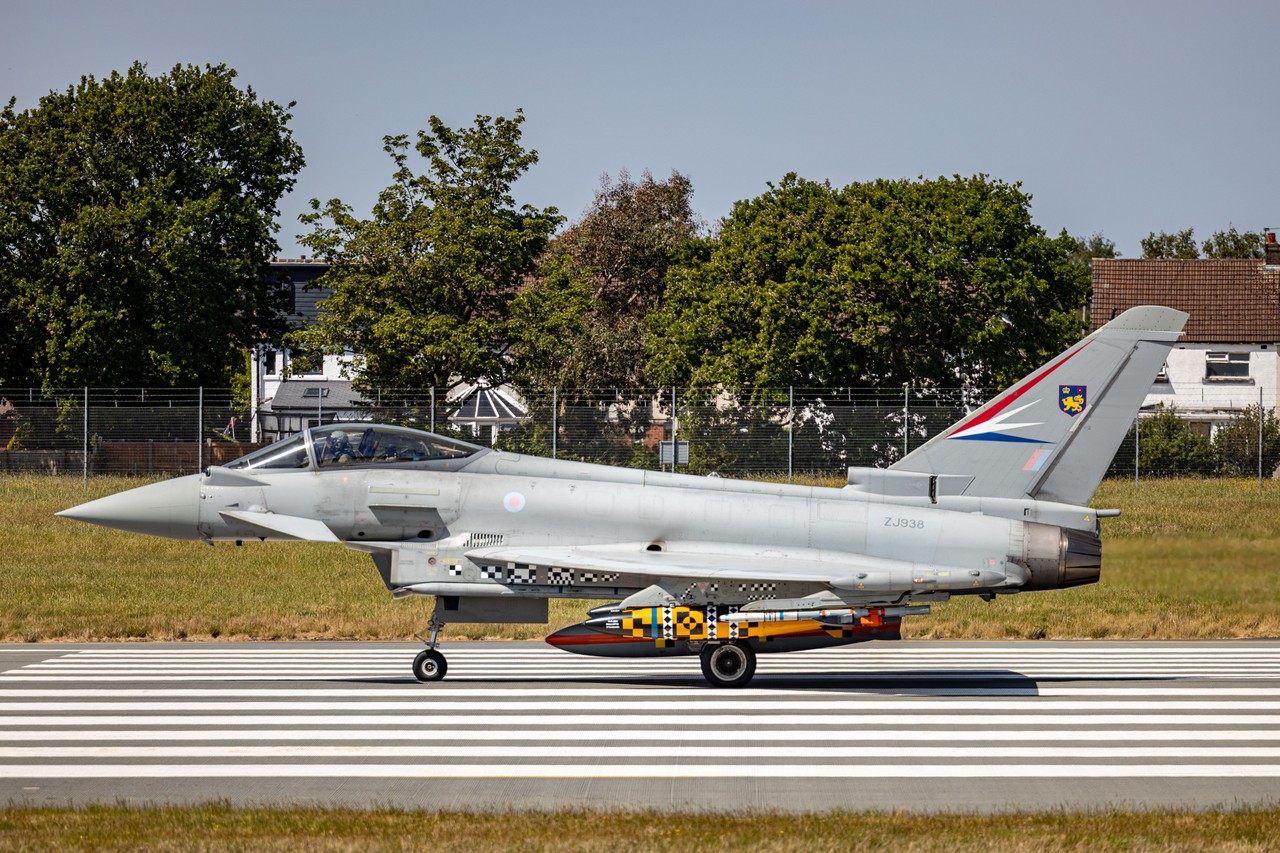
Multinational Development Program
The Eurofighter Typhoon emerged from a unique four-nation collaboration between the United Kingdom, Germany, Italy, and Spain, forming the largest defense cooperation project in European history. Development began in the 1980s with the British Aerospace EAP technology demonstrator first flying on August 6, 1986, paving the way for the production aircraft that would follow nearly a decade later.
The first Eurofighter prototype took to the skies on March 27, 1994, marking the beginning of an extensive test program. Three Instrumented Production Aircraft completed their maiden flights in rapid succession during April 2002: the Italian-built IPA2 on April 5 from Caselle, the German-built IPA3 on April 8 from Manching, and the British-built IPA1 on April 15 from Warton.
Manufacturing Excellence
Production is distributed across multiple European facilities, with each partner nation specializing in specific components. BAE Systems operates final assembly lines at Warton and Samlesbury in the UK, while also producing the advanced CAPTOR radar system in Edinburgh. EADS facilities in Manching, Germany manufacture the center fuselage sections, requiring approximately 80,000 man-hours per unit. The Spanish EADS-CASA facility in Getafe serves as another final assembly point, capable of delivering up to seven aircraft annually, while Alenia Aerospazio in Italy produces rear fuselage sections and wings.
The program's financial magnitude became evident when contracts for up to 620 aircraft were signed on January 30, 1998, valued at over 55 billion Deutsche Marks. The initial production contract for 148 Typhoons and 363 engines, worth nearly 14 billion Deutsche Marks, was formalized on September 21, 1998, with signatures from Jack Gordon of NETMA, Brian Phillipson of Eurofighter GmbH, and Ken Greenall of Eurojet GmbH.
Combat-Proven Performance
The Typhoon's Rolls-Royce EJ200 engines deliver exceptional performance, with the first production powerplants delivered on July 12, 2001. These military-specification turbofans provide the thrust necessary for the aircraft's air superiority mission while maintaining reliability across diverse operational environments.
Production has proceeded through distinct tranches, each incorporating enhanced capabilities. Tranche 1 comprised 148 aircraft delivered between 2002 and 2005, followed by 299 Tranche 2 aircraft from 2005 to 2010, and 124 Tranche 3A aircraft from 2010 to 2014. Germany's November 2020 order for 38 Tranche 4 aircraft, valued at 5.4 billion euros, demonstrates continued confidence in the platform's future.
Global Operations
As of March 2024, 680 Eurofighter Typhoons have been ordered by nine nations, with 603 already delivered. The four founding partners operate the majority: the United Kingdom with 160 aircraft, Germany with 143, Italy with 96, and Spain with 73. International success followed with Austria acquiring 15 aircraft, Saudi Arabia ordering 72 units including 24 from UK production with 48 assembled domestically, and Oman purchasing 12 Tranche 3A aircraft in December 2012.
The Royal Air Force designates certain variants as FGR4, representing Tranche 1 Block 5 standard aircraft. Different block configurations (Block 1, 2, 2B, and 5) incorporate incremental improvements, though these capability enhancements don't necessarily align with tranche boundaries.
Advanced Systems Integration
The Typhoon's CAPTOR radar system represents cutting-edge European technology, with the first production unit delivered by BAE Systems Edinburgh in February 2001. This advanced pulse-Doppler radar provides exceptional air-to-air detection capabilities while supporting the aircraft's expanding air-to-ground mission requirements.
Eurofighter International, established in 1999 as a unified export sales organization, manages international marketing and support. This streamlined approach has proven successful in securing contracts beyond the founding nations, with over 200 UK companies alone benefiting from £1.6 billion in production work.
Operational Legacy
Milestone achievements punctuate the program's success: the 100th aircraft delivered on September 29, 2006, the 250th on December 22, 2010, and the 400th on December 4, 2013. These deliveries underscore consistent production capability across multiple international assembly lines.
The aircraft officially adopted the "Typhoon" name in September 1998, initially intended for export variants but eventually applied universally. This nomenclature reflects the aircraft's formidable capabilities and its role as a cornerstone of European air defense.
Today, the Eurofighter Typhoon continues serving as Europe's premier air superiority platform, with ongoing upgrades ensuring relevance well into the 21st century. Its success demonstrates that multinational collaboration can produce world-class military aircraft while strengthening industrial partnerships across national boundaries.