
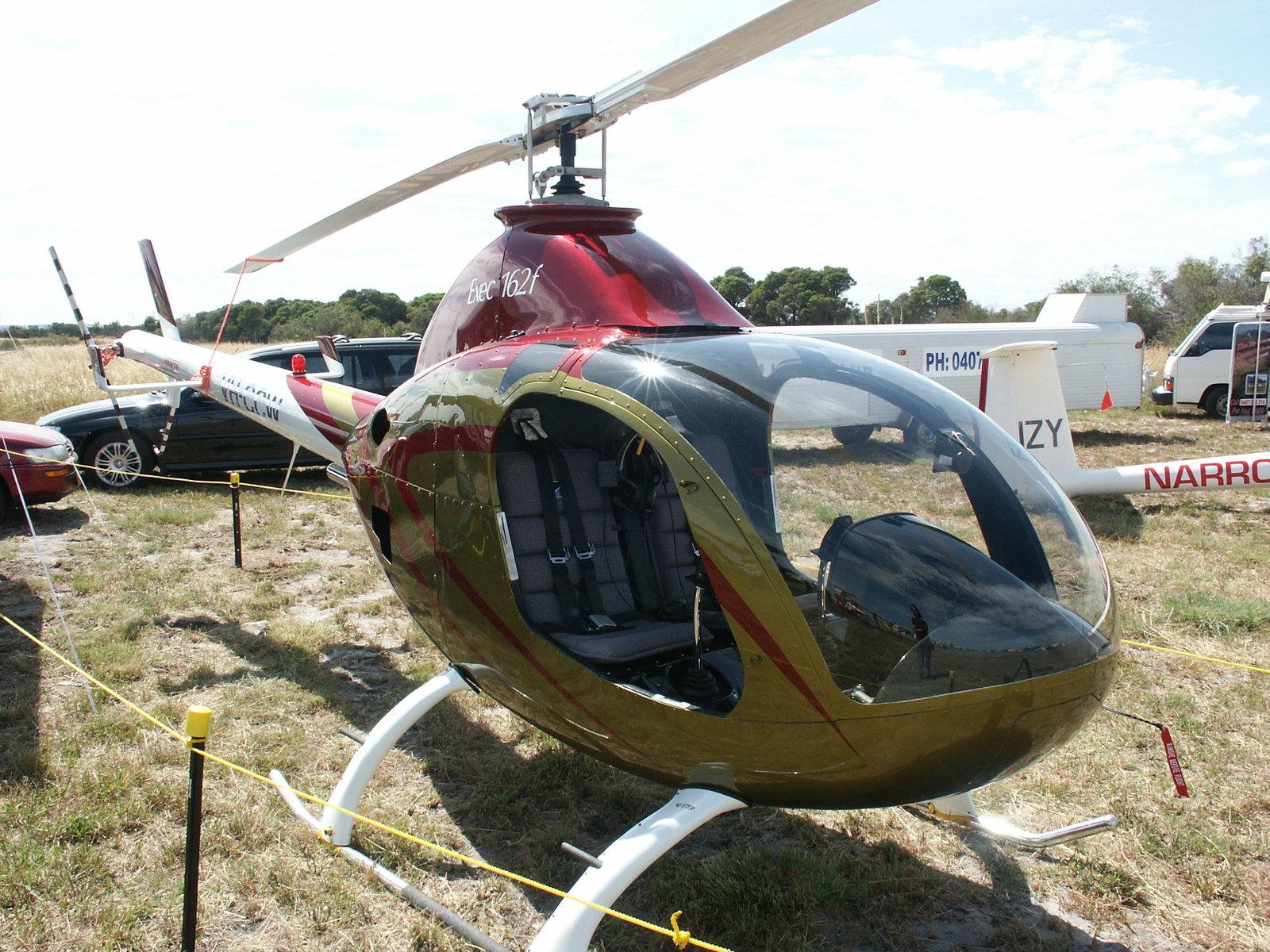
Revolutionizing Home-Built Aviation
The RotorWay Exec transformed personal helicopter ownership from an exclusive privilege into an achievable goal for aviation enthusiasts worldwide. Between 1994 and 2011, this kit helicopter enabled hundreds of builders to construct their own rotorcraft with just 300 hours of assembly time—among the lowest build times in the kit aircraft industry. The Exec's success stemmed from RotorWay's commitment to eliminating complex fabrication work, providing pre-assembled components and detailed construction manuals that required no welding experience.
The Visionary Behind RotorWay
B.J. Schramm founded RotorWay International in San Gabriel, California during the early 1960s, driven by a vision to make helicopter flight accessible to civilian pilots. After seven years of development, Schramm's original Javelin prototype first flew in August 1965, evolving into the Scorpion I production kit by 1967. The company relocated to a modern 37,000-square-foot facility in Chandler, Arizona around 1994, housing sales, manufacturing, and flight training operations under one roof.
RotorWay grew to become the world's oldest and largest kit-helicopter manufacturer, selling aircraft to builders in over 50 countries. Despite facing financial difficulties in the late 1980s that led to bankruptcy by 1995, new ownership revitalized the company and continued production until RotorWay's assets transferred to Rotor X in 2021.
Engineering Innovation and Power
The Exec's success depended heavily on RotorWay's decision to develop their own powerplant when suitable engines from other manufacturers proved unavailable. In 1974, the company introduced the RW133 four-cycle engine, followed by the RW145 in 1980, and ultimately the RI 162F that powered the Exec series from 1986 onward.
The 150-horsepower RI 162F engine incorporated advanced features rarely seen in kit aircraft, including fuel injection with electronic ignition, dual electronic ignition systems, and a Fully Automated Digital Electronic Control (FADEC) system. This sophisticated engine management consumed just eight gallons of 92-octane fuel per hour—no aviation gasoline required—making operation economically practical for recreational pilots.
Design Excellence and Safety
The Exec featured a clockwise-rotating main rotor system, unusual among American-designed helicopters, mounted on an elliptical hub plate engineered to withstand stresses far exceeding normal operational loads. RotorWay introduced asymmetrical rotor blades in 1982, enabling improved high-altitude performance and enhanced autorotation characteristics for emergency landings.
The enclosed fiberglass cabin provided 44 inches of shoulder room—equivalent to a Cessna airplane—with side-by-side seating for pilot and passenger. At 975 pounds empty weight, the Exec achieved its design objective of carrying two people while remaining under the critical weight thresholds for experimental aircraft certification.
Global Service Record
Exec helicopters found employment in diverse roles across six continents, from crop spraying and ranch work to police surveillance and forestry observation. The aircraft's low operating costs and simple maintenance requirements made it particularly attractive for commercial operators in developing nations where certified helicopter service remained prohibitively expensive.
RotorWay customers consistently earned top Experimental Aircraft Association awards throughout the 1990s and 2000s, demonstrating the high build quality achievable with the company's kit systems. The Exec 162F earned marketing recognition as "the world's best selling helicopter in its class," reflecting its dominance in the kit-built rotorcraft market.
Evolution and Legacy
The Exec series underwent continuous refinement from its 1980 introduction through final production in 2011. The Exec 90, launched in 1990, became the first piston-powered helicopter utilizing asymmetrical airfoils and featured distinctive eyebrow windows for improved visibility. The definitive Exec 162F variant, introduced in 1994, incorporated the fuel-injected engine and FADEC systems that defined the type's mature configuration.
RotorWay's 2007 launch of the A600 Talon represented the Exec's evolutionary successor, featuring the 147-horsepower RI 600N engine and modernized avionics. Across all variants, RotorWay manufactured approximately 1,861 aircraft, establishing a production record unmatched by any other kit helicopter manufacturer.
The Exec's influence extended beyond RotorWay's own products, inspiring international variants including the Italian AvioTecnica ES-101 Raven, which paired the basic Exec design with a Solar T-62-A turboshaft engine and carbon-fiber rotor blades. Though RotorWay's independent operations concluded in 2021, the Exec established the template for affordable personal helicopters that continues influencing kit aircraft design today.