
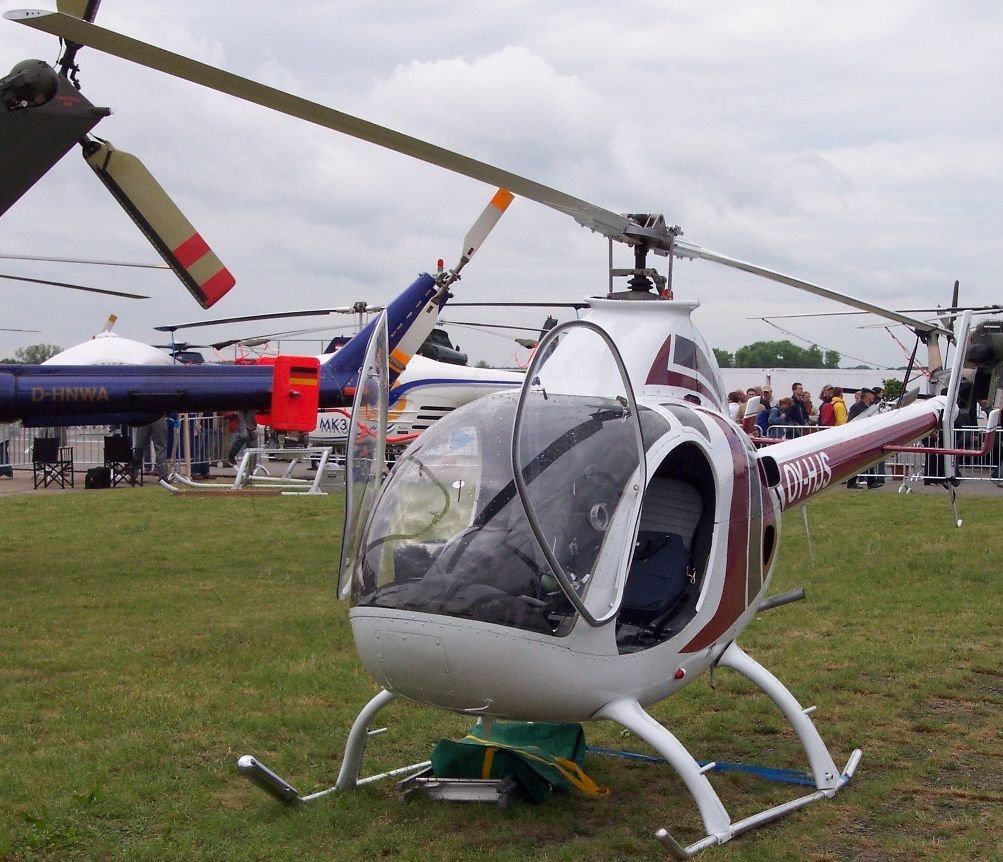
Development and Design Philosophy
The JetExec emerged during RotorWay International's most productive period in the 1990s, when the company was exploring advanced propulsion alternatives to their proven piston-engine formula. Building upon the success of the Exec 90, which had established itself as the only piston-powered helicopter utilizing an asymmetrical airfoil for enhanced autorotation characteristics, RotorWay's engineering team sought to create a turbine-powered variant that would appeal to builders seeking higher performance.
The timing coincided with RotorWay's 1990 corporate reorganization, when RotorWay Aircraft transformed into RotorWay International under new management structure. This period marked the company's most ambitious expansion, with over 1,000 Exec kits sold and more than 650 aircraft completed by the mid-2000s, providing a solid foundation for experimental variants like the JetExec.
Technical Innovation
The JetExec retained the fundamental airframe geometry of the standard Exec series while incorporating significant modifications to accommodate jet propulsion. The basic Exec design, introduced in 1980 as a modernized evolution of the earlier Scorpion model, provided proven aerodynamics and structural integrity that could be adapted for higher power-to-weight ratios typical of turbine engines.
Unlike the standard Exec 162F's fuel-injected piston engine with electronic ignition and FADEC, the JetExec required extensive modifications to the engine bay, fuel system, and exhaust routing. The challenge of adapting a kit helicopter design originally optimized for a 152-horsepower piston engine to accommodate jet propulsion represented significant engineering complexity for homebuilders.
Production and Registration Records
Documented serial numbers ranging from 61 to 3001 suggest the JetExec designation was applied across an extended production sequence, though actual completion rates remained limited. Registration records indicate JetExec aircraft operated in both Canada and the United States, with specific examples including Canadian registrations C-GJEX and C-FNLC, and U.S. registrations N25566 and N3764G.
The limited number of completed aircraft reflects the technical challenges and costs associated with jet propulsion in the experimental helicopter market. While RotorWay had achieved remarkable success with over 900 helicopters flying by 2007, the JetExec remained a specialized variant appealing to a narrow segment of builders willing to tackle complex turbine installations.
The RotorWay Legacy
RotorWay International's journey began in the early 1960s when B.J. Schramm established the company in San Gabriel, California, pioneering the kit helicopter market. By 1998, the company had transitioned to employee ownership, maintaining its position as the dominant force in homebuilt rotorcraft.
The company's success stemmed from its focus on practical, buildable designs that ordinary enthusiasts could complete in home workshops. The original Exec series proved this concept, offering cruise speeds of 113 mph and maximum speeds of 130 mph with a 400-pound payload capacity - performance figures that attracted serious builders seeking genuine transportation capability.
Market Position and Competition
The JetExec represented RotorWay's attempt to capture the high-performance segment of the kit helicopter market, where turbine power offered significant advantages in power-to-weight ratio and operational simplicity. However, the complexity and cost of jet engines created barriers that limited market acceptance compared to the proven piston-powered variants.
The experimental nature of jet-powered kit helicopters meant that builders faced not only higher initial costs but also ongoing maintenance challenges and fuel consumption rates that made the JetExec impractical for most recreational users who formed RotorWay's core market.
End of Production
The JetExec's limited production run ended when RotorWay unveiled the A600 Talon in July 2007 at EAA AirVenture in Oshkosh, Wisconsin. The Talon represented a complete redesign featuring a wider fuselage, improved double-redundant FADEC, and standard glass cockpit instrumentation, focusing on advanced piston technology rather than jet propulsion.
In 2021, RotorWay International's assets transferred to Rotor X, marking the end of the original company's six-decade run. The JetExec remains a rare footnote in kit helicopter history, representing an ambitious but ultimately impractical attempt to bring jet propulsion to the homebuilt market.