
Design Origins
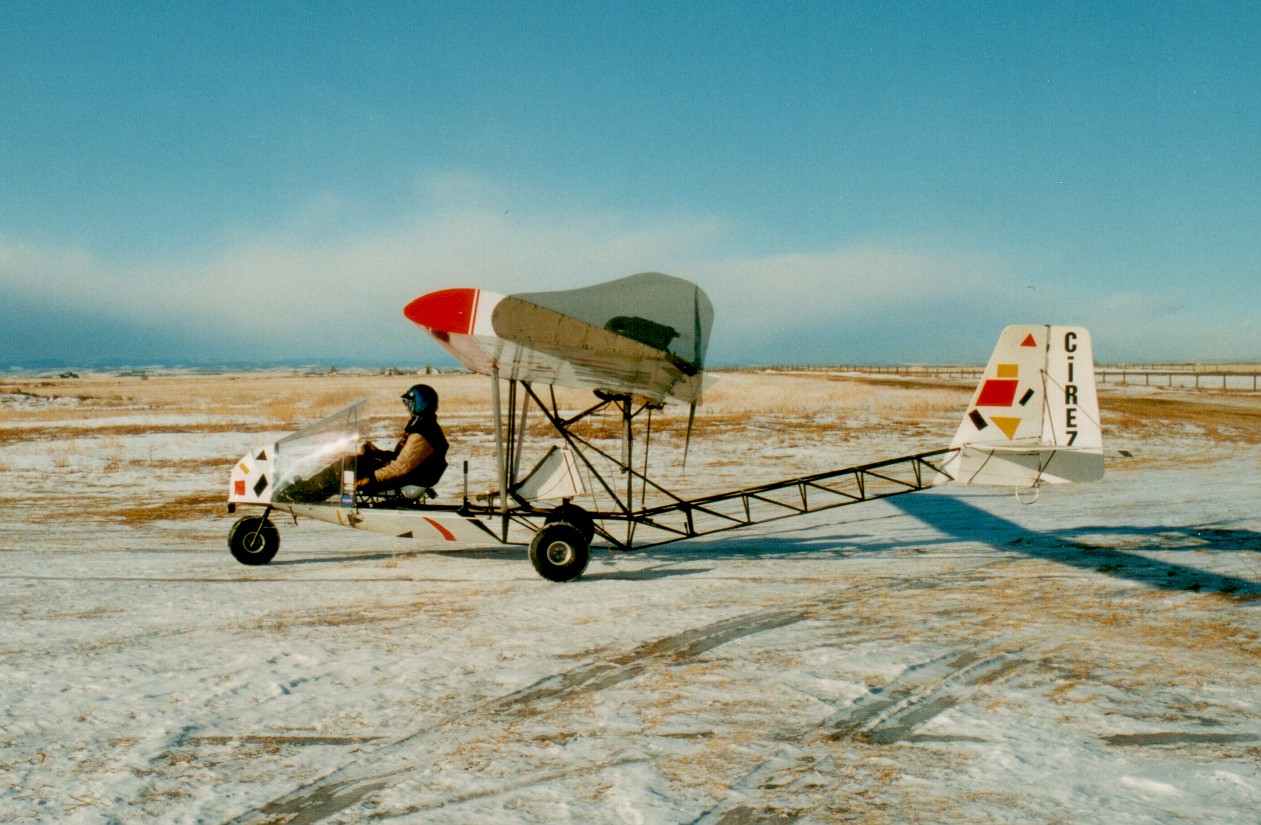
Wayne Winters of Indus, Alberta conceived the E-Z Flyer as his inaugural aircraft design project, drawing inspiration from the Breezy homebuilt and his operational experience with Ultraflight Lazairs. Winters prioritized creating a forgiving, slow-flying trainer with open-cockpit configuration that would excel in flight instruction roles. His design philosophy centered on developing a high-performance kit aircraft that evolved into a lighter, more manageable tandem two-seat pusher with exceptionally docile flight characteristics.
The prototype incorporated several innovative features, including a distinctive open lattice "N" girder fuselage constructed from 4130 steel tubing and an entirely new tail design. Winters adapted wings from the Merlin EZ, incorporating Junkers ailerons and the proven Clark Y airfoil to ensure stable handling qualities. The wing construction featured leading-edge "D" cell construction with foam ribs, contributing to the aircraft's lightweight yet robust structure.
Production History
Merlin Aircraft initiated production of the E-Z Flyer in mid-1995, delivering the first kits to builders seeking an affordable training aircraft option. Blue Yonder Aviation acquired the complete program in 1998, relocating manufacturing operations to Indus, Alberta, where they continued producing both kits and completed aircraft. The company offered flexibility by providing either partial kits for amateur builders or fully assembled aircraft for immediate operation.
By 2011, total production reached 64 aircraft, with Blue Yonder Aviation serving both the recreational market and flight training schools. The manufacturer operated their own Blue Yonder Ultralight Flight School, where the original prototype accumulated 2,500 instructional hours by May 2001, demonstrating the design's durability and suitability for intensive training operations.
Engine Configuration
The E-Z Flyer accommodates multiple Rotax powerplant options in pusher configuration, allowing operators to select engines based on performance requirements and budget considerations. The Rotax 503 two-stroke engine produces 50 horsepower, while the Rotax 582 delivers 64 horsepower for improved performance. Four-stroke options include the 80-horsepower Rotax 912 and the 100-horsepower Rotax 912S, providing smoother operation and enhanced reliability for commercial training operations.
This engine flexibility proved particularly valuable for flight schools, as the prototype's extensive service with minimal wear demonstrated the reliability of the Rotax powerplants in training environments. The pusher configuration eliminates propwash over the wings and cockpit while providing excellent forward visibility for both instructor and student.
Flight Characteristics
The E-Z Flyer's design priorities emphasized safety and ease of handling over maximum performance, resulting in a stall speed of just 38 mph that provides significant safety margins for student pilots. Maximum speed reaches 100 mph with the Rotax 582 engine, while cruise speed settles at 70 mph for economical operation. The aircraft achieves a service ceiling of 12,000 feet with a maximum range of 382 miles.
The Clark Y airfoil and Junkers aileron combination delivers predictable stall characteristics and responsive control inputs without being overly sensitive. Pilots consistently praised the aircraft's forgiving nature, which made it ideal for primary flight training and recreational flying by pilots of varying experience levels.
Operational Service
Flight schools and private owners comprised the primary market for the E-Z Flyer, with Blue Yonder Aviation's own flight school serving as the primary demonstration of the aircraft's training capabilities. By 2001, more than 30 aircraft were serving private owners and educational institutions, establishing a small but dedicated operator base across North America.
Registration records from November 2016 showed eight aircraft registered in Canada and eight in the United States, indicating sustained interest in the type among recreational pilots and training organizations. The tandem seating arrangement with open cockpits provided excellent communication between instructor and student while offering the authentic flying experience that many pilots prefer over enclosed cabin aircraft.
Technical Innovation
The E-Z Flyer's structural design represented a thoughtful evolution of existing ultralight concepts, incorporating proven elements while introducing specific improvements for training use. The open lattice fuselage construction provided excellent strength-to-weight ratio while allowing easy inspection and maintenance access. Wing area of 176 square feet combined with the aircraft's 495-pound empty weight delivered a power-to-mass ratio of 18.75 pounds per horsepower with the Rotax 582 installation.
Blue Yonder Aviation also developed a twin-engine variant, expanding the basic design concept to accommodate different mission requirements and providing a progression path for pilots seeking multi-engine experience in an affordable platform.
Legacy
While production numbers remained modest compared to major manufacturers, the E-Z Flyer established itself as a reliable training platform that fulfilled its design objectives. The prototype's accumulation of 2,500 hours without major issues validated Winters' design approach and demonstrated the aircraft's structural integrity under intensive use. Current flying examples continue serving recreational pilots and flight schools, though exact numbers of airworthy aircraft beyond 2016 remain undocumented.