
Commercial Dominance
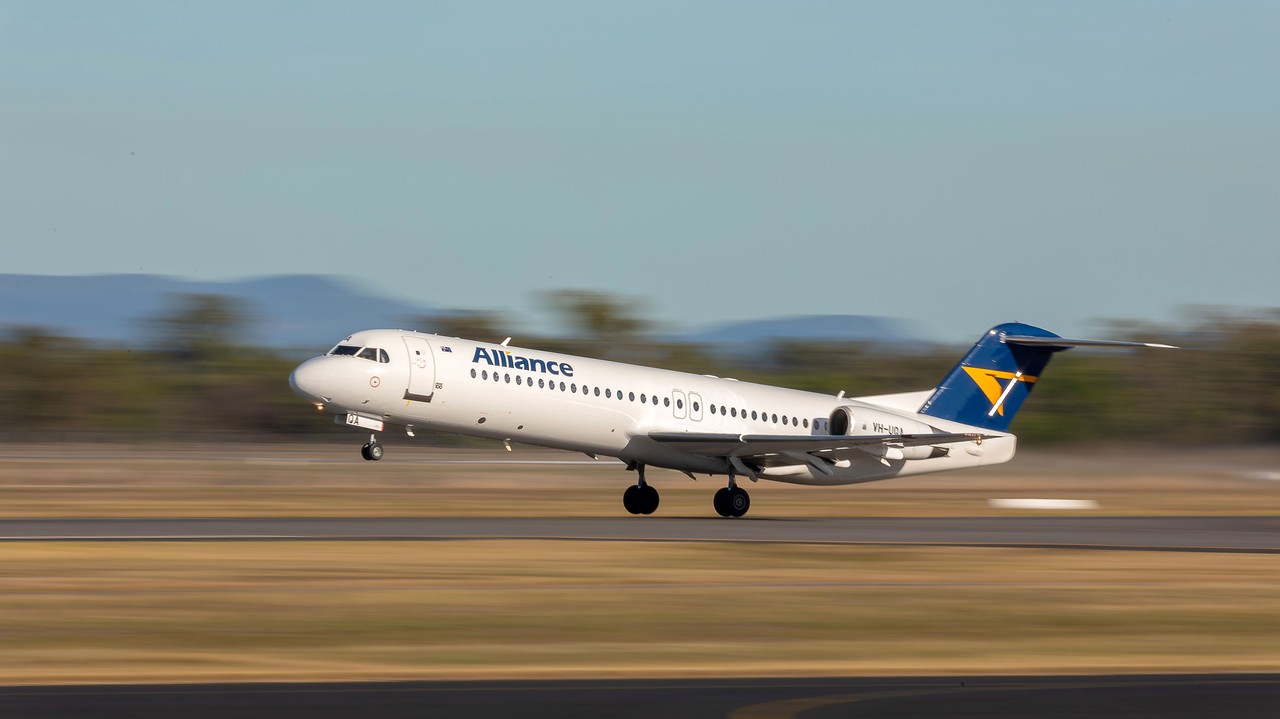
The Fokker 100 captured significant market share in the underserved 100-seat regional airliner segment during the late 1980s and 1990s. American Airlines placed the largest single order with 75 aircraft worth $3.1 billion in March 1989, branding them as "Luxury Jets" and operating them from 1991 until 2004. The airline specifically chose the Fokker 100 after it "easily defeated the competing BAE 146, MD87 and 737-500" in comprehensive evaluations, citing its 18 percent weight advantage over the Boeing 737-500.
Development and Design Innovation
Development began in November 1983 as Fokker sought to modernize and expand their successful F.28 regional jet. The design team retained the proven rear-engine T-tail configuration while stretching the fuselage to accommodate significantly more passengers than the F.28's original capacity. This approach allowed Fokker to leverage existing certification and manufacturing processes while delivering substantial performance improvements.
The first prototype took flight on November 30, 1986, followed by certification on November 20, 1987. The innovative design reused many F.28 components, allowing the aircraft to be designated as the Fokker F.28-0100 on its Type Certificate rather than requiring complete recertification as an entirely new aircraft type.
Manufacturing and Production
Fokker manufactured the aircraft at their Schiphol facility in the Netherlands, while distributing component production among aviation companies in Germany, Ireland, England, and the United States. Production commenced with the first delivery to launch customer Swissair on February 29, 1988. When the shorter Fokker 70 variant entered production in April 1993, both aircraft were built on a single production line to maximize manufacturing efficiency.
Between 1986 and 1997, Fokker completed 281 to 283 Fokker 100s, making it one of the most successful European regional airliner programs. Production ended abruptly when Fokker declared bankruptcy on March 15, 1996, with final deliveries completed in 1997 as the company fulfilled remaining orders.
The Manufacturer's Legacy
Fokker Aircraft traced its origins to one of aviation's pioneering companies, having previously produced successful models including the F.27 and F.28. The F.28 served as the direct predecessor to the Fokker 100, establishing the rear-engine configuration that became the larger aircraft's signature design element. Despite the company's rich aviation heritage spanning decades, financial difficulties in the mid-1990s forced the historic manufacturer into bankruptcy.
Following Fokker's collapse, a company called Rekkof (Fokker spelled backwards) announced revival plans during the 2000s, later evolving into the Netherlands Aircraft Company. However, multiple attempts to restart production ultimately failed, and Fokker eventually became a subsidiary of Airbus, focusing on maintenance and component manufacturing rather than complete aircraft production.
Operational Excellence
Major operators included TAM Transportes Aéreos Regionais with 50 aircraft and USAir with 40 aircraft, while KLM operated 23 Fokker 100s throughout the type's service life. American Airlines deployed their Fokker 100 fleet to replace aging Boeing 727-100s on thinner routes while building up operations at hubs in San Jose and Raleigh-Durham, demonstrating the aircraft's versatility in various market applications.
The aircraft's efficiency and passenger comfort made it particularly attractive to airlines seeking to optimize operations on medium-density routes. Its 109-passenger capacity positioned it perfectly between smaller regional jets and larger narrow-body aircraft, filling a crucial market niche during the airline industry's evolution in the 1990s.
Production Variants and Technical Achievement
The Fokker 70, introduced in April 1993, provided a shorter derivative with up to 85 passengers while sharing the Fokker 100's advanced systems and operational characteristics. This family approach allowed operators to standardize training, maintenance, and operations across different capacity requirements while maintaining fleet commonality.
The Fokker 100's technical achievements included its remarkable 30 percent improvement in cruise efficiency over the F.28, accomplished through aerodynamic refinements, updated systems, and optimized weight distribution. These improvements demonstrated how evolutionary design approaches could deliver substantial performance gains without the risks associated with completely new aircraft programs.
Current Status and Continuing Legacy
Approximately 58 Fokker 100s remained in active service as of recent assessments, with about 150 of the 281 produced aircraft still flying as of June 2020. American Airlines retired their fleet in 2004, citing high maintenance and operating costs that became increasingly difficult to justify as newer, more efficient regional jets entered service.
The Fokker 100 represents a significant chapter in European aviation history, demonstrating how established manufacturers could successfully compete in the global airliner market through innovative design and strategic market positioning. Though production ended prematurely due to financial circumstances rather than technical shortcomings, the aircraft's commercial success and operational reliability established it as one of Europe's most important contributions to regional aviation development.