
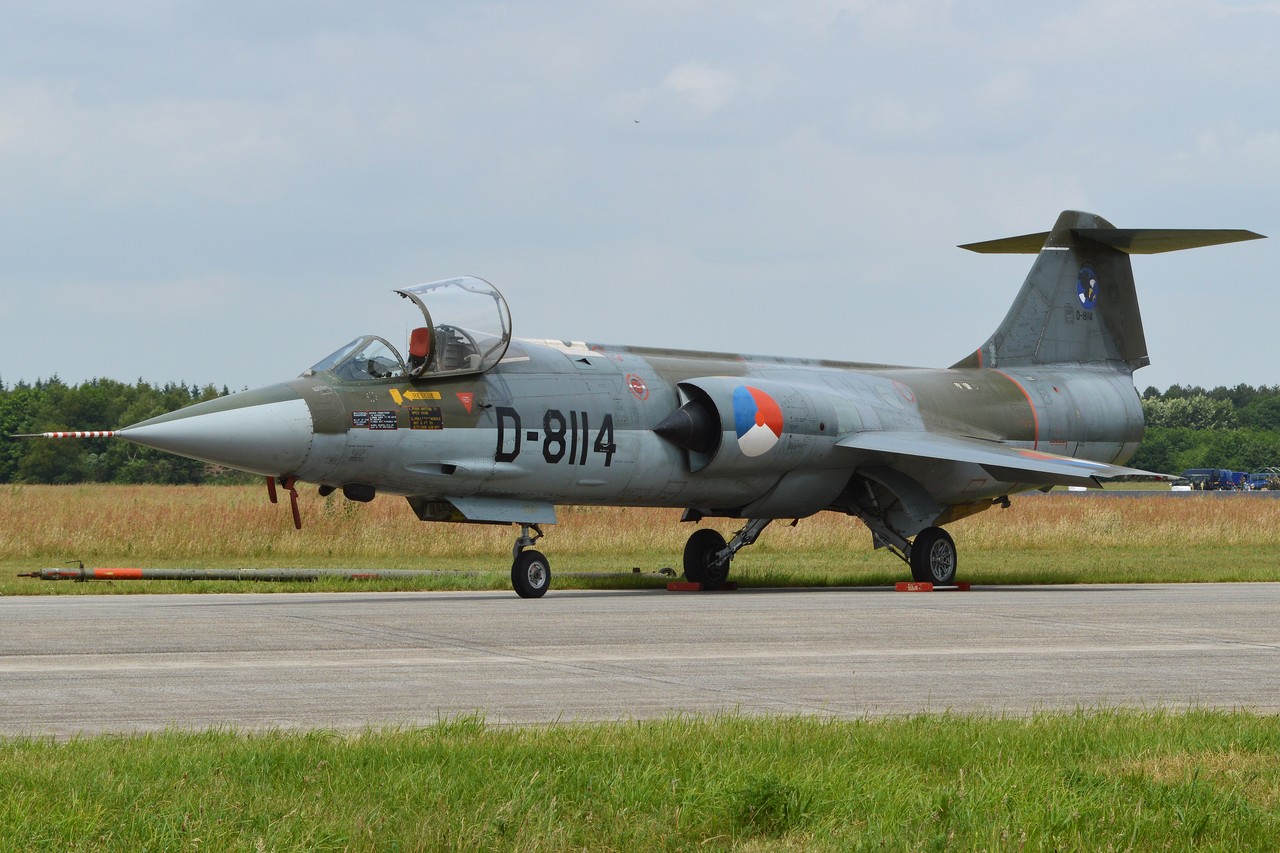
Service History
The F-104 Starfighter entered United States Air Force service on January 28, 1958, when the 83rd Fighter Interceptor Wing received its first F-104A model. Despite its brief USAF career ending in 1969, the Starfighter achieved unprecedented success in international markets, with over 2,500 aircraft sold to 14 nations in what became known as the "Deal of the Century." The aircraft served as the primary interceptor for NATO forces throughout the 1960s and 1970s, with countries like West Germany operating more than 900 F-104Gs in various roles.
Wartime and Operational History
The Starfighter saw combat during the Second Taiwan Strait Crisis in 1958, where USAF F-104As provided a crucial deterrent against Chinese MiG-15 and MiG-17 fighters. During the Vietnam War from 1965 to 1967, F-104C variants operated in both air superiority and fighter-bomber roles, though high loss rates to ground fire limited their effectiveness in the theater.
Major variants included the initial F-104A interceptor with 153 aircraft built, the two-seat F-104B trainer, and 77 F-104C fighter-bombers equipped with bomb racks. The most successful variant proved to be the multirole F-104G, with over 1,000 examples produced under license for NATO allies. Canada operated the specialized CF-104 variant, while Italy developed the advanced F-104S with improved radar and missile capabilities.
The Manufacturer
Lockheed Aircraft Corporation, founded in 1912 as the Alco Hydro-Aeroplane Company and renamed Lockheed in 1926, developed the Starfighter through its famous Skunk Works division. Under the leadership of Kelly Johnson, Lockheed's secretive advanced development unit had already produced groundbreaking aircraft and would later create the U-2 spy plane and SR-71 Blackbird. The company merged with Martin Marietta in 1995 to form Lockheed Martin, which continues operations today as a major aerospace contractor.
To support international production, Lockheed established the SURE (Starfighter Utilization Reliability Effort) program, providing technical assistance to licensees including Canadair in Canada, Fiat and Aeritalia in Italy, Messerschmitt and MBB in Germany, Fokker in the Netherlands, Mitsubishi in Japan, and SABCA in Belgium.
Engine and Technical Innovation
The F-104's performance centered on the General Electric J79 turbojet engine, an afterburning powerplant producing 10,000 to 11,000 pounds of dry thrust and up to 17,950 pounds with afterburner engaged depending on the variant. The reliable J79 enabled sustained Mach 2+ operations and became so successful that European licensees including Orenda, BMW, Fabrique Nationale, and Alfa Romeo produced over 1,225 engines under license.
Kelly Johnson's design team created the Starfighter's most distinctive feature: wings with an unprecedented 3 percent thickness-to-chord ratio, essentially razor-thin surfaces optimized for supersonic flight. This radical wing design, combined with a fuselage scaled from the proven F-86 Sabre, delivered exceptional high-altitude performance but required a boundary layer control system to maintain acceptable low-speed handling characteristics.
Pilot Perspective
The Starfighter demanded exceptional pilot skill, earning the nickname "Widowmaker" in German and Italian service due to its unforgiving flight characteristics and accident record. The aircraft's primary armament consisted of the M61 Vulcan 20mm cannon in early models, supplemented by AIM-9 Sidewinder missiles on wing-tip rails. Later variants could carry bombs and additional ordnance on underwing pylons.
With a maximum speed exceeding 1,320 miles per hour at altitude, the F-104 could reach 58,000 feet and maintained a combat range of approximately 1,000 miles with external fuel tanks. The aircraft's phenomenal climb rate of 48,000 feet per minute made it unmatched as a point-defense interceptor, though its limited fuel capacity and specialized design restricted versatility in other roles.
Production and Legacy
Lockheed and its international partners manufactured exactly 2,578 F-104 Starfighters between 1956 and 1983, with the first production F-104A rolling off the assembly line at Air Force Plant 42 in Palmdale, California on April 17, 1956. The final aircraft, an Aeritalia-built F-104S, was delivered around 1980-1983, marking the end of a 27-year production run.
Today, few Starfighters remain airworthy, with most serving as museum displays worldwide. Notable examples include F-104A serial number 56-817 at the Pearl Harbor Aviation Museum in Hawaii, an F-104C at the National Museum of the United States Air Force, and an F-104G at the Planes of Fame Air Museum. The Starfighter's legacy lies not only in its pioneering supersonic design but also in its influence on lightweight fighter development and its role as a symbol of Cold War technological competition between East and West.