
Revolutionary Combat Performance
The F-117 Nighthawk proved its revolutionary capabilities during Operation Desert Storm in 1991, where 42 aircraft flew 1,271 combat sorties while suffering only one combat loss. Despite representing just 2 percent of coalition aircraft, F-117s struck 40 percent of strategic targets in heavily defended Baghdad. The stealth fighters achieved an 80 percent mission success rate, delivering 2,030 tons of precision munitions against 1,600 high-value targets throughout Iraq.
The aircraft's combat debut actually occurred two years earlier during Operation Just Cause in Panama in December 1989, where F-117s from the 37th Tactical Fighter Wing conducted their first operational missions. The type's near-perfect combat record validated decades of classified research into radar-absorbing technology and angular design principles.
Development at the Skunk Works
Lockheed's Advanced Development Projects division, known as Skunk Works, began developing the F-117 in 1975 under project manager Ben Rich and designer Alan Brown. The program originated from the "Hopeless Diamond" concept, so named because its angular faceted design resembled a cut gemstone. Mathematician Bill Schroeder and radar specialist Overholser built upon theoretical work by Soviet physicist Pyotr Ufimtsev to create the first aircraft designed entirely around stealth principles.
The Defense Advanced Research Projects Agency awarded Lockheed a contract in 1976 to build two prototype "Have Blue" stealth demonstrators. Following successful testing at the classified Groom Lake facility in Nevada, full-scale development began on November 1, 1978. Remarkably, the first YF-117A prototype flew just 31 months later on June 18, 1981, demonstrating the Skunk Works' legendary rapid development capabilities.
Manufacturing and Secrecy
Production occurred entirely at Lockheed's Burbank, California facility between 1982 and 1990. The company manufactured 64 total aircraft: five full-scale development prototypes and 59 production F-117As. The final Nighthawk was delivered on July 3, 1990, ending an eight-year production run conducted under the strictest secrecy.
The program remained classified until 1988, and the aircraft did not appear publicly until 1990. All flight operations initially took place at night from the remote Tonopah Test Range in Nevada, earning the aircraft its "Nighthawk" designation. The 4450th Tactical Group achieved initial operational capability in October 1983, five years before the program's existence was officially acknowledged.
Engineering Innovation
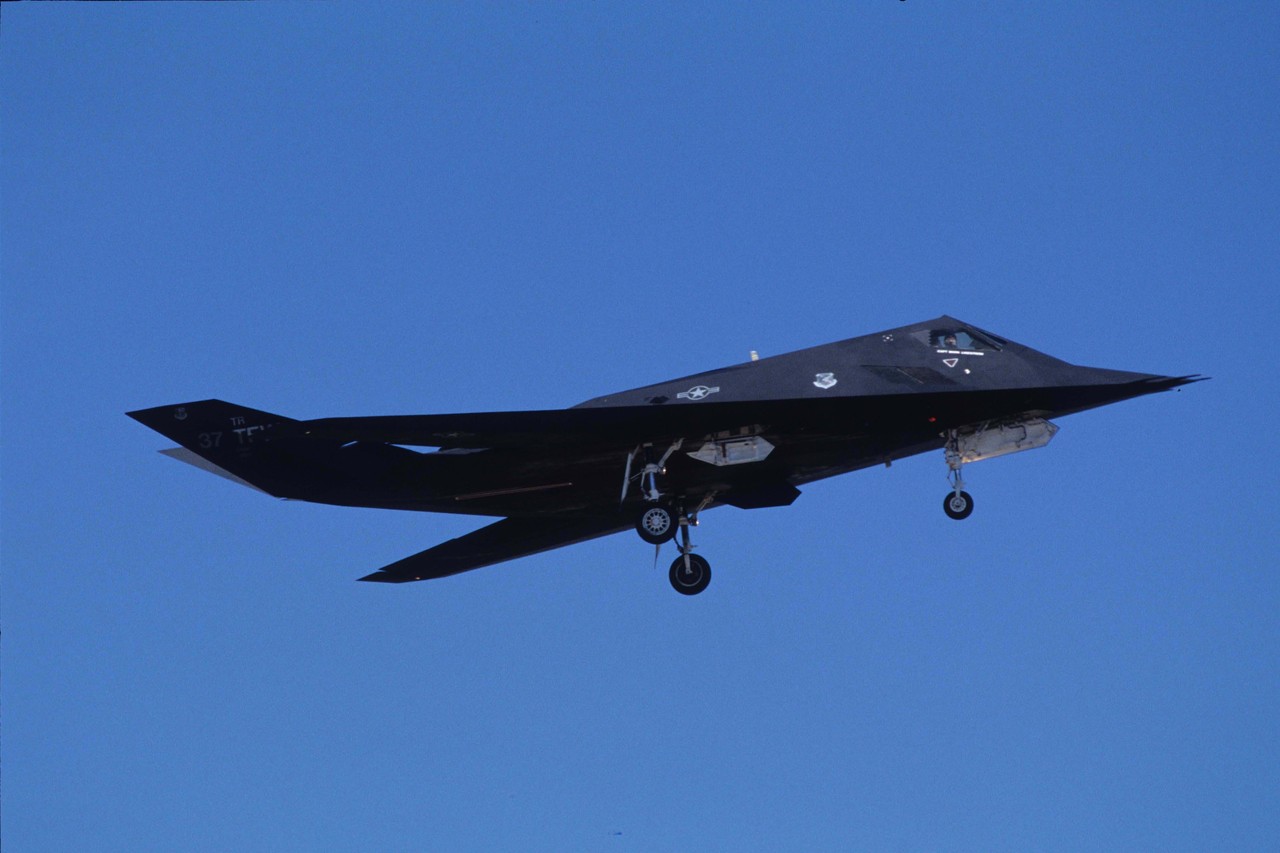
The F-117's distinctive angular design resulted from 1970s computer limitations that could only calculate radar reflection from flat surfaces. Engineers created a multifaceted airframe using hundreds of triangular panels coated with radar-absorbing materials. This configuration reduced the aircraft's radar cross-section to approximately that of a small bird, making it virtually invisible to enemy radar systems.
Two General Electric F404-F1D2 turbofan engines, producing 10,600 pounds of thrust each, powered the subsonic aircraft. Special inlet and exhaust configurations further reduced radar and infrared signatures. The F-117 measured 65 feet 11 inches long with a 43-foot 4-inch wingspan, making it smaller than most tactical fighters despite its strategic attack role.
Operational Service
The Air Force operated F-117s from Tonopah Test Range until 1992, when the 49th Fighter Wing relocated to Holloman Air Force Base, New Mexico. Peak inventory reached 59 operational aircraft distributed among multiple squadrons. Pilots required extensive training to master the aircraft's unique handling characteristics, as its angular design prioritized stealth over aerodynamic efficiency.
Each F-117 cost approximately $122 million in 1998 dollars, reflecting the sophisticated materials and manufacturing processes required. The internal weapons bay accommodated various precision munitions, including laser-guided bombs and air-to-surface missiles, though the aircraft carried no defensive armament or countermeasures.
Retirement and Legacy
Program Budget Decision 720, issued on December 28, 2005, accelerated F-117 retirement to fund F-22 Raptor procurement. The last operational Nighthawk, serial number 86-0831, was retired on August 11, 2008, ending 25 years of active service. However, the Air Force slowed the disposal process, maintaining approximately 45 aircraft in "Type 1000" storage for potential future use.
Several F-117s have appeared at air shows and museums since retirement, including the "Dark Angel" displayed at Pima Air and Space Museum in Tucson since 2022. The Nighthawk's influence extends far beyond its operational service, as its stealth technology principles shaped subsequent aircraft designs including the B-2 Spirit, F-22 Raptor, and F-35 Lightning II. The F-117 fundamentally transformed military aviation doctrine and established the United States' dominance in stealth technology.