
Historical Significance
The original Junkers F-13 transformed commercial aviation when it first flew on June 25, 1919, piloted by Emil Monz. As the world's first successful all-metal passenger airliner, it accounted for over one-third of all air traffic in the early 1920s and remained in commercial service for more than thirty years. The aircraft's revolutionary corrugated aluminum construction and cantilever wing design established principles that would dominate aviation for decades.
The Modern Reconstruction Project
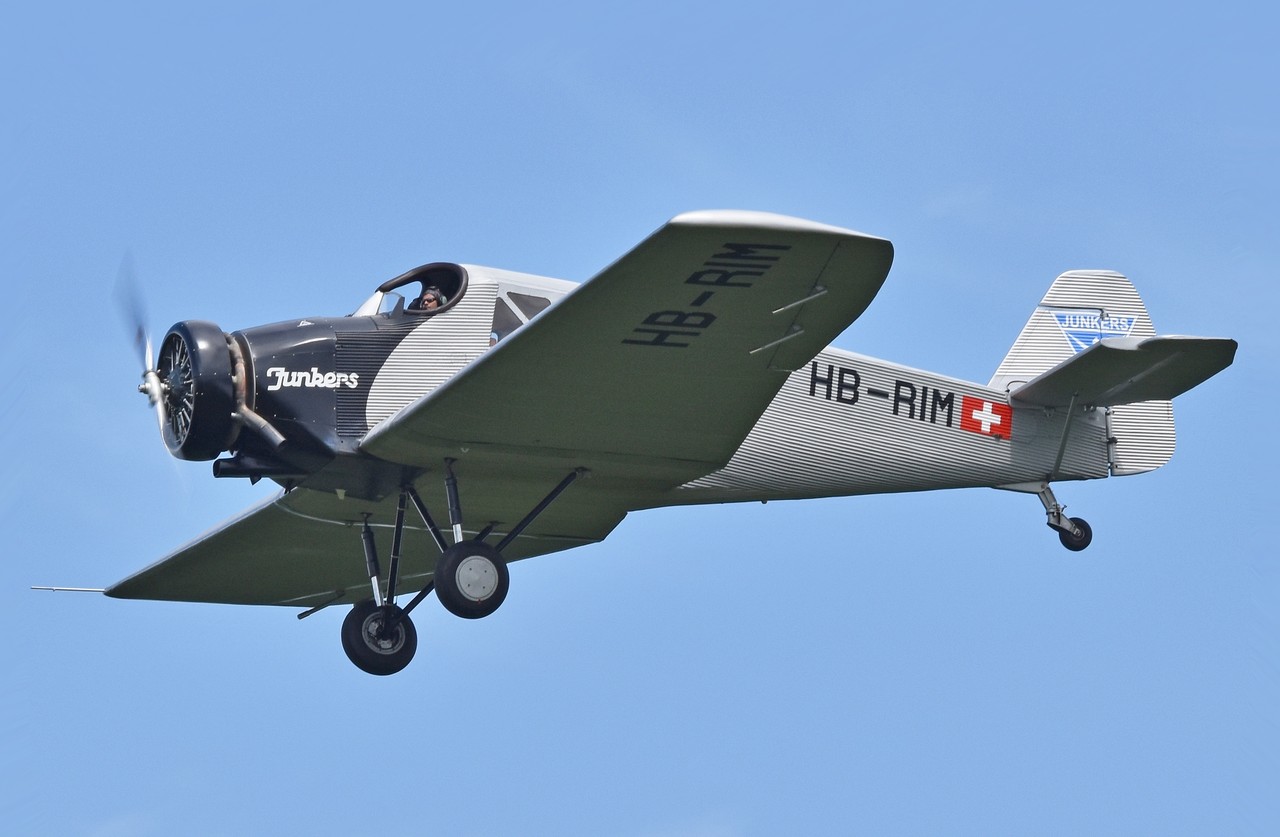
Junkers Flugzeugwerke (SD303) undertook the ambitious replica project to honor Hugo Junkers' centennial legacy. The company invested thousands of hours recreating the aircraft from original blueprints and detailed laser scans of an original F-13 housed at the Museum of Air and Space at Le Bourget, Paris. The finished replica incorporates 2,600 individual parts assembled with tens of thousands of rivets, maintaining the authentic corrugated metal construction that made the original famous.
The reconstruction team faced unique challenges in sourcing period-appropriate materials while meeting modern airworthiness standards. The completed aircraft achieved its first flight on September 15, 2016, marking a successful return of Hugo Junkers' design to active flight status after decades of museum-only preservation.
Design Heritage and Innovation
Hugo Junkers led the original F-13's development team, investing approximately 9,000 development hours between January and June 1919. The first prototype, construction number 533, was christened "Annelise" after Junkers' daughter. The aircraft's all-metal construction represented a radical departure from the fabric-covered wooden designs prevalent in 1919, establishing durability standards that enabled the type's remarkable longevity in service.
The original F-13 achieved commercial success despite post-World War I restrictions that initially prohibited its operation within Germany. This limitation paradoxically accelerated international expansion, with the aircraft ultimately serving 70 airlines across 30 countries. The design's adaptability spawned numerous variants, including floatplane configurations, ski-equipped versions for Arctic operations, and specialized mail carriers.
Technical Specifications and Performance
While the original F-13 employed inline water-cooled engines—initially a 170-horsepower Mercedes D.IIIa, later upgraded to the 185-horsepower BMW IIIa—the modern replica utilizes a Wasp radial engine for improved reliability and parts availability. This powerplant change represents the primary deviation from original specifications while maintaining the aircraft's distinctive flight characteristics.
The original F-13 achieved a maximum speed of 106 miles per hour, revolutionary performance for early commercial aviation. Its robust construction enabled operations in challenging environments worldwide, from Arctic conditions with ski landing gear to tropical seaplane operations with float configurations.
Production Legacy
Original F-13 production spanned thirteen years from 1919 to 1932, yielding 322 aircraft—an exceptional production run for early commercial aviation. Peak production occurred in 1925 with 68 aircraft completed. Manufacturing primarily took place at Junkers' Dessau facility, though economic pressures during 1921-1923 shifted production to plants in Danzig and Reval. A notable international agreement established production at Plant No. 22 near Moscow between 1922 and 1923.
Luft Hansa, formed through the 1926 merger that included Junkers Luftverkehr, operated 55 F-13s on 43 domestic routes by 1928. The airline's F-13 fleet accumulated 9.5 million miles before the merger, demonstrating the type's operational reliability. Some F-13s remained in active Luft Hansa service until 1938, maintaining over 50 weekly flights on four routes as late as 1937.
Contemporary Preservation Efforts
Only five original F-13 examples survive today in various states of preservation. The replica program addresses this scarcity by providing flight-capable examples for demonstration and education. As of 2016, Junkers Flugzeugwerke planned three additional replicas, with the second airframe scheduled for maiden flight in early summer 2019.
One notable survivor, CF-ALX (construction number 2050), known as "Königsgeier" (King Vulture), was produced in 1930 and exported to Vancouver, British Columbia. Added to the Canadian civil register on May 27, 1930, this aircraft underwent restoration at the Royal Aviation Museum of Western Canada, preserving original construction techniques for future study.
Influence on Aviation Development
The F-13's success established the foundation for subsequent Junkers designs, including the W 33 and W 34 transports. Its all-metal construction methodology influenced aircraft development worldwide, while its commercial success proved the viability of scheduled passenger service. The replica program ensures that Hugo Junkers' revolutionary design principles remain accessible to new generations of aviation enthusiasts and engineers, preserving both the physical aircraft and the innovative spirit that created it.