
Service History
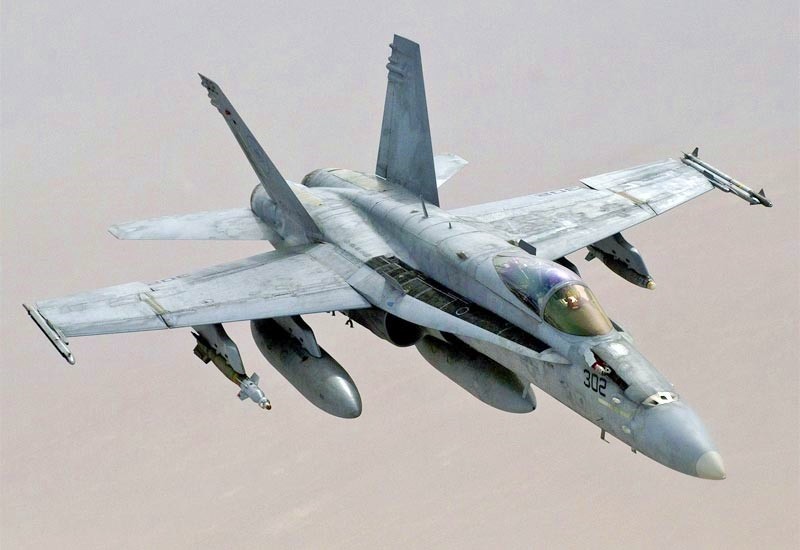
The F/A-18C Hornet emerged as the backbone of U.S. Navy and Marine Corps tactical aviation, with production beginning in September 1987 as an improved version of the earlier F/A-18A model. McDonnell Douglas manufactured 1,480 total Hornets across the A/B/C/D variants, with C model production running until 2000. The aircraft served with distinction in multiple air forces worldwide, including 179 Marine Corps C/D models still operational as of 2024, with planned service extending to 2030.
Beyond American service, the Hornet found international success with operators including the Royal Australian Air Force (75 aircraft delivered 1984-1990), Spanish Air Force (96 EF-18A/B variants from 1986-1998), Finnish Air Force (64 aircraft from 1995-2000), Swiss Air Force (34 aircraft from 1997-1999), and Royal Canadian Air Force (138 CF-188 variants). This widespread adoption demonstrated the design's versatility and reliability across diverse operational environments.
Combat Operations
The F/A-18C proved its combat effectiveness through extensive operational deployment beginning with the 1986 U.S. bombing of Libya. During the 1991 Gulf War, Hornets flew 4,551 sorties with remarkable survivability—only three aircraft were lost with just one attributable to enemy fire. Ten Hornets sustained damage during Desert Storm, yet the type's resilience was dramatically demonstrated when one aircraft flew 125 miles back to base despite dual engine hits, requiring only days for repair.
Subsequent combat operations included 1990s missions over Bosnia and Kosovo, extensive service during the 2003 Iraq War, and continuing Middle East operations. The Kuwait Air Force exemplified the type's endurance during the Yemen Civil War from 2015-2017, flying 3,000 sorties from King Khalid Air Base. This combat record established the F/A-18C as a proven multirole platform capable of both air superiority and precision ground attack missions.
The Manufacturer
McDonnell Douglas Corporation, formed through the 1967 merger of McDonnell Aircraft and Douglas Aircraft companies, dominated military aviation production until Boeing acquired the company in 1997. The corporation traced its heritage to McDonnell's 1939 founding and Douglas's establishment in 1920, bringing together decades of aerospace innovation under one organization.
The company rolled out the first F/A-18A on September 13, 1978, in distinctive blue-on-white colors marked "Navy" on the left side and "Marines" on the right. Primary manufacturing occurred at McDonnell Douglas facilities in St. Louis, Missouri, though international assembly lines operated in Australia at Government Aircraft Factories in Avalon, Finland through Finavitec, and Switzerland via Swiss Aircraft and Systems at Emmen. Following Boeing's acquisition, F/A-18 production continued with the larger Super Hornet variants, maintaining the design lineage into the 21st century.
Engine and Technical Innovation
Powering the F/A-18C were two General Electric F404-GE-402 afterburning turbofan engines, providing the reliable thrust essential for demanding carrier operations. These engines enabled supersonic performance while maintaining the fuel efficiency necessary for extended patrol missions and long-range strikes. The powerplant's proven reliability became legendary during Gulf War operations, where engine-related failures remained minimal despite intensive combat sorties.
The aircraft incorporated significant technological advances including multifunction displays that revolutionized pilot workload management and redesigned stores stations enabling true multirole capability. Early wing stiffness issues were resolved to improve roll rate performance when carrying heavy external loads, enhancing combat maneuverability across the entire mission spectrum.
Development and Design Philosophy
McDonnell Douglas and Northrop design teams developed the Hornet under the Navy's VFAX program during the mid-1970s, seeking to replace both the A-7 Corsair II and F-4 Phantom II with a single multirole aircraft. Originally conceived as separate F-18A fighter and A-18A attack variants, advancing avionics technology enabled merging both roles into the unified F/A-18 designation, alongside the two-seat TF-18A trainer version.
The prototype, designated Hornet One (Bureau Number 160775), achieved first flight on November 18, 1978, from St. Louis. Production F/A-18A models began flying on April 12, 1980, with the improved F/A-18C variant following on September 2, 1987. Development testing utilized a "principal site concept" centralizing evaluation at NAS Patuxent River with Navy and Marine Corps pilots, ensuring the design met demanding carrier-based operational requirements.
Production Legacy
With manufacturing ending in 2000 at a unit cost of $28 million (1996 dollars), the F/A-18C represented the culmination of first-generation Hornet development. The 11 prototype aircraft accumulated 2,756 flights totaling 3,583 hours during the comprehensive test program, validating the design's airworthiness and combat capability.
Today, museum examples preserve the Hornet's legacy at institutions including the National Naval Aviation Museum (F/A-18C), Hickory Aviation Museum (F/A-18A Legacy Hornet), Pima Air & Space Museum, Patriots Point Naval & Maritime Museum, and Fort Worth Aviation Museum. While the U.S. Navy Blue Angels transitioned from Hornets to Super Hornets in 2020, active F/A-18C operations continue with Marine Corps squadrons and international operators, testament to an enduring design that successfully bridged legacy fighters to modern multirole aircraft capabilities.