
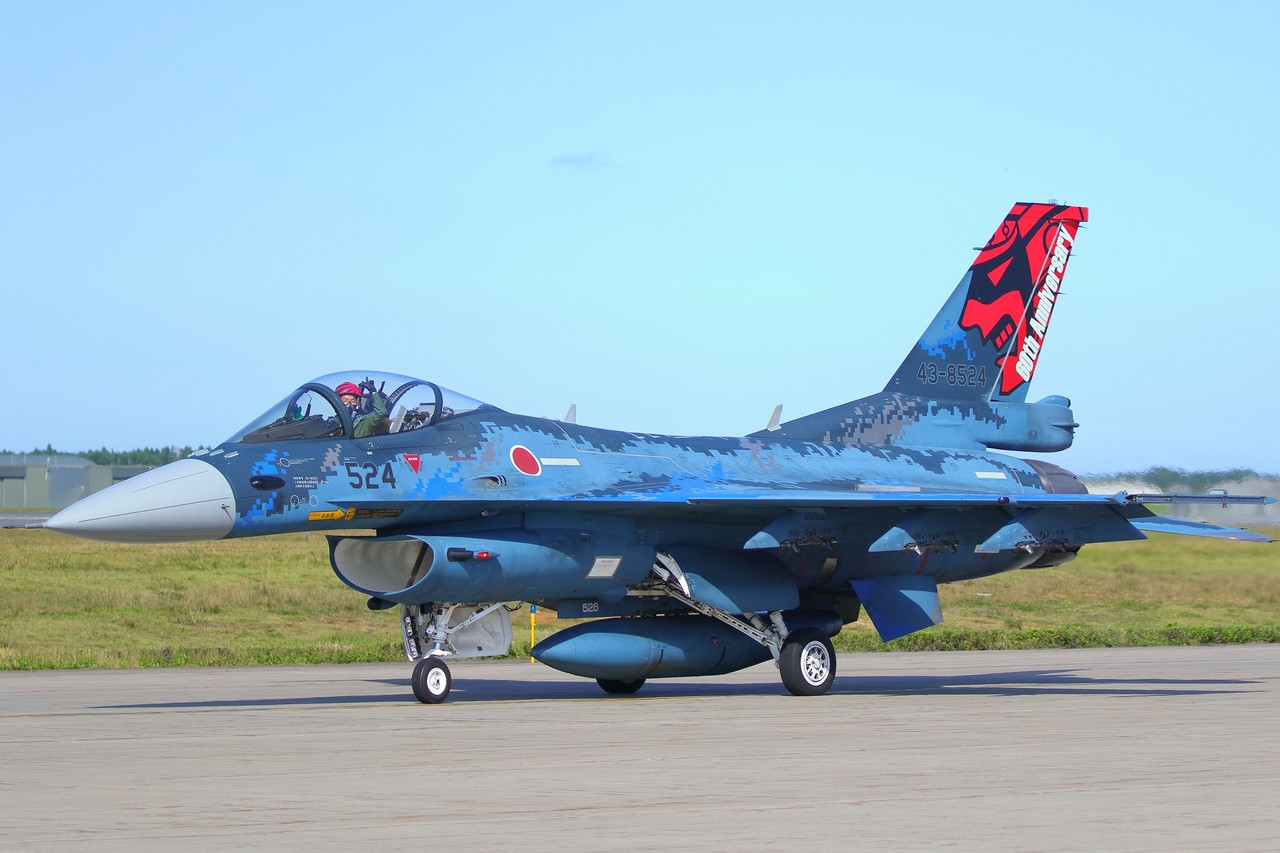
Development and Design Innovation
The F-2 program originated from Japan's FS-X studies that began in the late 1970s, aimed at replacing the aging F-1 fighter in Japan Air Self-Defense Force service. After extensive deliberation, Japan and the United States reached a cooperation agreement in August 1987, with the F-16 selected as the baseline design in October 1987. Mitsubishi Heavy Industries was chosen as prime contractor in November 1988, with Lockheed Martin providing substantial technical assistance while Japanese companies handled 60 percent of the development work.
The aircraft incorporated revolutionary technology for its era, most notably the indigenous J/APG-2 active electronically scanned array radar—the first AESA system installed in a production fighter aircraft. Engineers enlarged the wing area to 34.84 square meters compared to the F-16's design, providing improved range and payload capacity essential for Japan's maritime defense requirements. Extensive use of composite materials reduced structural weight while maintaining strength.
Development proved challenging and costly. The first prototype was rolled out on January 12, 1995, at Mitsubishi's Komaki South Plant, achieving first flight on October 7, 1995. However, structural issues emerged during testing, including wing cracking problems in mid-1999 and fin root difficulties later that year. These setbacks doubled development costs to 327 billion yen, equivalent to $3.27 billion.
Production and Service History
Production commenced in 2000, with initial aircraft deliveries to the Japan Air Self-Defense Force beginning in September 2000. Manufacturing occurred at Mitsubishi facilities in Nagoya and the Komaki South Plant, with major subcontractors including Kawasaki Heavy Industries and Fuji Heavy Industries. Lockheed Martin manufactured 80 percent of the left-hand wing boxes under the international partnership agreement.
A total of 100 airframes were constructed through September 2011, comprising four flying prototypes, two ground test articles, and 94 production aircraft. The JASDF operated two variants: the single-seat F-2A for operational missions and the two-seat F-2B trainer version. Originally, Japanese planners intended to procure 130 aircraft, but budget constraints and escalating unit costs of approximately $110 million per aircraft forced reduction to the final 94 production examples.
Operational Capabilities
The F-2 serves exclusively with the Japan Air Self-Defense Force in multirole capacity, handling air defense, close air support, and anti-ship missions. The aircraft demonstrates impressive performance characteristics, achieving speeds exceeding Mach 2 and operating at altitudes up to 18,000 meters. Its combat radius extends 840 kilometers, while maximum takeoff weight reaches 22,100 kilograms.
Armament flexibility represents a key operational advantage. The F-2 carries a 20-millimeter JM61A1 cannon and can mount up to 9,000 kilograms of ordnance on eight hardpoints plus three underwing stations. Weapon options include ASM-1 and ASM-2 anti-ship missiles, air-to-air missiles, and various bombs. The J/APG-2 radar provides advanced target acquisition and tracking capabilities crucial for both air-to-air and surface attack missions.
Challenges and Losses
The F-2 fleet suffered its most significant loss during the March 2011 Tōhoku earthquake and tsunami. The natural disaster struck Matsushima Air Base, damaging 18 F-2 aircraft with 12 declared total losses beyond economical repair. This single event eliminated nearly 13 percent of the entire F-2 fleet, highlighting the risks of concentrating advanced aircraft at limited facilities.
Despite these setbacks, the F-2 has maintained an otherwise clean safety record throughout its operational career. The aircraft has never participated in combat operations, serving purely in peacetime air defense and training roles consistent with Japan's post-war defense posture.
Cultural Significance and Legacy
Japanese aviation enthusiasts dubbed the F-2 the "Viper Zero" or "Heisei Zero Fighter," deliberately evoking comparisons to the legendary World War II A6M Zero while emphasizing modern technological capabilities. This nickname reflects national pride in Japan's return to indigenous fighter aircraft development after decades of dependence on American designs.
The F-2 program proved Japan could develop sophisticated military aircraft through international cooperation while maintaining technological sovereignty. The successful integration of Japanese AESA radar technology influenced subsequent fighter development worldwide, establishing Japan as a leader in advanced radar systems.
As of recent assessments, approximately 60 to 70 F-2 aircraft remain operationally available to the Japan Air Self-Defense Force. The type continues serving as Japan's primary multirole fighter while the nation develops next-generation replacement aircraft. The F-2's legacy extends beyond its operational service, demonstrating Japan's aerospace industry capabilities and establishing foundations for future indigenous defense projects.