
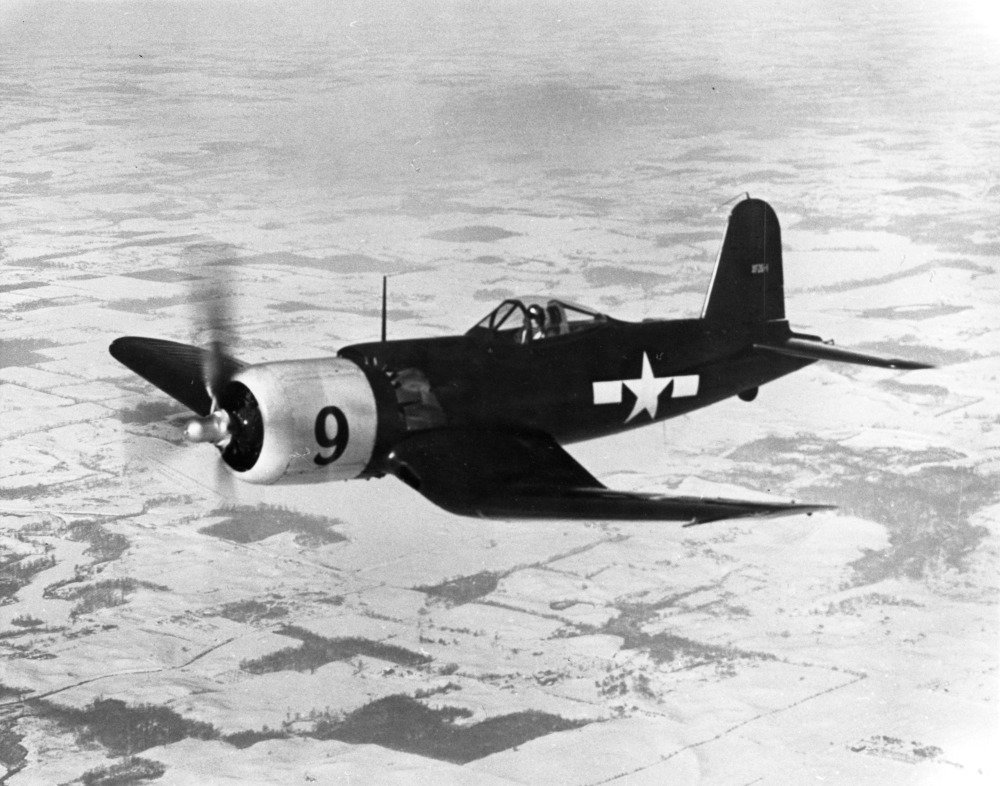
The Goodyear F2G "Super Corsair" was developed during the final stages of World War II as a specialized low-altitude interceptor intended to counter fast, low-level threats, specifically kamikaze aircraft. Designed and produced by the Goodyear Aircraft Company—a division of the Goodyear Tire & Rubber Company based in Akron, Ohio—the F2G was an in-house redesign of the Vought F4U Corsair airframe. While Goodyear had previously license-built Corsairs as the FG-1, the F2G required substantial modifications to the forward fuselage and systems to accommodate a significantly larger and heavier powerplant.
At the heart of the F2G was the Pratt & Whitney R-4360 "Wasp Major," a 28-cylinder, four-row, air-cooled radial engine. This engine, the largest displacement piston aircraft engine to enter series production, provided approximately 3,000 hp. To improve pilot visibility, Goodyear replaced the early "birdcage" canopies of the original Corsair with a bubble canopy and a cut-down rear fuselage. The aircraft was heavily armed for its role, featuring six 0.50-inch Browning M2 machine guns and the capability to carry various ordnance, including 1,600 lb armor-piercing bombs, 5-inch HVAR rockets, and "Tiny Tim" rockets.
Production was extremely limited. Although the U.S. Navy issued a contract in March 1944 for 418 F2G-1 and 10 F2G-2 aircraft, only 10 new-build units were completed in 1945: five land-based F2G-1s and five carrier-based F2G-2s. An additional seven aircraft were converted from FG-1 Corsairs, bringing the total to 17 airframes. The F2G-1 was distinguished by a larger-diameter propeller and the absence of an arresting hook, while the F2G-2 featured hydraulically folding wings and a smaller propeller for carrier deck clearance.
Despite its performance, the F2G never saw combat. By the time the first production aircraft (BuNo 88454) was delivered in 1945, the war was ending and the emergence of jet fighters rendered the high-power piston concept obsolete. The Navy utilized the F2G primarily for testing and evaluation at NAS Norfolk and the Naval Air Test Center at NAS Patuxent River between 1945 and 1948. Following their military service, several F2Gs entered the civilian air racing circuit. Most notably, pilot Cook Cleland acquired four surplus F2Gs and modified one by clipping six feet from the wingspan, using it to win the 1947 Thompson Trophy race at a speed of 396 mph. Today, the first production F2G-1 (BuNo 88454) is preserved at The Museum of Flight in Seattle, Washington.