
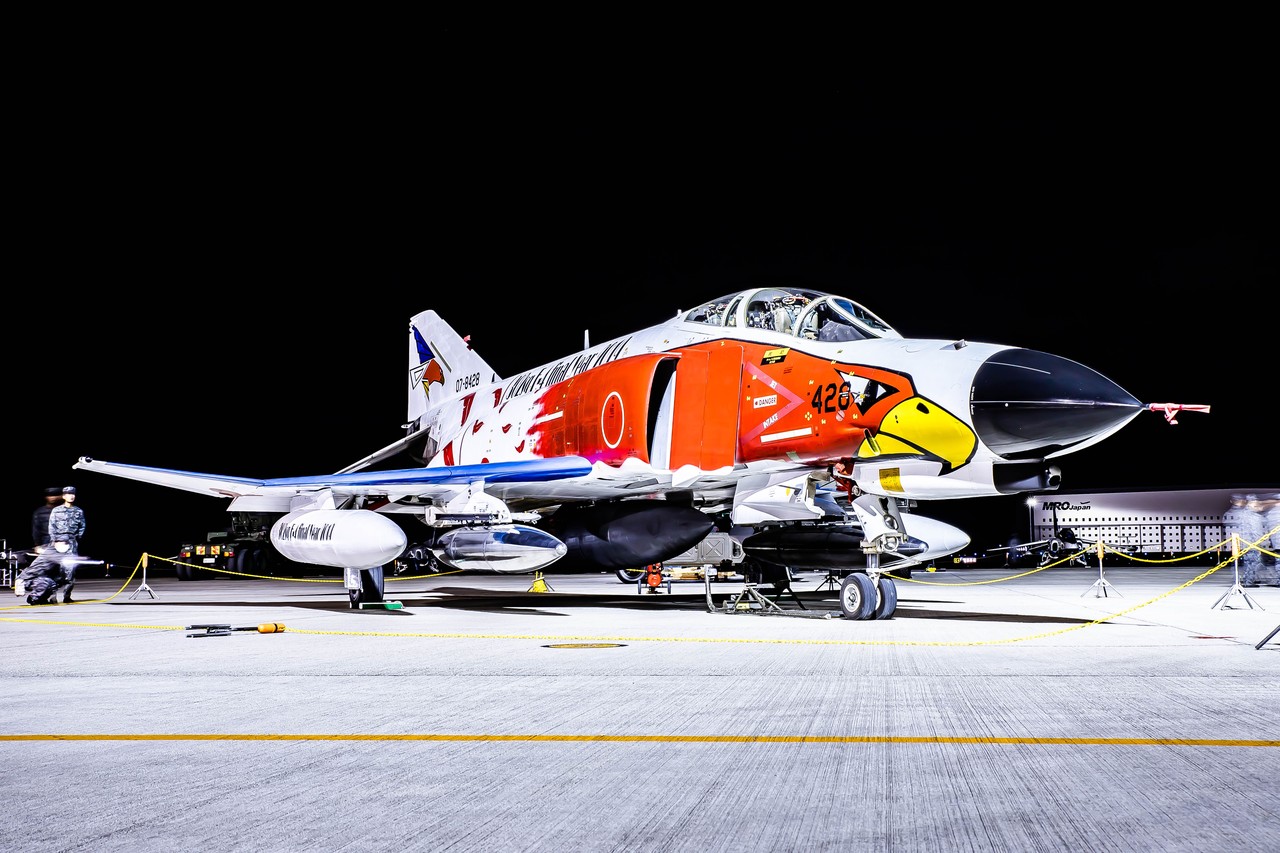
Dominating the Skies
The F-4 Phantom II achieved unprecedented success in military aviation, with 5,195 aircraft produced between 1958 and 1981—making it the most-produced American supersonic fighter. The United States Air Force operated 2,874 Phantoms while the Navy and Marine Corps flew 1,264, with an additional 919 exported to allied nations. During the Vietnam War, 16 squadrons deployed permanently from 1965 to 1973, peaking at 353 aircraft stationed in Thailand in 1972. The Phantom achieved over 320 aerial victories throughout the conflict, establishing itself as America's primary air superiority fighter.
Combat Legacy
In Vietnam, the F-4 proved its versatility across multiple roles—air-to-air combat, ground attack, and reconnaissance missions. The Air Force lost 445 Phantoms during the war, with 370 combat losses including 33 to enemy MiGs, 30 to surface-to-air missiles, and 307 to anti-aircraft artillery. Notable aces emerged from Phantom cockpits, including Air Force Colonel Robin Olds with four MiG kills and Navy pilot Randy Cunningham who achieved five victories. The aircraft continued serving in Operation Desert Storm in 1991, demonstrating its enduring combat effectiveness across multiple decades.
Design Innovation
Dave Lewis led the design team at McDonnell Aircraft under James S. McDonnell's direction, creating the Phantom in response to a 1954 Navy requirement for a high-performance fleet defense interceptor. The innovative tandem two-seat configuration reduced pilot workload by pairing a pilot with a weapons systems officer. Initially designed without an internal cannon, the F-4 relied entirely on missiles including the AIM-7 Sparrow and AIM-9 Sidewinder, representing a revolutionary shift in fighter design philosophy. Later variants like the F-4E incorporated the 20mm M61 Vulcan cannon based on combat experience.
Manufacturing Excellence
McDonnell Aircraft Corporation, founded by James S. McDonnell in 1939, established itself as a premier military aircraft manufacturer before merging with Douglas Aircraft in 1967 to form McDonnell Douglas. The company had previously achieved success with the FH-1 Phantom in 1947—the Navy's first jet fighter—and the F2H Banshee. Production centered at the St. Louis, Missouri facility, with international collaboration including components from MBB in West Germany and licensed production of 138 aircraft by Mitsubishi Heavy Industries in Japan. Following Boeing's acquisition of McDonnell Douglas in 1997, the F-4 production legacy became part of the larger Boeing enterprise.
Powerplant Performance
Twin General Electric J79 turbojet engines provided the F-4's exceptional performance, with variants utilizing different models from the J79-GE-2 producing 16,100 pounds of afterburning thrust to the J79-GE-10 generating 17,844 pounds. General Electric produced over 17,000 J79 engines across all applications between 1955 and 1979. The engines featured innovative variable stator vanes for supersonic efficiency and reliable afterburners that enabled record-breaking performance, including Lieutenant Colonel Robert B. Robinson's 1,606.342 mph speed record on November 22, 1961, during Operation Skyburner.
Operational Variants
The Phantom family encompassed numerous specialized variants serving distinct missions. Early F-4A and F-4B models equipped Navy squadrons, while the Air Force operated F-4C, F-4D, and F-4E fighters. The F-4J incorporated improved AN/AWG-10 radar with look-down/shoot-down capability, with 522 built between 1966 and 1972. Reconnaissance variants included the RF-4C and RF-4E, while the F-4G Wild Weasel specialized in suppressing enemy air defenses. The final operational variant, QF-4 target drones, continued flying until December 21, 2016, marking the end of 58 years of Phantom operations.
Global Service
Beyond American service, the F-4 equipped air forces worldwide including Germany, Israel, Turkey, South Korea, and Japan. As of 2011, seven countries still operated Phantoms, with 631 remaining in service globally by 2008. The aircraft's versatility enabled adaptation to diverse operational requirements, from NATO air defense missions to Middle Eastern conflicts. Turkey's Air Force represented one of the last major operators, maintaining upgraded Phantoms well into the 21st century.
Enduring Legacy
The F-4 Phantom II's influence extends far beyond its production numbers, fundamentally shaping modern fighter design concepts. Its multi-role capability proved that a single aircraft could excel in air superiority, ground attack, and reconnaissance missions. Museum examples preserve this legacy, including displays at the San Diego Air & Space Museum and MAPS Air Museum. The Phantom's 38-year service record and role as the "signature Cold War aircraft" established design principles that influenced successors like the F-15 Eagle and F-16 Fighting Falcon, cementing its position as one of aviation's most significant military aircraft.