
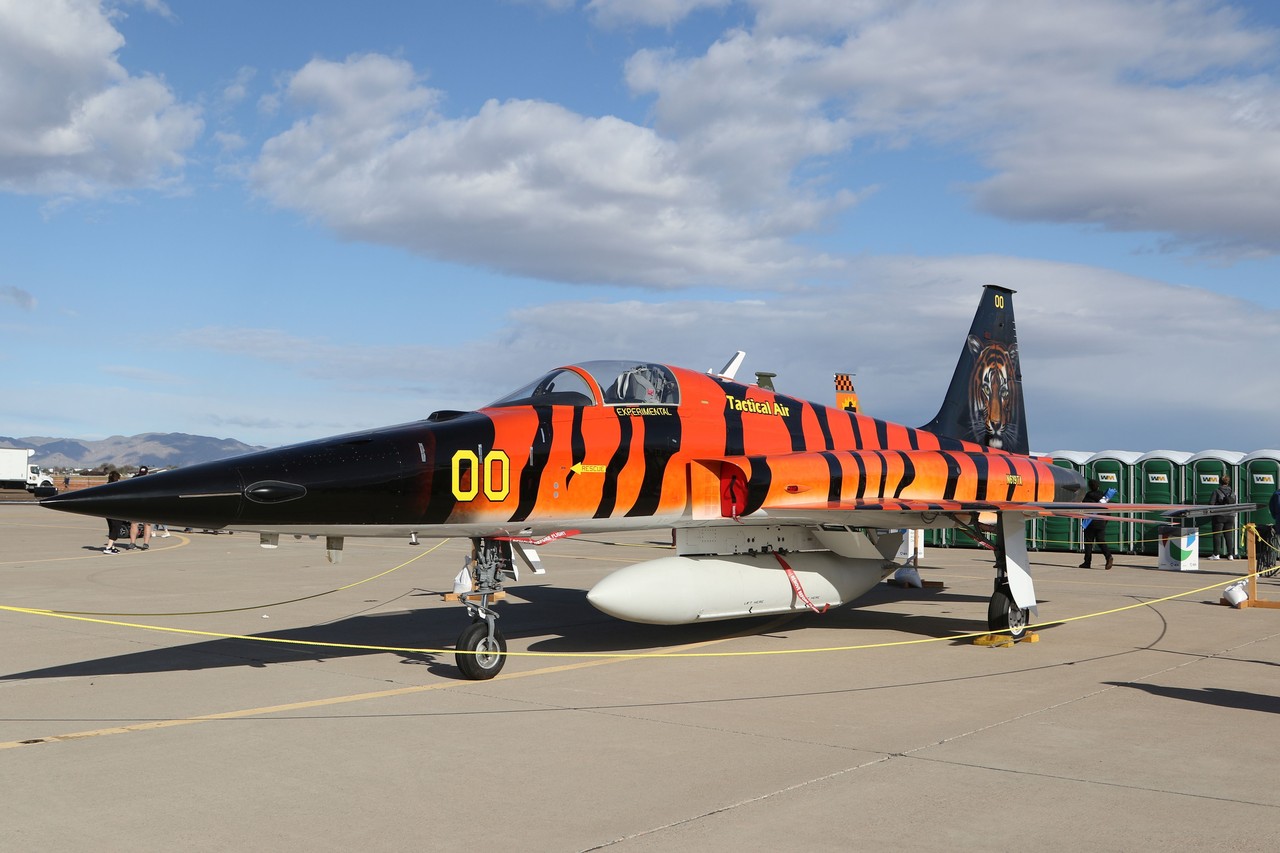
Development Origins
Northrop Corporation launched the F-5 program in the mid-1950s as a privately funded venture under the company designation N-156. The design team wrapped a highly aerodynamic airframe around two compact General Electric J85 engines, prioritizing performance while maintaining low acquisition and operating costs. This philosophy ran counter to the era's trend toward increasingly complex and expensive fighters, making the F-5 ideal for allied nations with limited technical infrastructure.
The program struggled initially, surviving more than seven years without sales before receiving its first production order in fall 1962. The Kennedy Administration's renewed emphasis on providing affordable export fighters to allies led to the F-5's selection as winner of the F-X competition on April 23, 1962. The aircraft officially became the F-5A Freedom Fighter and entered production in October 1962.
Combat Service and Variants
The F-5A entered service in the early 1960s and saw extensive combat during the Vietnam War. Over 800 F-5As were produced through 1972 specifically for U.S. allies during the Cold War. The Royal Norwegian Air Force placed the first international order on February 28, 1964, operating their NF-5s from 1971 to 1991 before transitioning to F-16s.
Northrop developed several specialized variants to expand the aircraft's capabilities. The RF-5A reconnaissance variant featured four-camera noses for intelligence gathering missions. The F-5B served as a two-seat trainer, with 200 aircraft built to maintain pilot proficiency. The most significant evolution came with the F-5E Tiger II, which first flew on August 11, 1972, featuring enhanced performance and avionics. An additional 792 F-5Es were manufactured alongside 140 two-seat F-5Fs.
Production Achievement
Northrop's Hawthorne, California facility produced all F-5 variants from 1959 to 1987, manufacturing 2,246 aircraft across the program's lifespan. The company built 624 F-5As, including three YF-5A prototypes, plus 86 RF-5A reconnaissance aircraft. International licensed production expanded total output significantly, with Canadair building 240 first-generation aircraft, CASA in Spain producing 70 more, and Asian manufacturers contributing substantially - Malaysia built 56 F-5Es and F-5Fs plus 5 RF-5Es, South Korea manufactured 68 aircraft, and Taiwan produced 308 units.
This production achievement was remarkable for its consistency and reliability. From the F-5's first delivery in 1964 to its final delivery in 1989, every aircraft was delivered on schedule, at or below contract price, and with performance meeting specifications.
The Northrop Legacy
Northrop Corporation, founded by aviation pioneer Jack Northrop, established itself as an innovator in aircraft design through programs like the F-5. The company's emphasis on unconventional solutions and efficient design philosophies made it a significant player in Cold War aviation. Northrop eventually merged to form Northrop Grumman, which continues operating today and maintains support for F-5 operations worldwide.
The F-5 represented Northrop's successful challenge to the industry assumption that effective fighters required maximum complexity and cost. By focusing on reliability, maintainability, and performance efficiency, Northrop created an aircraft accessible to nations that could never afford or maintain contemporary American fighters like the F-4 Phantom II.
Engine and Performance
The General Electric J85-GE-21B turbojet engines gave the F-5 its performance edge while maintaining the simplicity that defined the program. These compact, high-thrust engines provided sufficient power for supersonic performance while requiring minimal maintenance infrastructure. The twin-engine configuration offered redundancy and safety margins important for single-pilot operations.
Pilots appreciated the F-5's predictable handling characteristics and forgiving flight envelope. The aircraft's lightweight design and efficient engines provided excellent acceleration and climb performance, while its small size made it difficult for adversaries to visually acquire in combat.
Continuing Service
Approximately two-thirds of all F-5s produced remain operational across 26 countries, demonstrating the design's fundamental soundness. The United States Navy and Marine Corps continue operating over 400 F-5N and F-5F variants as adversary trainers, using them to simulate enemy aircraft in aerial combat exercises. These aircraft provide realistic training against agile, nimble opponents that represent potential threats American pilots might face.
The F-5's longevity extends beyond active military service. Many aircraft serve in museums worldwide, including preserved examples at the Western Museum of Flight in California. Technical schools use F-5s for maintenance training, ensuring new generations of technicians understand the aircraft's systems and philosophy.
The F-5 Freedom Fighter's legacy lies not in revolutionary technology but in its demonstration that effective military capability could be achieved through intelligent design focused on reliability, affordability, and operational practicality. This approach made advanced fighter capability accessible to dozens of nations that became crucial American allies during the Cold War.