
Service History
The F9F Panther fundamentally transformed U.S. Navy aviation by successfully bridging the gap between propeller-driven fighters and the jet age. Fleet deliveries began in May 1949, and by 1950 the Panther had become the Navy's primary carrier-based jet fighter. The aircraft's significance was immediately demonstrated during the Korean War, where it became the first U.S. Navy jet to enter combat on July 3, 1950, flying from the carrier USS Valley Forge to provide air cover for propeller-driven F4U Corsairs and AD Skyraiders.
Korean War Operations
During the Korean conflict, Panthers achieved several historic milestones that cemented their place in naval aviation history. On July 3, 1950, Navy F9F Panthers became the first U.S. Navy jets to shoot down enemy MiG-15 aircraft, marking a pivotal moment in jet-versus-jet combat. The aircraft served with distinction in both Navy squadrons such as VF-51 and VF-52, and Marine Corps units, demonstrating exceptional versatility in both air-to-air combat and ground attack missions.
The Panther's combat loadout proved highly effective for the varied missions over Korea. Beyond its standard armament of four 20mm cannons, the aircraft could carry six 5-inch High Velocity Aircraft Rockets (HVARs) or various bomb configurations including two 1,000-pound bombs, six 500-pound bombs, or eight smaller 100 to 250-pound bombs. This flexibility allowed Panthers to excel in close air support missions while maintaining their air superiority capabilities.
The Manufacturer
Grumman Aircraft Engineering Corporation, operating from 1929 until its 1994 merger with Northrop to form Northrop Grumman Corporation, built the F9F Panther as the company's first jet fighter. Based in Bethpage, New York, Grumman had established its reputation during World War II with legendary aircraft including the F6F Hellcat and TBF Avenger. The transition to jet propulsion represented a crucial evolution for the company, positioning it as a leader in naval aviation technology that continues today through Northrop Grumman.
Engine and Technical Innovation
The Panther's development began under an April 1946 U.S. Navy contract for a carrier-based night fighter designated G-75 (XF9F-1). However, engine complications with the original twin-jet configuration led Grumman's design team to revise the concept into a single-engine straight-wing day fighter, the XF9F-2. This design decision proved fortuitous, as the single-engine configuration offered superior reliability and maintenance characteristics crucial for carrier operations.
Early production Panthers utilized the Pratt & Whitney J42-P-6/8 turbojet, a licensed version of the British Rolls-Royce Nene producing 5,000 pounds of dry thrust or 5,700 pounds with water injection. Later F9F-5 variants incorporated the more powerful Pratt & Whitney J48-P-2, a licensed Rolls-Royce Tay engine that required a two-foot fuselage extension to accommodate its larger size.
Groundbreaking design features included permanent wingtip fuel tanks that served dual purposes: extending the aircraft's range beyond 1,100 miles while simultaneously improving roll rate characteristics. The aircraft also featured innovative leading-edge flaps specifically designed to reduce landing speeds for safer carrier operations, making it exceptionally well-suited for the demanding environment of naval aviation.
Production and Variants
Grumman produced exactly 1,382 Panthers across multiple variants between 1948 and 1952. The production breakdown included 567 F9F-2 base fighters, 54 F9F-3 aircraft (many later converted to F9F-2 standard), 109 F9F-4 experimental engine test aircraft, 616 F9F-5 improved models with the J48 engine, and 36 F9F-5P reconnaissance variants. This substantial production run demonstrated the Navy's confidence in the design and the aircraft's operational success.
International Service and Blue Angels
Beyond U.S. service, the Panther found international operators when Argentine Naval Aviation received 28 ex-U.S. Navy F9F-2B aircraft between 1957 and 1961, with 24 remaining operational. The aircraft's stellar reputation also earned it selection by the U.S. Navy Blue Angels demonstration team, which flew Panthers in 1950 and again from 1952 to 1954, showcasing the type's handling characteristics and performance to millions of spectators.
Legacy and Museum Preservation
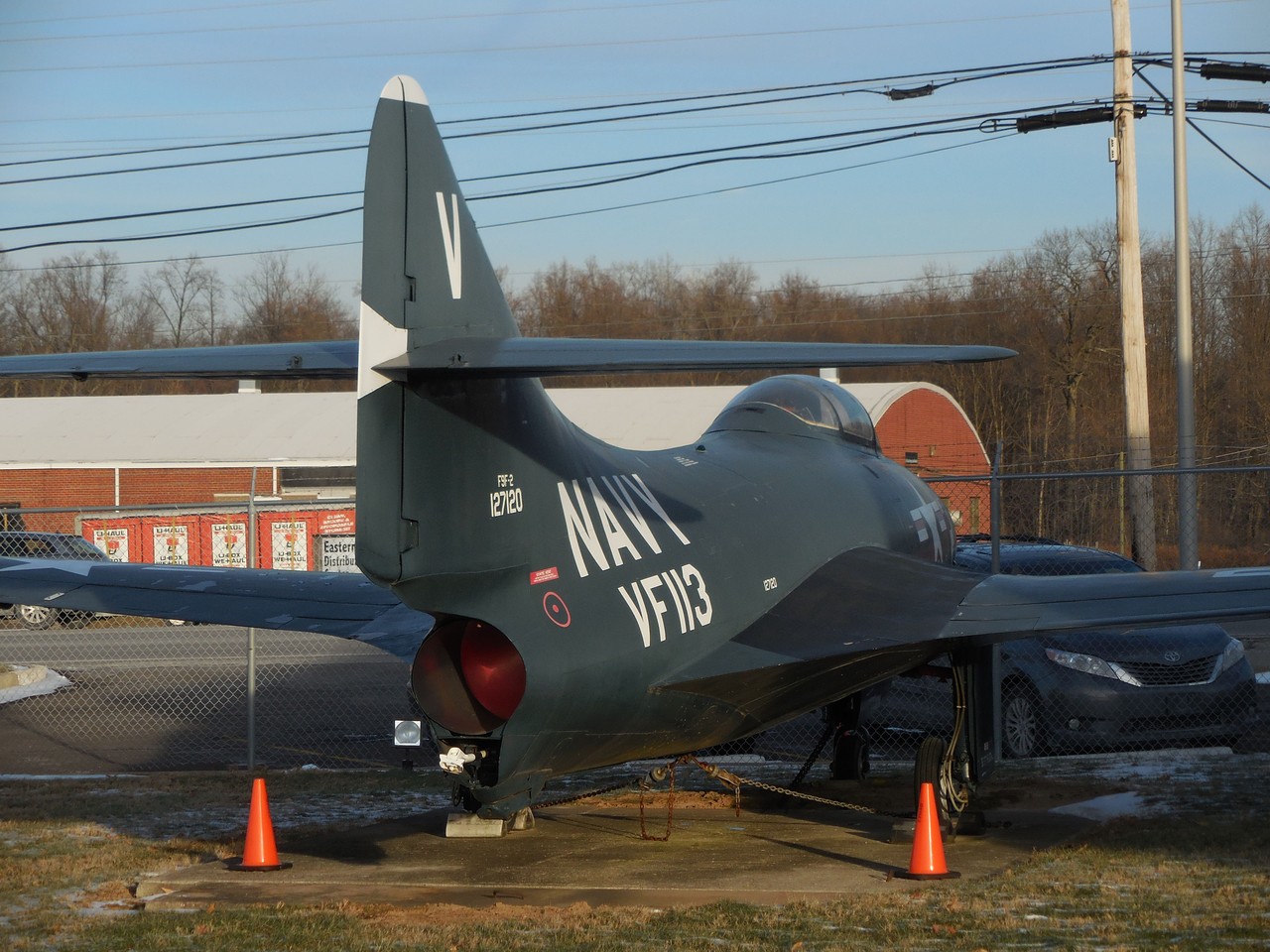
The F9F Panther's legacy extends far beyond its combat record, as it established the foundation for successful carrier jet operations and evolved into the swept-wing F9F Cougar. The U.S. Navy retired the last Panthers around 1956, but several examples survive in museums today. Notable preserved aircraft include an F9F-5P (Bureau Number 126277) at the Planes of Fame Air Museum in static display condition, and an F9F-2 maintained by the Naval History and Heritage Command. These surviving examples represent crucial artifacts of the transition period that transformed naval aviation from the propeller age to the jet era.