
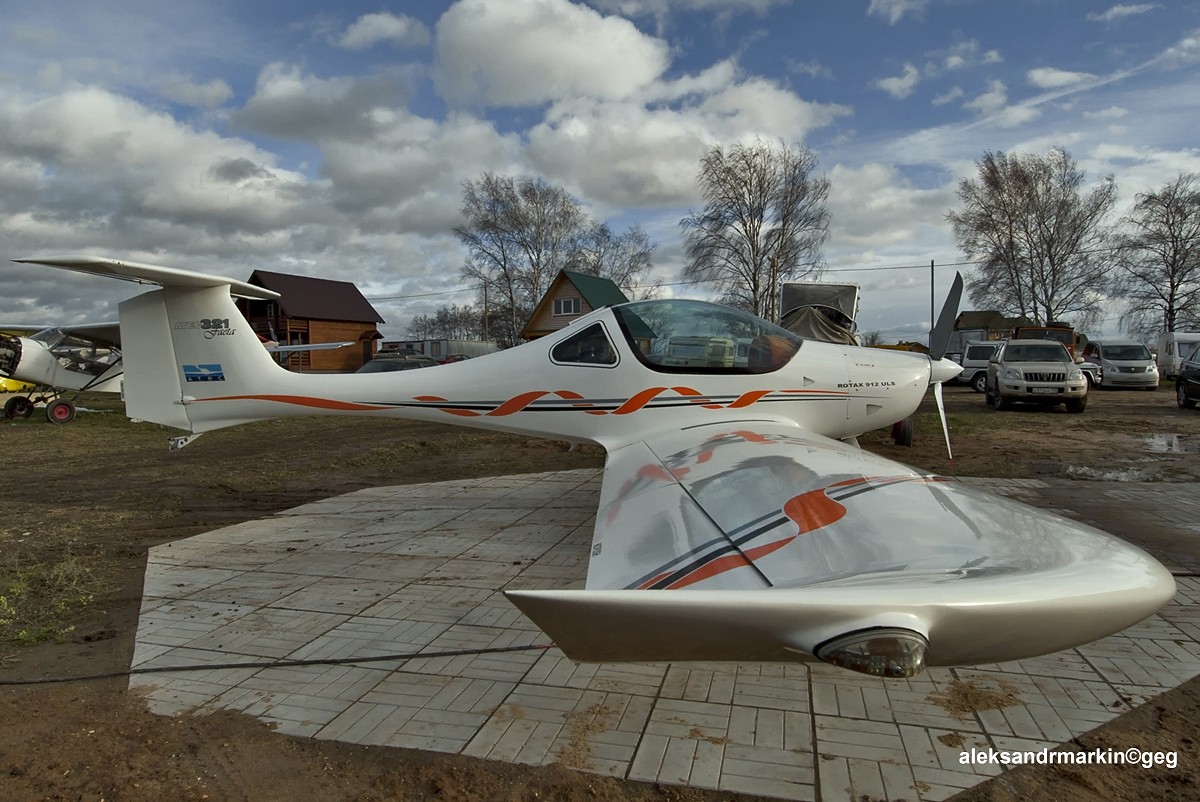
Development and Design
The Atec 321 Faeta emerged from the Czech Republic's growing light aircraft industry as an evolutionary step beyond the company's earlier Atec 122 Zephyr. The design team at Atec v.o.s. focused on creating an aircraft that could meet both European microlight regulations and the emerging US Special Light-Sport Aircraft category, requiring careful attention to weight limits and performance parameters.
The prototype, registered OK-IUG 15, incorporated several advanced features for its class, including a full carbon fiber fuselage shell with composite sandwich bulkheads and a distinctive T-tail configuration tested to 600 kilometers per hour for flutter resistance. The wing design utilized an SM 701 airfoil with a tapered planform spanning 9.6 meters, featuring slotted flaps and integral fuel tanks holding 100 liters total capacity. This represented a significant departure from the fuselage-mounted 70-liter tank used in earlier variants.
Certification and Production
Following its public debut at the Aero '03 exhibition in Friedrichshafen, Germany in April 2003, the Faeta underwent extensive flight testing throughout 2003. Certification came in 2005 for both ultralight and S-LSA categories, opening markets in Europe, Australia, and the United States. The aircraft's empty weight of just 278 kilograms and stall speed of 51-52 kilometers per hour with flaps deployed met the stringent requirements for both regulatory frameworks.
Production continued at Atec's facilities in Libice nad Cidlinou until 2021, when the original version was succeeded by the Faeta NG variant, which had been introduced alongside the original model in 2016. The company ships hundreds of aircraft annually worldwide, though specific production numbers for the Faeta 321 have not been disclosed.
The Manufacturer
Atec v.o.s. began operations in 1992 as a composite parts supplier for other aircraft manufacturers before transitioning to complete aircraft production. The company's first original design, the Atec 122 Zephyr, flew in 1996 and entered production in 1997, establishing the foundation for the later Faeta development. The Zephyr's success provided valuable experience in light aircraft manufacturing and composite construction techniques that directly influenced the Faeta's design.
The Czech company remains active today under its original name, continuing to serve the international light sport aircraft market from its base in Libice nad Cidlinou. This facility handles all manufacturing operations, from composite layup to final assembly and testing.
Engine and Performance
The standard powerplant for the Faeta 321 is the Rotax 912ULS, a 100-horsepower four-stroke engine manufactured by BRP-Rotax in Austria. This liquid- and air-cooled, four-cylinder unit drives either 2- or 3-bladed composite propellers from the Czech Fiti brand. Alternative engine options include the 80-horsepower Rotax 912UL and the fuel-injected Rotax 912iS Sport, also rated at 100 horsepower.
The aircraft's performance envelope includes a maximum speed of 270-295 kilometers per hour and a cruise speed of 227-248 kilometers per hour. Rate of climb reaches 7 to 7.5 meters per second, while the service ceiling and range of up to 2,000 kilometers make it suitable for cross-country flights. The structure can withstand loads of +5 to -3 g, reflecting its sport aircraft role.
Operational Service
The Faeta 321 serves primarily in the recreational and training sectors across Europe and Australia. Private pilots and flying clubs in countries including the Czech Republic, France, Finland, Spain, and the Netherlands operate the type for sport flying and instruction. The side-by-side seating arrangement and docile handling characteristics make it particularly suitable for flight training applications.
Specific registered examples include PH-OA6, which was operating in Spain as of 2011, and OH-U588 in Finland. The aircraft's 2,000-kilometer range capability has enabled some owners to undertake significant cross-country flights, though no particularly notable routes or record flights have been documented.
Technical Innovation
The Faeta's carbon fiber construction represented a significant advancement in ultralight aircraft technology when introduced. The cantilever wing design eliminated external bracing while maintaining structural integrity within weight limits. The T-tail configuration, while adding complexity, improved propeller clearance and provided clean airflow over the control surfaces.
Safety features include integral wing fuel tanks that reduce fire risk compared to fuselage-mounted tanks, provision for ballistic recovery parachutes, and a firewall separating the engine from the cockpit. The tricycle landing gear configuration enhances ground handling compared to conventional tailwheel designs common in the ultralight category.
Legacy and Current Status
While exact numbers of airworthy Faeta 321 aircraft remain undocumented, examples continue flying in various countries nearly two decades after the type's introduction. The aircraft's significance lies in its role as a bridge between traditional ultralight construction methods and modern composite techniques, influencing subsequent designs in the light sport aircraft category.
The transition to the Faeta NG variant in 2021 marked the end of original Faeta 321 production, though the newer model retains the fundamental design philosophy while incorporating updated systems and construction methods. No examples are currently known to be preserved in aviation museums, reflecting the type's relatively recent introduction and ongoing operational use.