
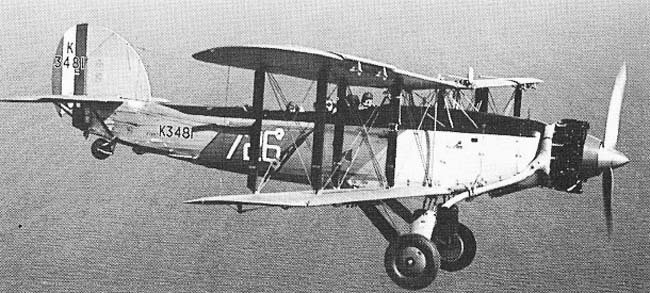
The Fairey Seal was a British naval aircraft developed during the 1930s to serve as a carrier-borne spotter-reconnaissance biplane. It emerged as a direct derivative of the successful Fairey IIIF series, tailored specifically to meet the operational requirements of the Royal Navy's Fleet Air Arm. The aircraft was designed for versatility in maritime environments, featuring a two-bay biplane configuration that could be adapted for different launch methods. While it operated as a landplane with a conventional wheeled undercarriage, it could also be fitted with twin floats, allowing it to be launched from shipboard catapults on cruisers and other naval vessels.
Production of the Seal was handled by the Fairey Aviation Company Limited. During the era of the Seal's development, Fairey's manufacturing was centered at its Hayes works in Middlesex. Although the company later expanded its production capabilities in 1935 by acquiring the former National Aircraft Factory No. 2 at Heaton Chapel (Ringway) near Stockport, the Seal is listed as a 1930-era design, suggesting the majority of its production occurred at the Hayes facility. The Fairey Aviation Company, founded in 1915 by Charles Richard Fairey and Ernest Oscar Tips, maintained a dominant position in the naval aviation sector throughout the inter-war period.
In operational service, the Seal was primarily utilized by the Royal Navy's Fleet Air Arm for maritime patrol and spotter-reconnaissance, a role that involved observing the fall of shot for naval gunfire. It served as a transitional aircraft in the fleet, bridging the gap between the earlier Fairey IIIF and the later Supermarine Walrus, which began replacing the Seal in the mid-to-late 1930s. While the aircraft was a staple of early 1930s naval aviation, there is no documented evidence in the available records regarding its participation in active combat during World War II.
The legacy of the Fairey Seal lies in its role as a link in the evolution of Fairey's naval aircraft lineage, paving the way for later iconic types such as the Swordfish, Firefly, and Gannet. Today, no surviving examples of the Seal are documented in major public collections, and the original manufacturer, Fairey Aviation Company Limited, ceased to exist as an independent entity in 1960 after being acquired by Westland Aircraft Ltd. The broader industrial successor to the group is now known as Spectris plc.