
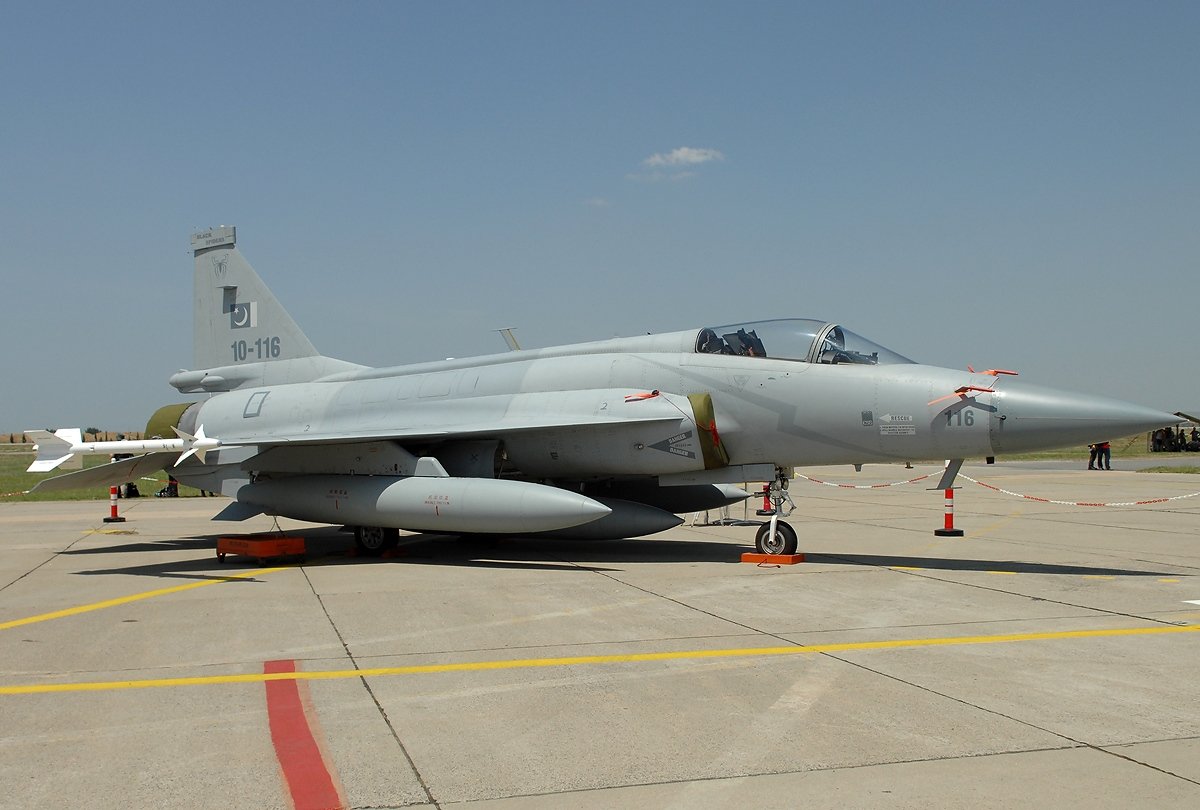
The Chengdu FC-1 Xiaolong, known in Pakistani service and export markets as the JF-17 Thunder, is a single-engine, lightweight multirole fighter. The aircraft originated from the conceptual lineage of the "Super-7" program, a joint project between China and Grumman in the late 1980s and early 1990s. A formal joint development agreement was signed in 1999 between the Chengdu Aircraft Corporation (CAC), a subsidiary of the Aviation Industry Corporation of China (AVIC), and the Pakistan Aeronautical Complex (PAC). The first FC-1 prototype performed its maiden flight on August 25, 2003, at Chengdu Wenjiang Airport, completing a 17-minute flight.
Designed to meet the Pakistan Air Force's (PAF) requirement for an affordable, fourth-generation fighter to replace aging A-5, F-7, and Mirage III/5 fleets, the FC-1 incorporates several advanced features. It utilizes a digital fly-by-wire control system and integrated avionics. The aircraft is powered by a single Russian-made Klimov RD-93 afterburning turbofan engine, which provides approximately 84.4 kN (19,000 lbf) of thrust. Technical specifications for the production family include a length of 14.93 meters, a wingspan of 9.44 meters, and a maximum take-off weight of 12,384 kg. It is capable of reaching speeds of Mach 1.6 and has a service ceiling of approximately 17,000 meters.
Operational service began in 2007, with the PAF achieving squadron-level capability by 2010. The aircraft is equipped with seven hardpoints supporting a payload of 3.7 tonnes, including SD-10 beyond-visual-range missiles, PL-5E short-range missiles, and C-802A anti-ship missiles. It also carries an internal 23 mm GSh-23-2 twin-barrel cannon. The program has evolved through several iterations, culminating in the Block 3 variant, which introduced the KLJ-7A AESA radar, an infrared search and track (IRST) system, and a helmet-mounted display, entering service in March 2023. Beyond Pakistan, the aircraft has been adopted by the air forces of Myanmar, Nigeria, and Azerbaijan. Total production is estimated at approximately 207 airframes, consisting of six prototypes and roughly 201 series production aircraft.