
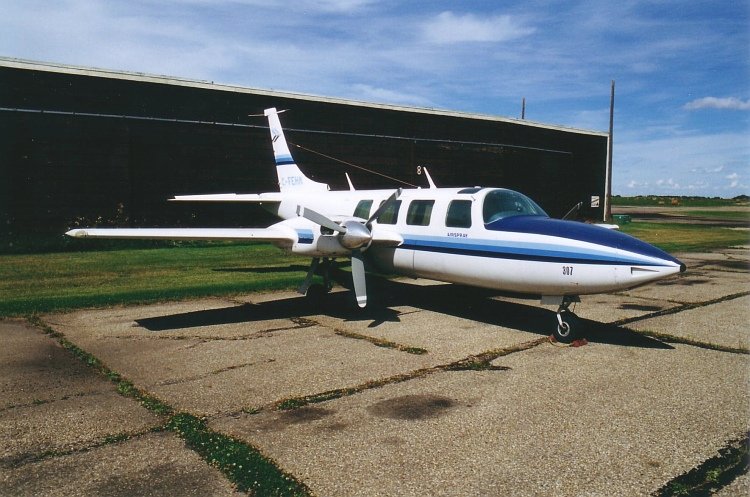
Design Innovation and Development
Ted R. Smith began developing the Aerostar in November 1964, drawing upon four decades of aviation experience that included designing the Aero Commander and Jet Commander series. Smith founded Ted Smith Aircraft Company in 1963 in Van Nuys, California, specifically to create a high-performance response to existing twin-engine aircraft limitations. The prototype Model 320/600 incorporated revolutionary design elements including exceptionally light construction and ultra-low drag characteristics that would become the aircraft's defining features.
Record-Setting Performance
The Aerostar immediately distinguished itself through unprecedented speed capabilities for a piston twin. On August 6, 1975, an Aerostar 601A piloted by Jack Chrysler established a C1d 2,000-kilometer closed-circuit speed record at 237.08 knots. Even more dramatically, between November 4-9, 1977, an Aerostar 601P flown by Philander Claxton III and Jack Cink set a round-the-world piston aircraft record, covering 19,974 nautical miles in just 104 hours, 5 minutes, and 30 seconds.
These achievements reflected the aircraft's exceptional cruise performance, with early Model 600 variants achieving 220 knots and later configurations reaching 261 knots. The pressurized 601P model, introduced in 1974, maintained cruise speeds exceeding 230 knots at 25,000 feet while providing a comfortable 11,000-foot cabin altitude through its 4.25 psi differential pressure system.
Manufacturing Evolution
The Aerostar's production history reflects the turbulent nature of general aviation manufacturing. Ted Smith Aircraft Company began certification in 1968 and entered production in 1969. However, financial pressures led to the sale of controlling interest to American Cement in 1968, followed by acquisition by Butler Aviation in 1970, which temporarily stalled production. Smith repurchased his design in 1972 under Ted R. Smith and Associates, resuming manufacturing in Santa Maria, California, from 1973.
Piper Aircraft Corporation ultimately acquired the design in 1978, redesignating the aircraft as the PA-60 Aerostar series. Piper continued production until the late 1980s when the company exited the cabin twin market. Across all manufacturers and variants, approximately 1,100 to 1,200 Aerostars were constructed, including 492 Model 601Ps and 124 Model 602Ps among the most popular configurations.
Technical Specifications
Early prototypes utilized 160-180 horsepower Lycoming IO-320 engines, but production models standardized on more powerful Lycoming IO-540 normally aspirated engines producing 260-300 horsepower, or turbocharged TIO-540 variants generating 290-350 horsepower. The turbocharged models incorporated Garrett TA-18 turbochargers or Rajay/Rotomaster units, consuming approximately 40 gallons per hour at high cruise settings.
Significant improvements appeared in the 600A variant, which featured a strengthened crankcase and crankshaft extending time between overhauls to 2,000 hours, while the 601A achieved 1,800-hour TBO intervals. Later 601B models introduced automatic wastegate controls after 1977, reducing pilot workload during high-altitude operations.
Operational Characteristics
The Aerostar's design prioritized speed over conventional twin-engine handling characteristics. Its low-drag configuration and relatively small wing loading contributed to exceptional cruise performance but demanded greater pilot proficiency, particularly during single-engine operations. The aircraft's fast climb rates and high-altitude capabilities made it ideal for cross-country travel, effectively competing with turboprop aircraft at a fraction of the operating cost.
The pressurized variants eliminated the need for life-limited components while providing airline-level comfort during high-altitude flight. Standard seating accommodated four to five passengers plus one or two crew members, with approximately four hours of endurance at normal cruise power settings.
Contemporary Legacy
Today, dozens of Aerostars remain active, with 77 examples listed in recent registry counts and many maintaining U.S. registration. Aerostar Aircraft Corporation, established in 1991, continues providing modification and support services for the existing fleet. The company has explored modernization initiatives, including a 2010 Aerostar Jet prototype featuring Pratt & Whitney CW615F turbofan engines and 355-knot cruise capability.
The Aerostar's cultural significance extends beyond raw performance numbers. It represents Ted Smith's engineering philosophy of maximizing speed through innovative design rather than brute power, establishing benchmarks that influenced subsequent general aviation development. As piston-powered aviation continues serving specialized roles, the Aerostar remains an icon of high-performance twin-engine flight, demonstrating that exceptional engineering can overcome conventional limitations.