
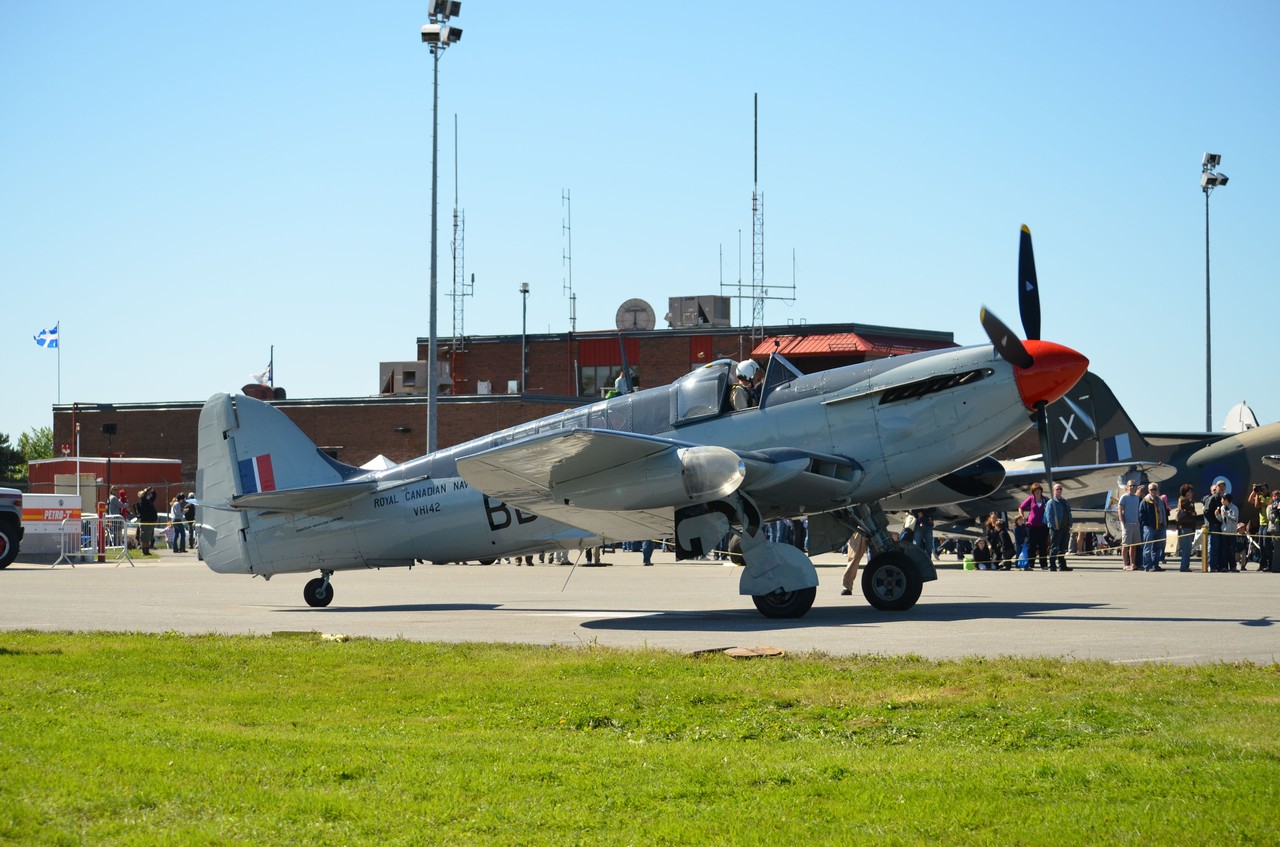
Service History
The Firefly dominated Fleet Air Arm operations during the final years of World War II, serving as the backbone of British carrier aviation in both European and Pacific theaters. By 1945, the type equipped multiple Royal Navy squadrons and had proven itself as the most capable two-seat fighter in naval service. The aircraft's versatility allowed it to excel in fighter, reconnaissance, and strike roles, making it indispensable for carrier operations where space and weight constraints demanded multi-role capability.
Wartime Operations
First entering operational service with 1770 Naval Air Squadron at RNAS Yeovilton on October 1, 1943, the Firefly quickly proved its worth in combat. By December 1943, the squadron had received 16 aircraft and was preparing for deployment aboard HMS Indefatigable. The type's combat debut came in July 1944 during coordinated strikes against the German battleship Tirpitz, where Fireflies provided fighter escort and reconnaissance support.
In the Pacific theater, Fireflies achieved historical significance as part of the British Pacific Fleet operations against Japanese targets. The aircraft conducted strikes against oil refineries, airfields, and strategic installations, with Fireflies becoming the first British aircraft to overfly Tokyo during the final stages of the war. During the Korean War, Royal Australian Navy squadrons 816 and 817 operated Fireflies from HMAS Sydney, conducting close air support and reconnaissance missions.
Variant designations included the F Mk I fighter, FR Mk I fighter-reconnaissance model equipped with ASH radar, and later the Mk IV and V variants optimized for strike and anti-submarine warfare. The specialized AS.5 and AS.6 anti-submarine variants carried rockets and depth charges, while the TT.1 target tug variant, including aircraft Z2033 delivered on April 30, 1944, served post-war training requirements.
The Manufacturer
Fairey Aviation Company, established in 1915 by Charles Richard Fairey as Fairey Aviation Co Ltd, developed the Firefly as part of its series of naval aircraft designs. The company operated independently until nationalization in 1945 under the Ministry of Supply, continuing Firefly production through government control. In 1960, Fairey merged into Westland Aircraft, which later became part of Leonardo S.p.A. through corporate acquisitions.
Fairey's design team, working to Admiralty Specification N.8/40 issued in March 1939, created the Firefly to replace multiple older types including the Sea Gladiator, Skua, and Fulmar. The specification demanded a two-seat multi-role naval fighter capable of 275 knots at 15,000 feet, leading to an entirely new design rather than a derivative of existing aircraft.
Engine & Technical Innovation
The Firefly was powered by Rolls-Royce Griffon V12 liquid-cooled engines, beginning with the Griffon IIB producing 1,735 horsepower on early aircraft. Later production switched to the Griffon XII generating 1,765 horsepower, while the Mk IV variant received the powerful Griffon 72 producing 2,330 horsepower. This engine progression allowed continuous performance improvements throughout the production run.
Key innovations included Fairey-Youngman flaps that provided enhanced low-speed handling for carrier operations, and improved aerodynamics that delivered a 40 mph speed increase over the preceding Fulmar despite a 4,000-pound weight increase. The separate pilot and observer stations optimized crew efficiency for multi-role missions, while the robust construction withstood the stresses of carrier landings and combat operations.
Armament consisted of four 20mm Hispano cannon mounted in the wings, providing devastating firepower against both aerial and ground targets. Later variants carried rockets, bombs, and depth charges for anti-submarine warfare, demonstrating the design's adaptability to evolving combat requirements.
Production & Legacy
Fairey produced 1,702 Fireflies between January 1943 and April 1956, including 429 F Mk I fighters and 376 FR Mk I fighter-reconnaissance aircraft. Manufacturing took place primarily at Fairey facilities in Hayes, Middlesex, and Stockport, with additional production by General Aircraft Ltd. The last 334 Mk I aircraft received upgraded Griffon XII engines, reflecting continuous improvement throughout production.
The Royal Australian Navy acquired 108 Fireflies between 1949 and 1953, operating them until replacement by more modern types. The aircraft served until 1956 when the Fairey Gannet superseded it in Royal Navy service, marking the end of an era for two-seat carrier fighters.
Approximately 20 Fireflies survive today, with few remaining airworthy. Notable preserved examples include TT.1 Z2033 at the Fleet Air Arm Museum in the United Kingdom and a Mk VI at the Canadian Warplane Heritage Museum. These survivors represent the Firefly's significance as the final generation of piston-engine naval fighters, bridging the gap between World War I-era biplanes and the jet age that followed.