
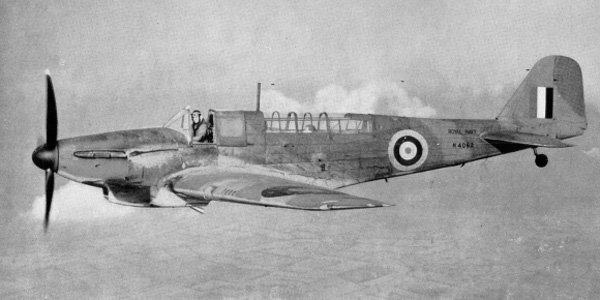
Production and Manufacturer History
The Fairey Fulmar was developed and produced by the Fairey Aviation Company Ltd. Production took place at Fairey's inland factory in Stockport, near Manchester, where existing production lines and components from the Fairey Battle were adapted for the new aircraft. A total of 600 machines were built between 1940 and December 1942, although some records extend the production span into early 1943.
Design and Development
Developed to meet Air Ministry Specification O.8/38, the Fulmar was a navalized evolution of the Fairey P.4/34 light bomber. The aircraft first flew on 4 January 1940. Unlike the single-seat fighters used by the RAF, the Fulmar featured a two-seat configuration consisting of a pilot and an observer/radio operator. This design choice prioritized long-range reconnaissance and navigation over raw performance. To facilitate carrier operations, the aircraft was equipped with folding wings and a robust structure capable of handling arrested landings and catapult launches.
Technical Specifications and Performance
The Fulmar was powered by a single Rolls-Royce Merlin liquid-cooled V-12 piston engine. Two primary variants were produced: the Mk I, utilizing the Merlin VIII with approximately 1,035 hp, and the Mk II, which used the Merlin 30/XXX producing between 1,260 and 1,300 hp. The Mk II offered improved performance, with a top speed of 266 mph and a service ceiling of 27,200 ft, compared to the Mk I's 247 mph and 21,500 ft ceiling.
Endurance was a hallmark of the design; the aircraft could achieve roughly 4 hours and 45 minutes of total endurance, which could be extended to 5.5 hours with a 60-gallon external drop tank. Its armament was heavy for its class, consisting of eight wing-mounted 0.303-in Browning machine guns, each with approximately 750 rounds. Some aircraft also carried a flexible 0.303-in Vickers K gun for the rear crewman and could carry up to two 100 lb or 250 lb bombs.
Military Service
Operated exclusively by the Royal Navy's Fleet Air Arm (FAA), the Fulmar entered service on 10 May 1940 with No. 806 Naval Air Squadron. It saw extensive action in the Mediterranean, including the Battle of Taranto from HMS Illustrious and convoy protection operations. The type also participated in the hunt for the German battleship Bismarck in May 1941 and served in the Indian Ocean and Ceylon against Japanese forces. While it was outclassed in speed and maneuverability by the Mitsubishi A6M Zero, the Fulmar became the top-scoring fighter in FAA service due to its widespread deployment. It served in front-line roles until 1943, when it was replaced by the Supermarine Seafire and Fairey Firefly, though some remained in second-line duties until 1945.
Legacy
The Fairey Fulmar bridged a vital gap in British naval aviation, transitioning the FAA from biplanes to modern monoplanes. While no examples are currently airworthy, at least one survives as a static exhibit, such as the Fulmar NF Mk II N1854 at the Fleet Air Arm Museum in Yeovilton, UK.