
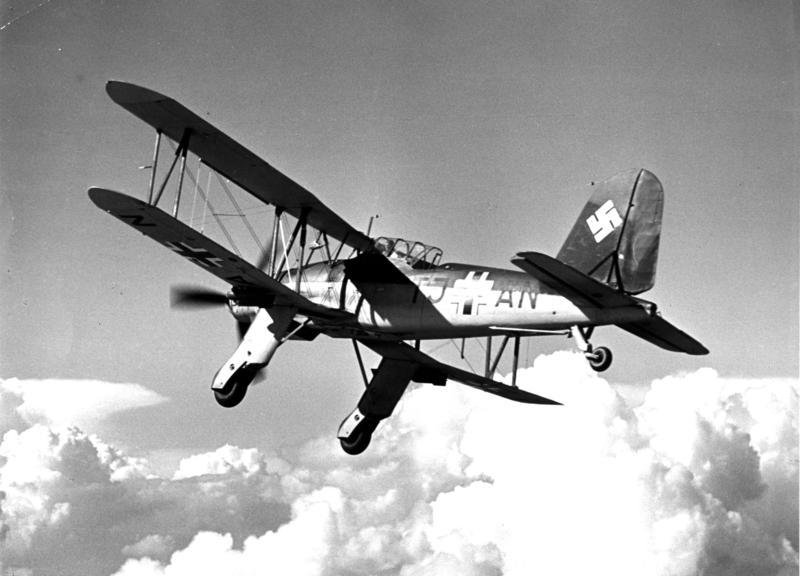
Design and Development
In 1937, the Reichsluftfahrtministerium (RLM) sought a carrier-borne torpedo and reconnaissance bomber to operate from the aircraft carrier Graf Zeppelin. Fieseler Flugzeugbau competed against Arado, and the resulting Fi 167 was selected over the Arado Ar 195. The aircraft first flew on November 12, 1937. Designed as a high-performance biplane, it featured folding wings for carrier storage and was engineered for catapult launches and arrestor-hook recoveries. The Fi 167 exceeded RLM specifications, which required a maximum speed of at least 300 km/h and a 1,000 km range; the aircraft surpassed these targets and could carry approximately twice the intended weapons payload.
Technical Specifications
The Fi 167 was powered by a single liquid-cooled, supercharged, inverted V-12 Daimler-Benz DB 601 piston engine. Depending on the variant, such as the DB 601 B-1, the engine produced approximately 1,100 hp (1,100 PS). This powerplant enabled a maximum speed of 325 km/h and a service ceiling of 8,100 m. The aircraft's structure was robust, featuring a strong undercarriage and jettisonable gear for ditching. For armament, it carried a fixed forward-firing 7.92 mm MG 17 machine gun and a flexible 7.92 mm MG 15 in the rear cockpit. Its external stores were versatile, capable of carrying a 765 kg LT F5b torpedo, a 1,000 kg SC 1000 bomb, or various smaller bomb loads.
Production and Service History
Production took place at Fieseler's facilities in Kassel, Germany, between 1938 and 1940. Total production is disputed, though most sources agree on 14 aircraft, consisting of two prototypes (V1 and V2) and twelve pre-production A-0 models. Production ceased in 1940 when work on the Graf Zeppelin was halted. Following this, aircraft were transferred to Luftwaffe/Erprobungsgruppe 167 for testing, and nine were deployed to a coastal naval squadron in the Netherlands for trials until mid-1943.
In September 1944, between 8 and 12 aircraft were sold to the Air Force of the Independent State of Croatia (Zrakoplovstvo Nezavisne Države Hrvatske). Due to their short-field performance, they were used as light attack aircraft and for transporting supplies to besieged garrisons. On October 10, 1944, an Fi 167 flown by Božidar Bartulović and gunner Mate Jurković was attacked by five RAF North American Mustang Mk III fighters near Sisak. Bartulović was killed, but Jurković reportedly shot down one Mustang before bailing out. Some aircraft were later acquired by Yugoslav Partisans and the Yugoslav People's Army (JNA), though they were eventually scrapped due to a lack of spare parts.
Legacy
No examples of the Fieseler Fi 167 are known to have survived the war. While it never saw operational carrier service, it remains historically significant as a high-performance biplane that outperformed contemporaries like the Fairey Swordfish. Its legacy is preserved through photographs and models, often cited in studies of German naval aviation and late-war Balkan operations.