
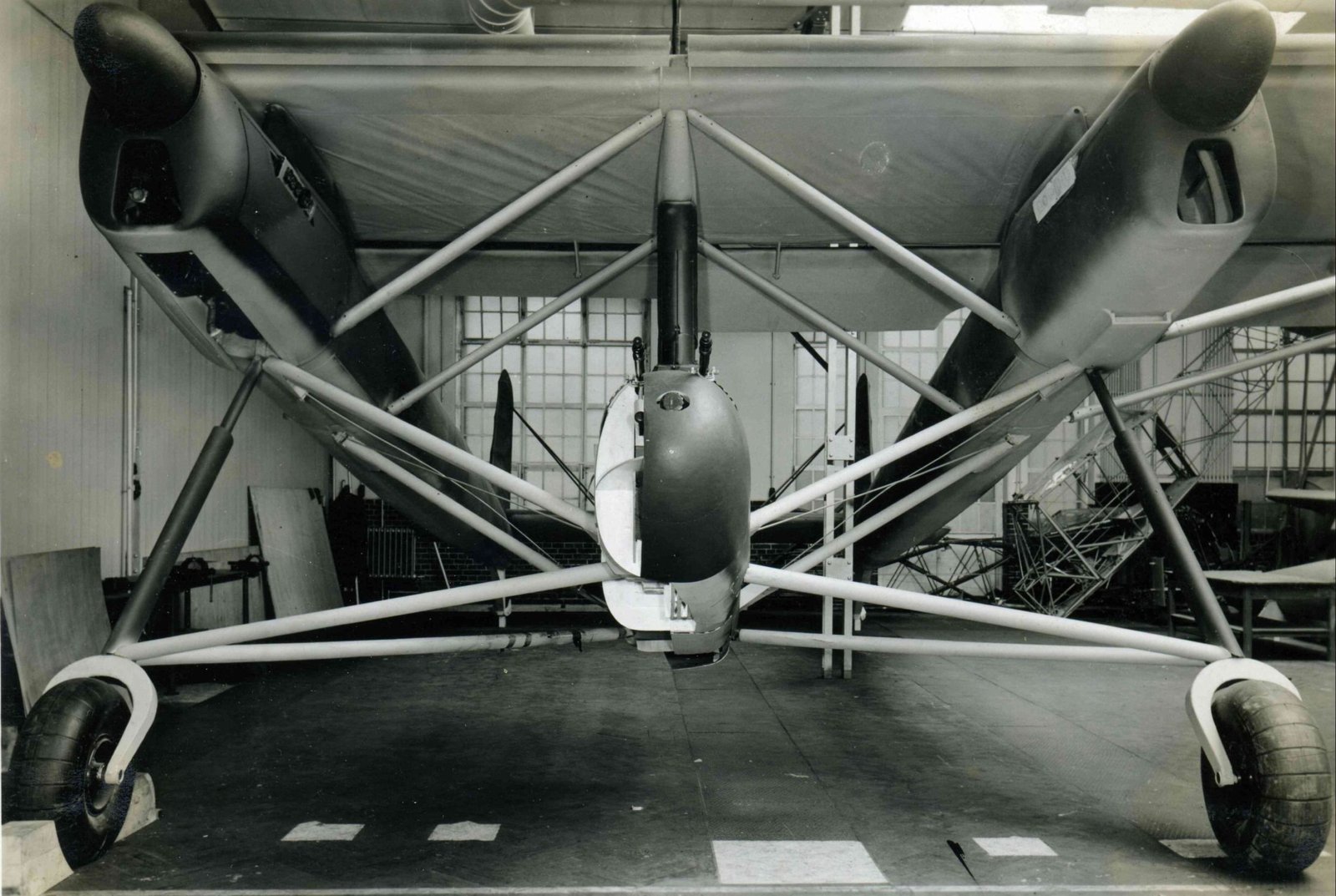
The Fieseler Fi 168 was conceived as a specialized ground-attack and close-support aircraft intended for the Luftwaffe. Developed during the late 1930s, the aircraft was designed specifically for low-level operations, focusing on anti-tank roles and battlefield interdiction. The project emerged during a period when the German air ministry was actively seeking dedicated Schlachtflugzeug (attack aircraft) to support ground forces.
Design work for the Fi 168 took place in 1938. While some secondary sources attribute the design to an individual named Frederik Kassel, this is not corroborated by mainstream reference works; consequently, the aircraft is officially recognized as a design project of Gerhard Fieseler Werke. Construction of a prototype began on September 1, 1938, at the company's facilities in Kassel, Germany. By April 1939, technicians from the Reichsluftfahrtministerium (RLM) conducted an inspection of the aircraft's mock-up. Despite these steps, there is no verifiable evidence that a completed prototype ever flew, and no first-flight date is recorded in the historical archive.
The aircraft was produced by Gerhard Fieseler Werke GmbH (also known as Fieseler Flugzeugbau), a firm established on April 1, 1930, by World War I ace Gerhard Fieseler. While the company achieved significant success with other designs, such as the Fi 156 Storch and the Fi 103 (V-1) flying bomb, the Fi 168 never progressed beyond the prototype construction phase. Due to this, no series production occurred, and no technical specifications regarding engine models, horsepower, dimensions, or performance metrics were ever finalized or documented.
Because the Fi 168 never reached operational status, it saw no combat and was never deployed by any military unit. The project was eventually superseded by other attack aircraft, such as the Henschel Hs 129. Following World War II, Gerhard Fieseler Werke ceased aircraft production and became defunct. Today, the Fi 168 exists only as a historical footnote in aviation literature, illustrating the breadth of pre-war German experimentation in specialized combat aircraft.