
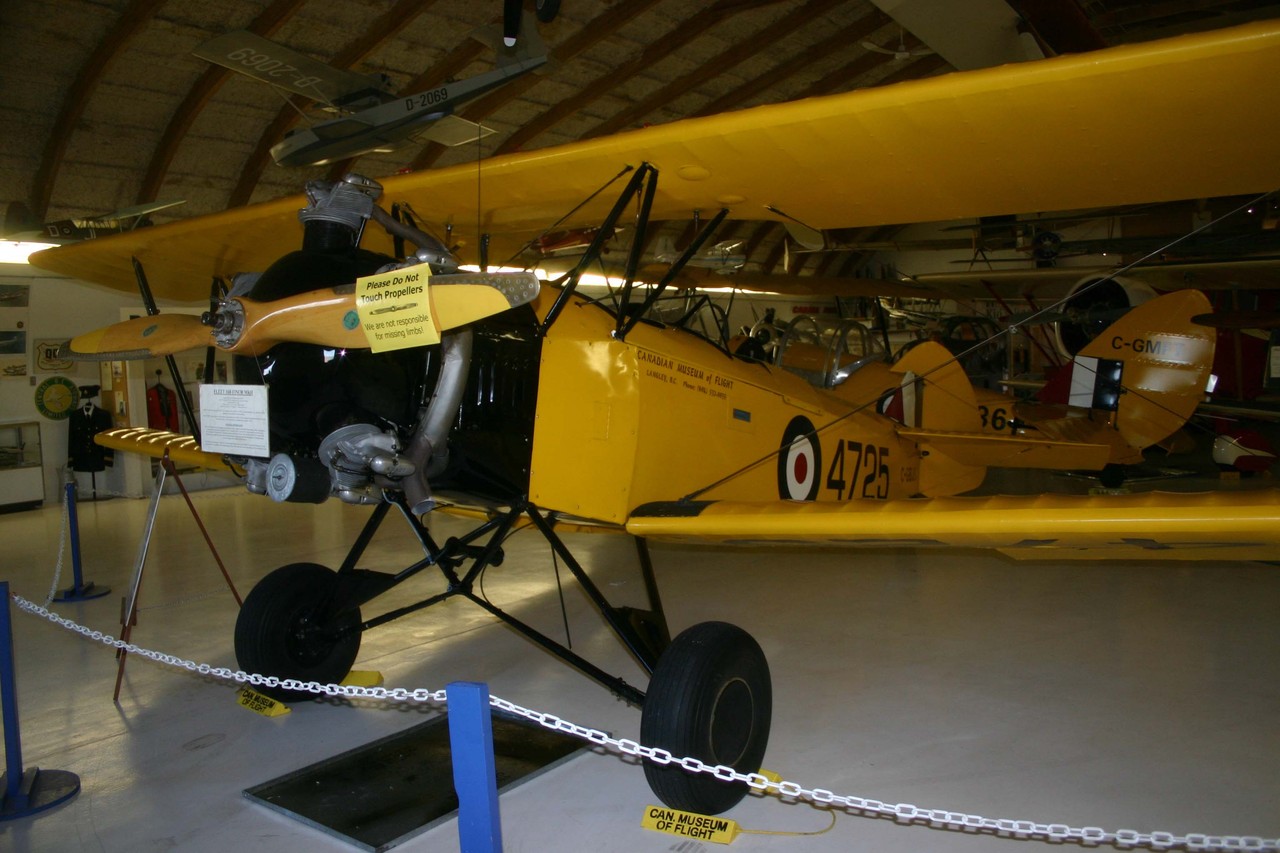
Wartime Dominance
The Fleet 16B Finch II dominated Canadian pilot training throughout World War II, operating at no fewer than 12 Elementary Flight Training Schools across Canada. Of the 431 total Fleet Finches built (including 27 Model 16R variants), virtually all served in the British Commonwealth Air Training Plan, making it one of the most crucial aircraft in Allied pilot preparation. Training schools in London, Ontario and Cap-de-la-Madeleine, Quebec, among others, relied on the Finch's dependable performance to transform civilian volunteers into combat-ready aviators.
The aircraft's significance extended beyond Canadian borders. Portugal's Navy acquired 15 Model 16D variants, while the Royal Romanian Air Force and Chinese Air Force also operated the type, demonstrating its international recognition as a superior training platform.
The Manufacturer
Fleet Aircraft Limited was established in Fort Erie, Ontario by Major Reuben Fleet and Jack Sanderson, operating from at least 1930 through 1941. The company proved Canada's wartime manufacturing capabilities, producing not only 431 Finches but also over 400 B-24 Liberator bombers and PBY Catalina patrol bombers for the United States during World War II.
Fleet Aircraft's expertise extended across multiple trainer models, including the Fleet 2, 7, 10, and 16 series for both the RCAF and civil operators. The company exported aircraft to nine countries, establishing Canada as a significant player in international aviation manufacturing. By 1938, Fleet Aircraft had become the Canadian agency for Kinner engines, ensuring reliable powerplant supply for their training aircraft.
Design Evolution
The 16B represented a progressive development of Reuben Fleet's original Consolidated Fleet primary trainer from the 1920s, specifically the Fleet 10. When the Royal Canadian Air Force evaluated the design in 1938, they recommended numerous improvements, leading Fleet Aircraft of Canada to adapt the design in spring 1938 for Canadian production requirements.
Test pilot Thomas Williams first flew the prototype 16B (RCAF serial 4405) on March 12, 1940, validating the design improvements. The aircraft featured tandem open cockpits, a configuration that provided instructors optimal visibility and communication with student pilots while maintaining the rugged construction necessary for training operations.
Engine and Performance
The Kinner B5-R five-cylinder radial engine, producing 130 horsepower, powered the 16B variant. This powerplant represented a deliberate choice for training aircraft, providing sufficient power for instructional maneuvers while maintaining simplicity and reliability. The engine selection also offered economic advantages over alternatives like the de Havilland Tiger Moth, as Canada bore full production costs rather than relying on British-supplied engines.
Different Finch variants employed various Kinner engines: the Model 16R (Finch I) used the 160-horsepower Kinner R5-2, while the Model 16D featured the 160-horsepower Kinner B5-2, allowing Fleet Aircraft to optimize each variant for specific operational requirements.
Production and Service Timeline
Production proceeded rapidly to meet wartime training demands: 27 Model 16Rs in 1939, followed by 335 aircraft in 1940, and 69 in 1941. This accelerated manufacturing schedule demonstrated Canadian industry's ability to support the massive pilot training program essential to Allied victory.
The Finch began its phase-out in October 1944 as the war situation improved and newer training aircraft became available. The Fairchild Cornell gradually replaced Finches from 1943 onward, representing the evolution of training aircraft technology. The last Model 16s were struck off RCAF strength in 1947, ending nearly a decade of military service.
Post-War Legacy
Many Finches entered civilian service as war surplus aircraft after 1945. The War Assets Commission sold these trainers to private owners, with some receiving American civilian registrations. One documented example, manufactured in July 1940, passed through storage, government disposal, and private ownership before Dr. D.A. McLean of Toronto restored it to original RCAF markings in 1964.
By the 1990s, only a few Finches remained airworthy, though several found homes in prominent museums. The Canada Aviation and Space Museum in Ottawa displays RCAF 4510, manufactured in July 1940 and restored for Air Force Day 1967. The Canadian Warplane Heritage Museum and Commemorative Air Force in Granbury, Texas also preserve examples of this historically significant trainer.
The Fleet 16B Finch II earned its place in aviation history not through speed records or combat victories, but through its fundamental role in Allied victory: training the pilots who would fly fighters, bombers, and transport aircraft in every theater of World War II.