
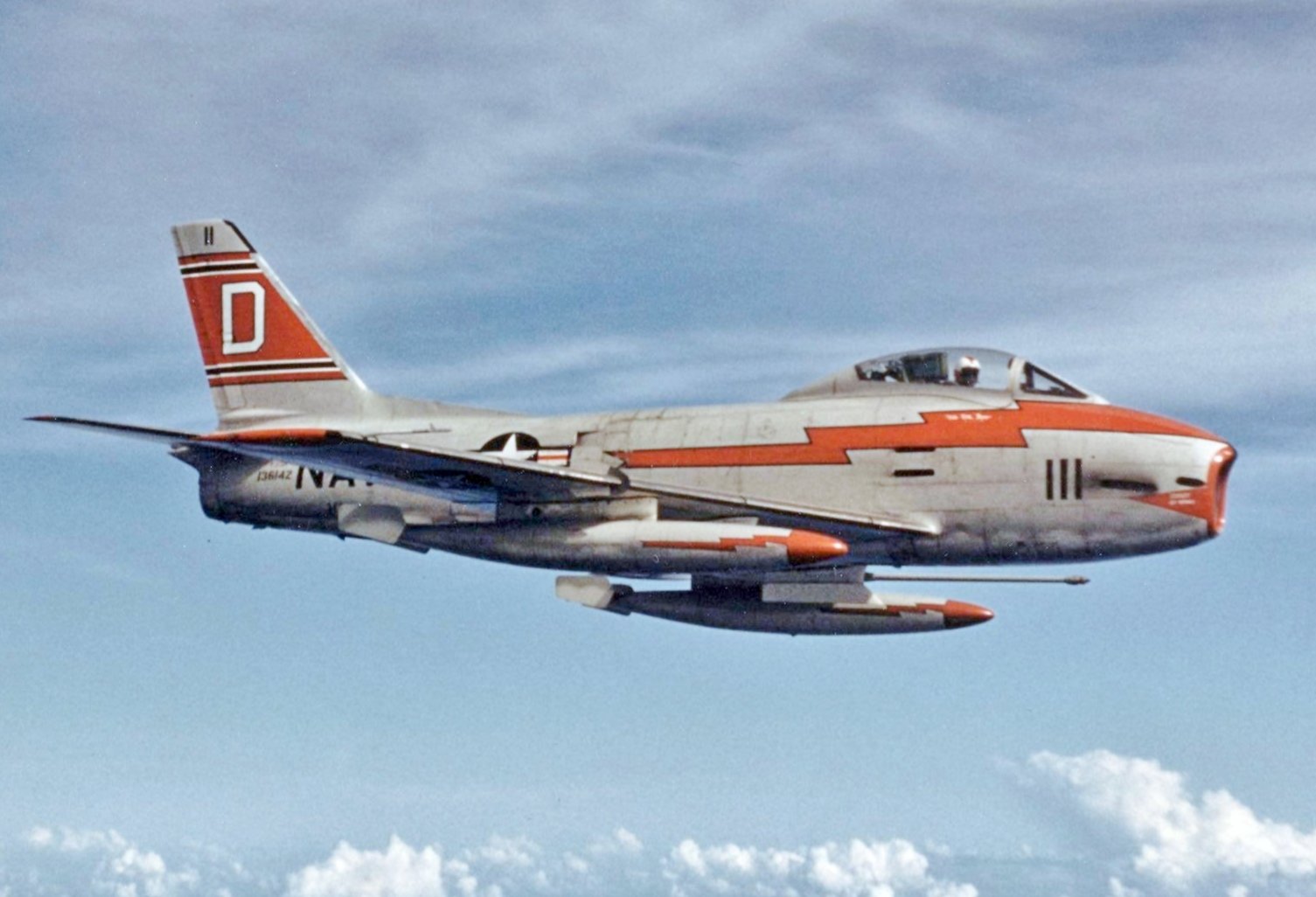
The North American FJ-2 and FJ-3 Fury were developed as navalized versions of the U.S. Air Force's F-86 Sabre. North American Aviation sought to adapt the successful Sabre airframe for carrier operations rather than designing a new aircraft from scratch. To achieve this, the FJ-2 incorporated folding wings for hangar storage, a longer nose landing-gear strut to improve the launch angle of attack, and a strengthened airframe and landing gear to withstand the stresses of deck landings. The FJ-2 first flew on December 27, 1951, and was intended to provide the Navy with a swept-wing fighter capable of matching the performance of the MiG-15, which had outperformed straight-wing naval jets during the Korean War.
Production of the FJ-2 began with an initial order of 300 aircraft, which was later reduced to 200 as the Korean War concluded. The first production FJ-2 was delivered in October 1952. While the FJ-2 reached speeds of approximately 676 mph, it suffered from significant operational issues aboard ships. Consequently, the U.S. Navy assigned the FJ-2 exclusively to six shore-based Marine Corps squadrons. Despite these limitations, the FJ-2 played a pivotal role in aviation history by participating in trials for the first steam catapult installed on a U.S. carrier.
The FJ-3 represented a more comprehensive navalization of the design, featuring a more powerful Wright J65 turbojet engine (a U.S. version of the Armstrong Siddeley Sapphire). The first production FJ-3 flew on July 3, 1953, using a converted FJ-2 (BuNo 131931) as a testbed. A total of 538 FJ-3 aircraft were produced at North American's plant in Columbus, Ohio. Unlike its predecessor, the FJ-3 became a fully operational carrier fighter, serving on Essex-class carriers such as the USS Intrepid, USS Bennington, and USS Bon Homme Richard, as well as the first U.S. supercarrier, the USS Forrestal. VF-173 was the first Navy squadron to achieve active status with the FJ-3 in September 1954, and eventually, 23 Navy and Marine Corps squadrons operated the type.
Technically, the FJ-2 was powered by a General Electric J47-GE-2 turbojet producing 6,000 lbf of thrust, while the FJ-3 utilized the Wright J65-W-2 or J65-WAD. Both variants were armed with four 20 mm cannons. The FJ-3 further expanded its utility with underwing hardpoints for bombs and rockets; later FJ-3M sub-variants were equipped to carry AIM-9B Sidewinder air-to-air missiles. The FJ-3's only documented combat involvement was providing close air support during the 1958 American intervention in Lebanon. The Fury lineage ended in September 1962, shortly after the FJ-3 was redesignated as the F-1C under the 1962 tri-service system. Today, surviving examples are held in static display at institutions such as the National Naval Aviation Museum, the Planes of Fame Air Museum, and the Hickory Aviation Museum.