
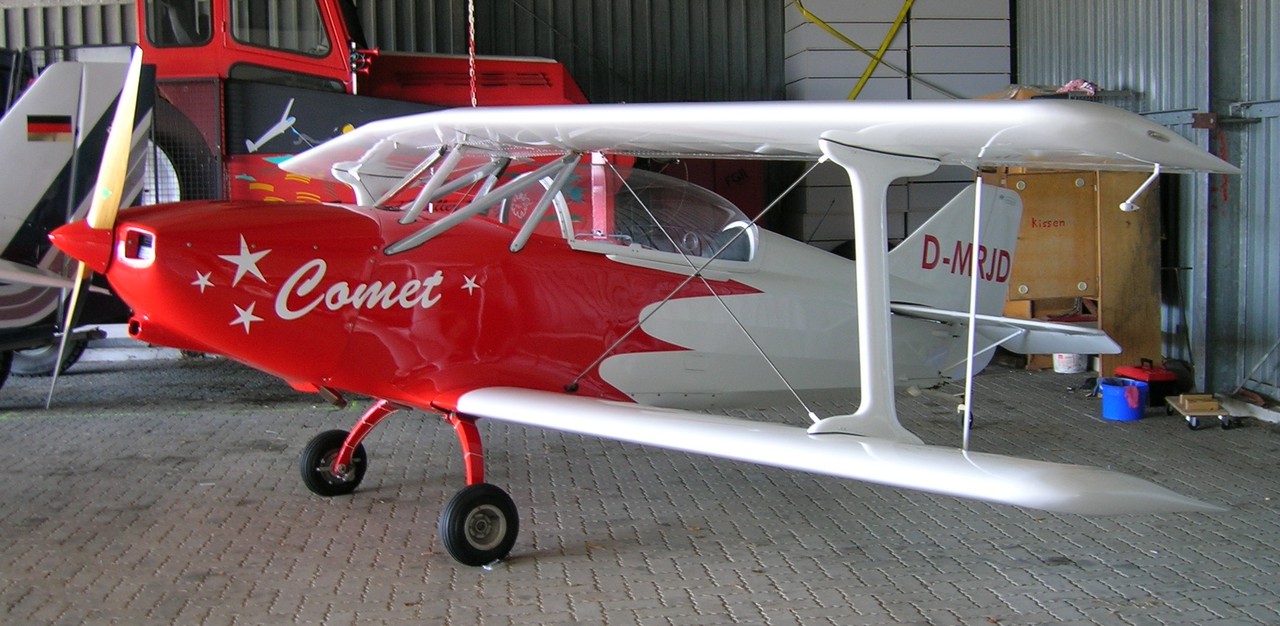
Design Innovation and Development
Peter Funk initiated the FK-12 Comet project in late 1994 with ambitious objectives: create a lightweight tandem-seat ultralight that preserved classical biplane styling while incorporating cutting-edge aerodynamic principles. Construction of the prototype began in 1995, culminating in the first flight of D-MPLI in March 1997. The design represented a revolutionary approach to ultralight aviation, combining laminar flow wing profiles with swept-back geometry and full-span flaperons.
The FK-12's most distinctive feature lies in its laminar airfoil wings, making it the world's only biplane design to successfully implement this advanced aerodynamic concept in production. The wings fold completely for storage, addressing practical concerns of hangar space while maintaining structural integrity. This engineering achievement required extensive development of composite materials, including carbon fiber wing spars and glass fiber reinforced plastic (GFRP) skin panels.
Manufacturing and Production History
Production commenced in late 1997 following successful certification trials, with the first production aircraft flying in May 1997. By January 2003, 57 FK-12 Comets were operational worldwide, establishing it as one of Europe's most successful biplane designs. The manufacturing process split between two countries: airframe construction occurred in Krosno, Poland, while final assembly took place at the company's Speyer, Germany facility.
B & F Technik Vertriebs GmbH achieved German certification in 1999, validating the aircraft's innovative design approach. The company offered both kit and ready-to-fly options, with kit versions priced at €25,000 and complete aircraft reaching €53,000 by 2003. Build times for kit aircraft ranged from 500 to 1,200 hours, depending on builder experience and available workshop time.
The Manufacturer Legacy
The FK-12's development traced back to a rich aviation heritage beginning with Otto Funk's 1959 Greif 1a glider design for Heinkel. Otto's son Peter Funk partnered with Dirk Breitkreuz in 1990 to establish B & F Technik Vertriebs GmbH, initially focused on producing the FK9 ultralight. The company's foundation built upon Otto's decades of experience, including his pioneering work on the FK6 ultralight in 1984 and collaboration on the FK9 design in 1989.
In 2010, corporate restructuring created FK-Lightplanes, dividing operations between FK-Lightplanes Poland (handling sales, marketing, and production) and FK-Lightplanes Germany (managing development, engineering, certification, and service). This organizational change enabled continued innovation, resulting in the improved FK12 S2 variant launched in 2009.
Technical Specifications and Performance
The FK-12 Comet accommodates two occupants in tandem seating configuration, with the pilot typically occupying the rear position for optimal weight distribution. Three Rotax engine options power the aircraft: the 912 UL producing 79.9 horsepower, the 912 ULS generating 98.6 horsepower, and the turbocharged 914 delivering 113.4 horsepower. All engines drive two or three-blade propellers manufactured by MT-Propeller, Junkers, or Duc WarpDrive.
Fuel capacity reaches 58 liters (15.3 US gallons), providing substantial range for an ultralight aircraft. The structural design employs welded steel tube construction in the forward fuselage section, transitioning to riveted aluminum framework aft. This hybrid approach optimizes strength-to-weight ratios while maintaining manufacturing efficiency.
Performance figures demonstrate the FK-12's exceptional capabilities within the ultralight category. Maximum speed reaches 220 km/h, making it the fastest aircraft in its class globally. Best rate of climb achieves 1,377 feet per minute at 54 knots, while takeoff distance over a 50-foot obstacle requires only 590 feet, enabling operations from short grass strips.
Pilot Experience and Handling
Pilots consistently praise the FK-12's combination of classical biplane handling characteristics with modern control responsiveness. The full-span flaperon system provides precise roll control throughout the speed range, while the laminar flow wing design delivers exceptional efficiency compared to traditional biplane configurations. Manual flight controls maintain direct pilot feedback without hydraulic or electric assistance.
The enclosed cabin configuration distinguishes the FK-12 from most ultralight designs, enabling comfortable year-round flying in European weather conditions. This feature significantly expanded the aircraft's utility beyond fair-weather recreational flying, attracting pilots seeking practical transportation capabilities.
Current Status and Legacy
The FK12 S2 variant, introduced in 2009, incorporated lessons learned from the original design. Modifications included a stretched fuselage for improved comfort, enhanced wing design for better roll rates, enlarged tail surfaces, and upgraded landing gear. Most significantly, the S2 achieved aerobatic certification, expanding the aircraft's operational envelope.
Today, FK-Lightplanes continues production and support operations, maintaining the FK-12's position as a unique entry in the modern aviation market. Examples operate across Europe and beyond, with aircraft like French-registered 59-CHP (serial number 012-059) demonstrating the type's international appeal. The FK-12 Comet's legacy lies in proving that innovative engineering can successfully merge historical aviation aesthetics with contemporary performance requirements.