
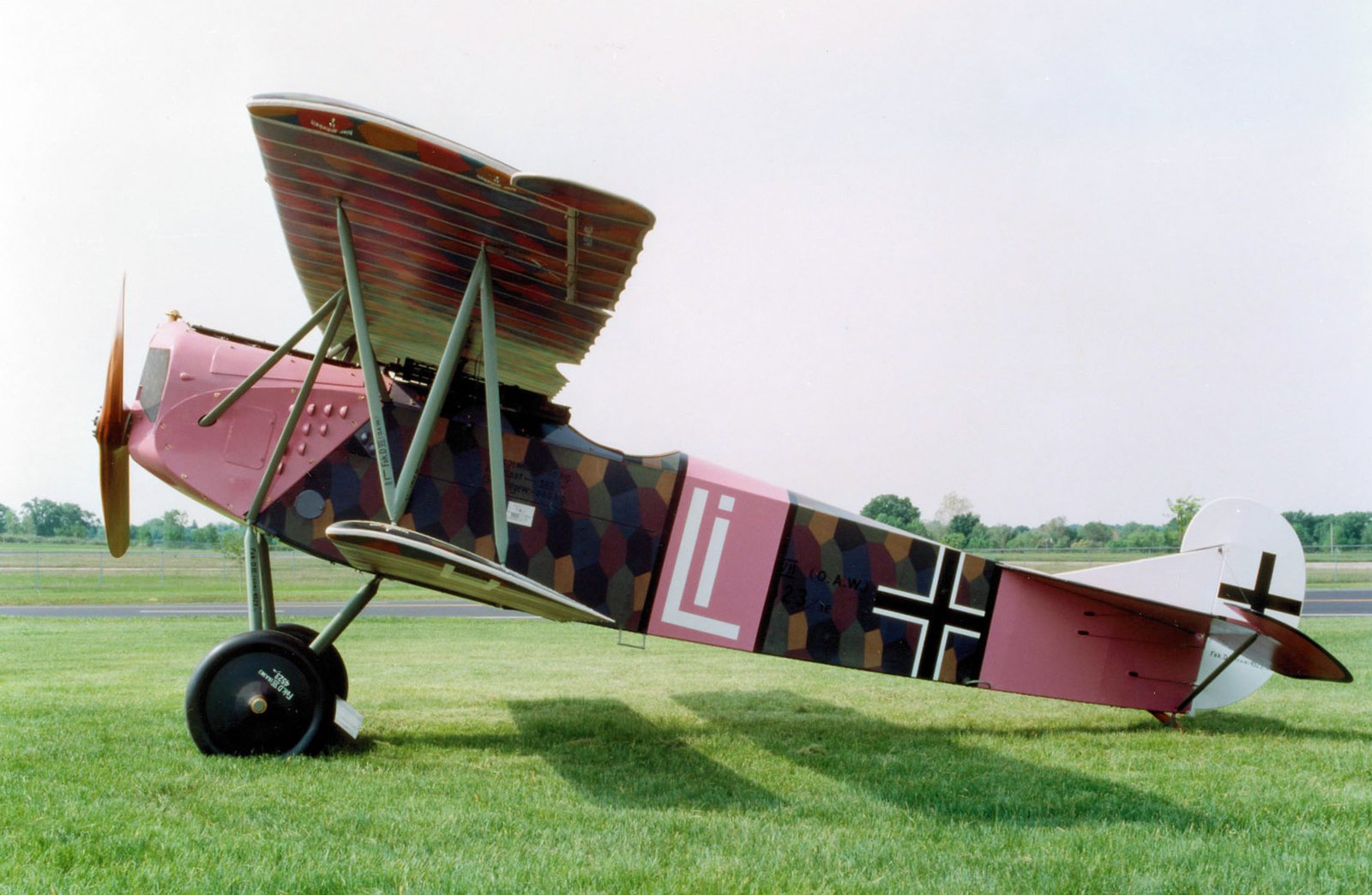
The Fokker D.VII was a pivotal German fighter aircraft introduced in 1918 that is widely considered one of the finest combat aircraft of the First World War. Designed by Reinhold Platz, the aircraft was the result of a January 1918 fighter competition where it won the in-line engine category. The D.VII was characterized by several innovative design features, most notably a welded steel-tube fuselage frame and thick cantilever wings that eliminated the need for bracing wires. These advancements provided a robust structure and clean aerodynamics, while the aircraft's exceptional slow-flight characteristics and high climb rate allowed pilots to attack effectively from below.
Production began in 1918 and was concentrated heavily in that year due to the November Armistice. While production figures vary, the National Museum of the USAF notes that principal manufacturers built over 1,700 aircraft, while other sources indicate nearly 3,300 were produced in the second half of 1918 alone. Manufacturing was distributed among Fokker Flugzeugwerke, Albatros Flugzeugwerke in Berlin-Johannisthal, and Ostdeutsche Albatros Werke (OAW) in Schneidemühl/Pila.
Technically, the D.VII utilized liquid-cooled, inline piston engines. Common powerplants included the Mercedes D.IIIa/D.IIIaü, producing between 160 and 180 hp, and the over-compressed 185 hp BMW IIIa. Depending on the engine, maximum speeds ranged from 120 mph to 124 mph, with service ceilings reaching up to 21,000 feet. For armament, the fighter was typically equipped with two fixed, forward-firing 7.92 mm Spandau machine guns.
In military service, the D.VII entered front-line combat in April and May 1918, serving with the Imperial German Air Service's Jagdstaffeln. It was flown by many of Germany's top aces, including Ernst Udet. Its combat effectiveness was immense; in August 1918 alone, German pilots achieved 565 victories over Allied aircraft. The aircraft's reputation was so formidable that it was the only aircraft specifically named in the Armistice and Treaty of Versailles for compulsory surrender. Following the war, the United States Army Air Service acquired 142 D.VIIs, six of which were transferred to the U.S. Navy and Marine Corps for use as trainers at Quantico until 1924. Additionally, the U.S. Navy utilized twelve D.VII-type aircraft in May 1920 for experimental research into metal construction.
Today, the legacy of the D.VII persists through museum exhibits and flying reproductions. Notable examples are held by the Smithsonian National Air and Space Museum and the National Museum of the USAF, the latter of which displays a reproduction painted to represent the aircraft of Jasta 35b leader Lt. Rudolph Stark. An active flying reproduction, powered by an original 200 hp Mercedes engine, is operated by the Old Rhinebeck Aerodrome.