
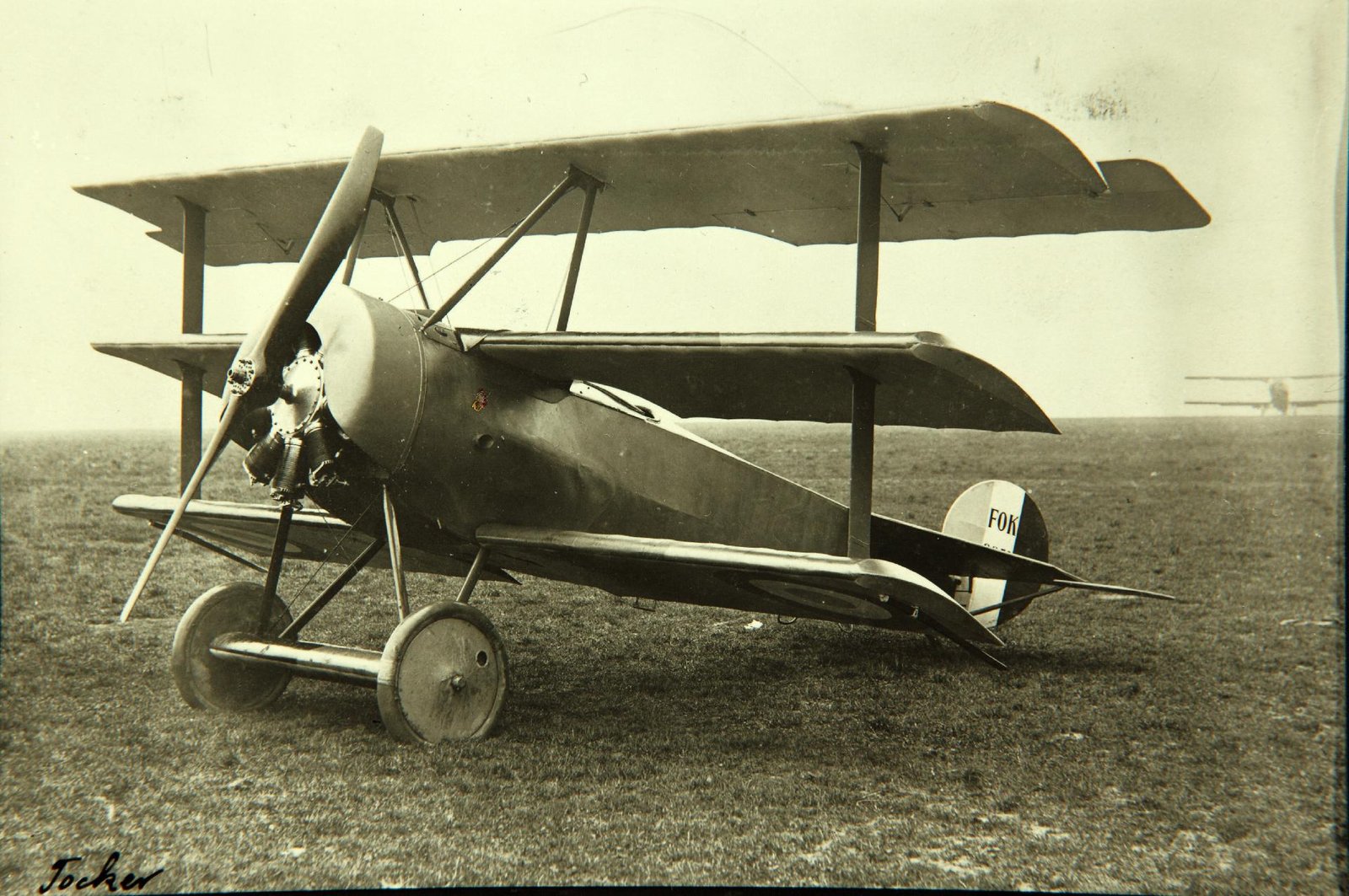
The Fokker F.I (also designated as the V.5) was a specialized triplane fighter developed in 1917 by Fokker Flugzeugwerke GmbH at their Schwerin factory in Mecklenburg, Germany. Designed under the direction of Reinhold Platz, the aircraft was an evolution of the earlier V.4 prototype, featuring an increased wingspan and the addition of interplane struts to address structural and handling issues. The F.I served as the critical transitional design that led directly to the mass-produced Fokker Dr.I.
Technically, the F.I was characterized by its high-lift triplane configuration. All three wings shared a chord of 1.000 m, though the spans increased from the bottom to the top: 5.725 m for the lower wing, 6.225 m for the middle, and 7.190 m for the upper wing. The airframe consisted of a welded steel-tube fuselage braced with wire and covered in fabric, while the wings utilized plywood box spars and ribs. The aircraft was powered by a single 110 hp Oberursel Ur.II nine-cylinder air-cooled rotary piston engine, which was a German license-built version of the French Le Rhône 9J. This engine drove a 2.660 m two-bladed fixed-pitch laminated wood propeller manufactured by Axial Propellerwerk AG.
Production was extremely limited, with only two operational aircraft completed and flown: F.I 102/17 and F.I 103/17, although some records suggest a possible third airframe. The first prototype, 102/17, made its maiden flight on 5 July 1917. Both aircraft entered frontline service with the Luftstreitkräfte in September 1917. F.I 102/17 was flown by the renowned ace Leutnant Werner Voss of Jasta 10, who was killed in combat on 23 September 1917. Another account notes that 102/17 was shot down by a Sopwith Camel on 15 September 1917, resulting in the death of Oberleutnant Kurt Wolff. F.I 103/17 was allocated to Rittmeister Manfred von Richthofen, commander of Jagdgeschwader I, who achieved at least two victories in the aircraft before transitioning to other types.
Performance figures for the F.I prototype indicate a maximum speed of 185 km/h at sea level and 166 km/h at 4,000 m, with a service ceiling of 7,000 m and an endurance of approximately 1.5 hours. For armament, it carried two synchronized 7.92 mm Spandau LMG 08/15 machine guns, each supplied with 550 rounds. No original F.I airframes survive today, as both operational units were lost in combat; modern examples are replicas based on Dr.I specifications.