
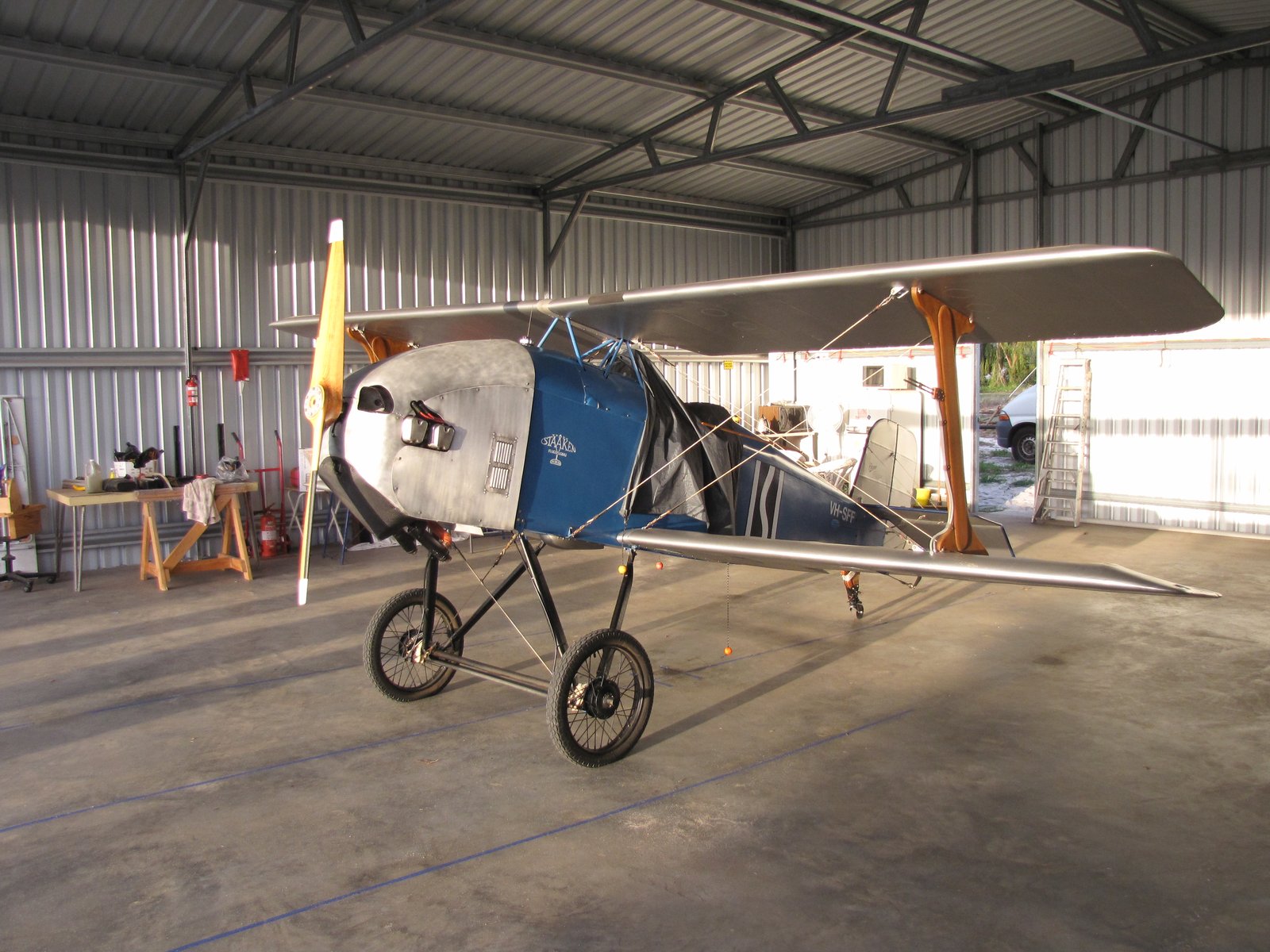
Design Philosophy and Development
Lynn Williams, a British aviation artist and aeronautical enthusiast, conceived the Flitzer series as an homage to the golden age of sport aviation. His vision was to create an aircraft with "a distinctly period flavor, masquerading as a 1920s German sport biplane" while incorporating decades of aeronautical advancement. The original Z-1 prototype served as Williams's testbed for exploring the balance between vintage aesthetics and modern safety.
Technical Innovation
The Z-1 Flitzer employed conventional wood construction with built-up ribs and plank spars, covered in doped aircraft fabric. This traditional approach appealed to homebuilders seeking authentic construction methods while maintaining structural integrity. Williams's design incorporated an 1835cc Volkswagen engine, part of a growing movement among experimental aircraft builders to adapt reliable automotive powerplants for aviation use.
The aircraft's compact dimensions - 18 feet 1 inch wingspan with 97 square feet of wing area - created an intimate flying experience reminiscent of early sport planes. The open cockpit design enhanced the period authenticity while providing excellent visibility for the pilot.
Evolution to the Z-21
Learning from the Z-1 prototype's performance, Williams refined his design into the Z-21 variant. The primary improvement was a longer-span horizontal stabilizer that enhanced longitudinal stability and control authority. This modification addressed handling characteristics that emerged during flight testing of the original design.
The Z-21 demonstrated impressive performance figures for its power-to-weight ratio. With an empty weight of 481 pounds and gross weight of 752 pounds, the aircraft achieved a maximum speed of approximately 95 mph and cruise speed of 85 mph at 3000 rpm. The climb rate of 700 feet per minute provided spirited performance, while the maneuvering speed of 100 mph and never-exceed speed of 120 mph established a reasonable flight envelope for sport flying.
Manufacturing and Distribution
Flitzer Sportplanes of Aberdare, Wales, became the primary source for Z-21 plans and components. The company's location in Wales positioned it within the active British homebuilding community, where vintage-inspired designs found enthusiastic reception. In the late 1990s, Bell Aeromarine of Leicester, UK, expanded distribution by offering Z-21 kits to builders seeking more comprehensive component packages.
The Z-21A variant addressed a practical concern for larger pilots by incorporating an enlarged 24-inch cockpit. This modification broadened the aircraft's appeal without compromising its fundamental design characteristics or performance envelope.
Engine Options and Performance
While the original Z-1 utilized the 1835cc Volkswagen engine, the Z-21 series accommodated various powerplants up to 110 horsepower. Some builders opted for the Rotec R2800 radial engine, which provided additional power while enhancing the vintage aesthetic with its radial configuration. These engine choices allowed builders to tailor performance characteristics to their specific mission requirements and budget constraints.
International Appeal
The Flitzer design found favor among international homebuilders, with examples constructed in New Zealand and other countries by 2012. This global reach demonstrated the universal appeal of Williams's design philosophy and the accessibility of his construction methods to amateur builders worldwide.
Legacy and Continuing Availability
As of 2012, plans for the Z-21 remained available, ensuring the design's continued accessibility to new generations of homebuilders. The Flitzer series represents a successful fusion of nostalgic design elements with practical homebuilding techniques, creating an aircraft that delivers authentic vintage flying experiences while meeting contemporary safety expectations.
The Williams Z-1 and its derivatives established a template for period-inspired homebuilt aircraft that influenced subsequent designs in the experimental aviation community. Williams's approach of combining artistic sensibility with aeronautical knowledge created an aircraft that serves both as a capable sport plane and a rolling tribute to aviation's golden age.