
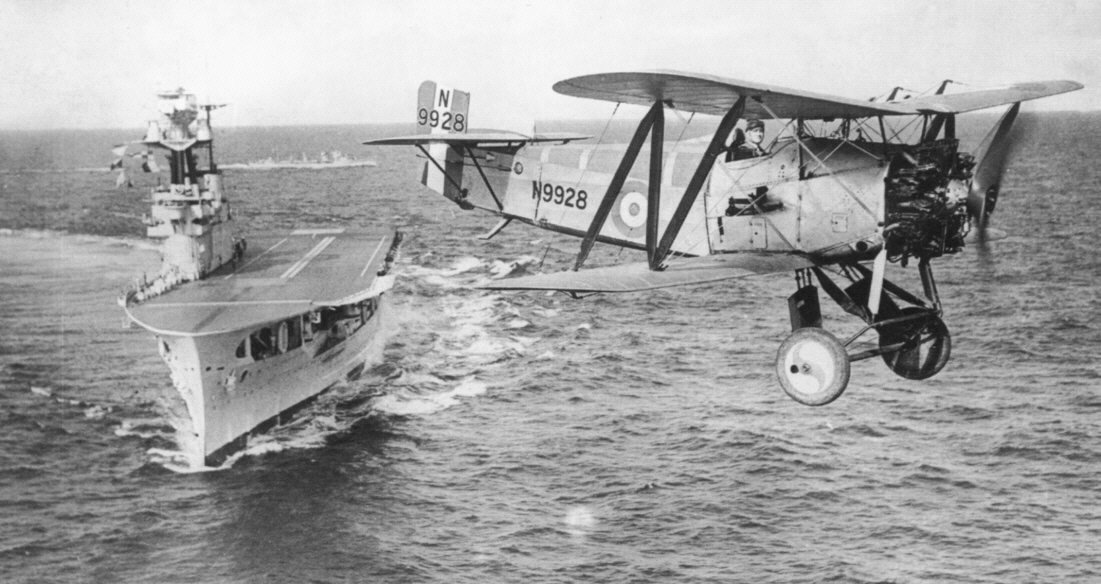
The Fairey Flycatcher was a seminal aircraft in the development of British naval aviation, serving as the Royal Navy's primary carrier-borne fighter from 1923 until 1932. Designed by the Fairey Aviation Company to meet Air Ministry Specification N.6/22, the aircraft was intended to replace the Gloster Nightjar. It was notable for being one of the first single-seat fighters purpose-built for carrier operations rather than being adapted from existing land-based designs. The prototype made its maiden flight on November 28, 1922, with testing conducted by Lt. Col. Vincent Nicholl.
Production took place at Fairey's main works in Hayes, Middlesex, England. While production dates vary slightly across records, the main run occurred between 1923 and 1926, though some sources indicate production batches were ordered as late as March 1930. Total production figures are estimated between 193 and 196 airframes. The aircraft was powered by a 400 hp Armstrong Siddeley Jaguar IV, a 14-cylinder, two-row air-cooled radial piston engine. This powerplant enabled a maximum speed of 133 mph and a service ceiling of 19,000 feet.
Technically, the Flycatcher was a single-bay biplane known for its robustness and maneuverability. It featured a convertible undercarriage, allowing it to operate as a wheeled landplane or a floatplane. Its strong structure permitted steep dives at full power, allowing it to function as a dive-bomber carrying four 20 lb bombs under the lower wings. For defense, it was armed with two synchronized, forward-firing Vickers machine guns. On November 26, 1929, a Flycatcher achieved a historic milestone by becoming the first aircraft to successfully make a night landing on a carrier at sea, landing on HMS Courageous after flying from Hal Far, Malta.
Operationally, the Flycatcher equipped all Fleet Air Arm fighter Flights (401 through 408) and served across the Home Fleet, Mediterranean Fleet, East Indies Squadron, and the China Station. In China, floatplane versions were utilized for policing missions and strafing Chinese pirates. Beyond the United Kingdom, the Argentine Navy operated a single Flycatcher Mk.I. The type was officially declared obsolete in 1935. Although no original airframes survive, a full-scale replica (G-BEYB) built in the late 20th century is preserved in the reserve collection of the Fleet Air Arm Museum at Yeovilton, Somerset.