
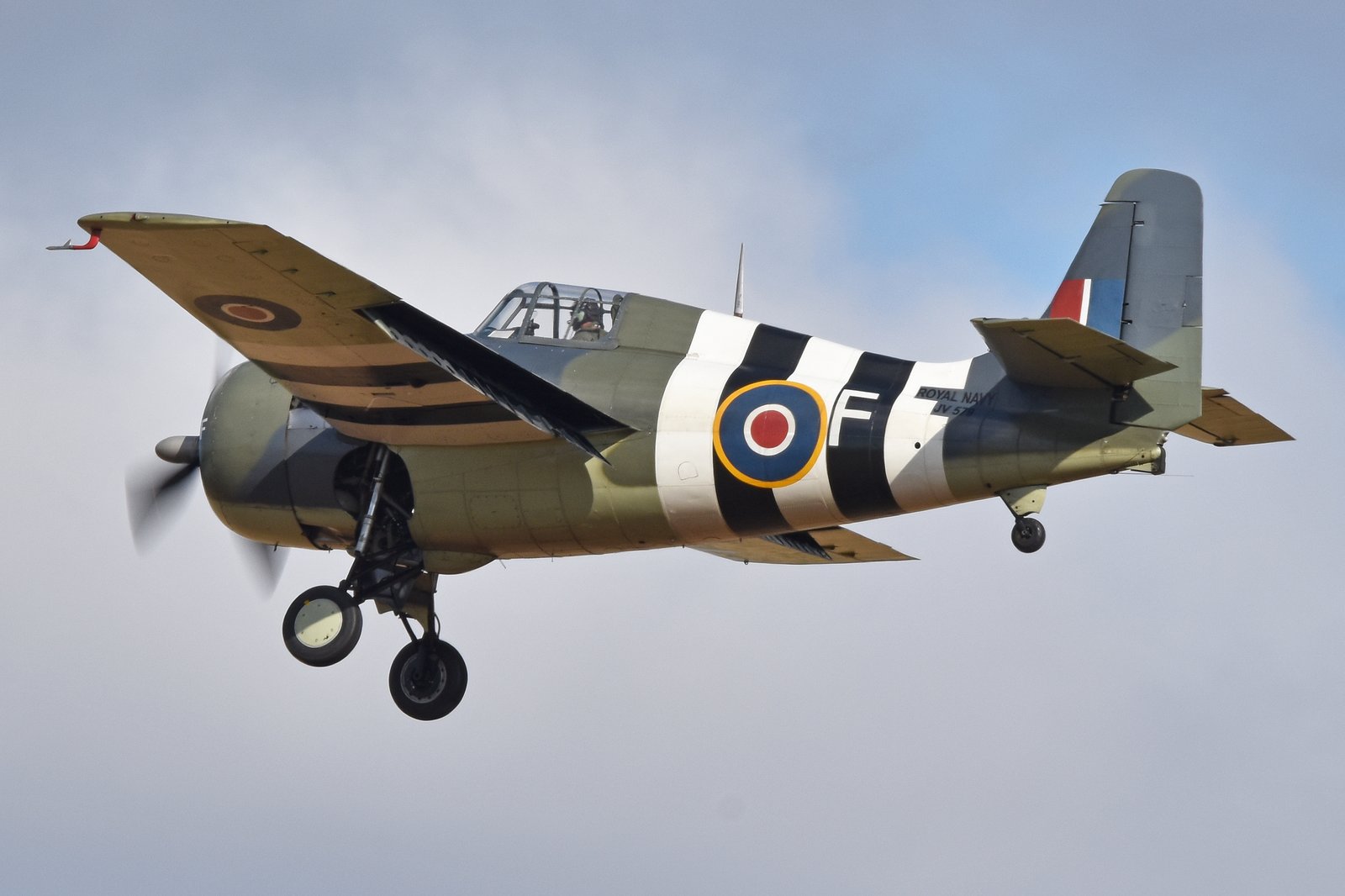
The FM-2 Wildcat represented the final and most numerous combat variant of the Wildcat family. Designed by Grumman Aircraft Engineering Corporation under the leadership of co-founder Leroy R. Grumman, the aircraft was a navalized, lightened, and higher-powered development of the F4F-4. To meet urgent wartime demands, the U.S. Navy arranged for General Motors to establish the Eastern Aircraft Division (EAD) to license-build these fighters. Production took place between 1943 and 1945 at EAD plants, including facilities in Linden, New Jersey, as well as Trenton, NJ, Bloomfield, NJ, and Baltimore, MD. While Grumman ceased its own Wildcat production in May 1943 to focus on the F6F Hellcat, Eastern continued producing the FM-1 and FM-2. Total production for the GM FM-series is estimated between 5,280 and 5,837 units, with the FM-2 forming the bulk of these numbers, estimated at roughly 4,000 to 4,800 aircraft.
Technically, the FM-2 was specifically optimized for the limited deck space of escort carriers (CVE). It was powered by a Wright R-1820-56 Cyclone nine-cylinder air-cooled radial engine producing approximately 1,350 hp, often utilizing water injection for increased takeoff power. To handle the increased torque of this engine, the FM-2 featured an enlarged vertical tail with a taller fin and rudder. Weight was reduced by simplifying the internal structure and reducing the wing armament from six to four .50 caliber Browning M2 machine guns, though the ammunition capacity per gun was increased. The aircraft could also carry up to two 250 lb bombs or six 5-inch rockets. These modifications allowed the FM-2 to reach a maximum speed of approximately 332 mph at 28,000 feet and a service ceiling of about 34,000 feet.
During World War II, the FM-2 served as the standard fighter for nearly all U.S. and British escort carriers. In the Atlantic, they provided convoy protection and antisubmarine warfare (ASW) support, often pairing with TBM Avengers to attack surfaced U-boats. In the Pacific, they supported amphibious operations, including the invasion of Okinawa in 1945, where units such as VC-93 aboard the USS Petrof Bay (CVE-80) operated. The Royal Navy Fleet Air Arm also utilized the type, designating it the Wildcat VI. The Wildcat family is noted for a combat kill-to-loss ratio of approximately 6.9:1. Today, several FM-2s are preserved in museums, including the National Naval Aviation Museum, the Museum of Flight, and the Military Aviation Museum, where an airworthy example built in Linden, New Jersey, remains active.