
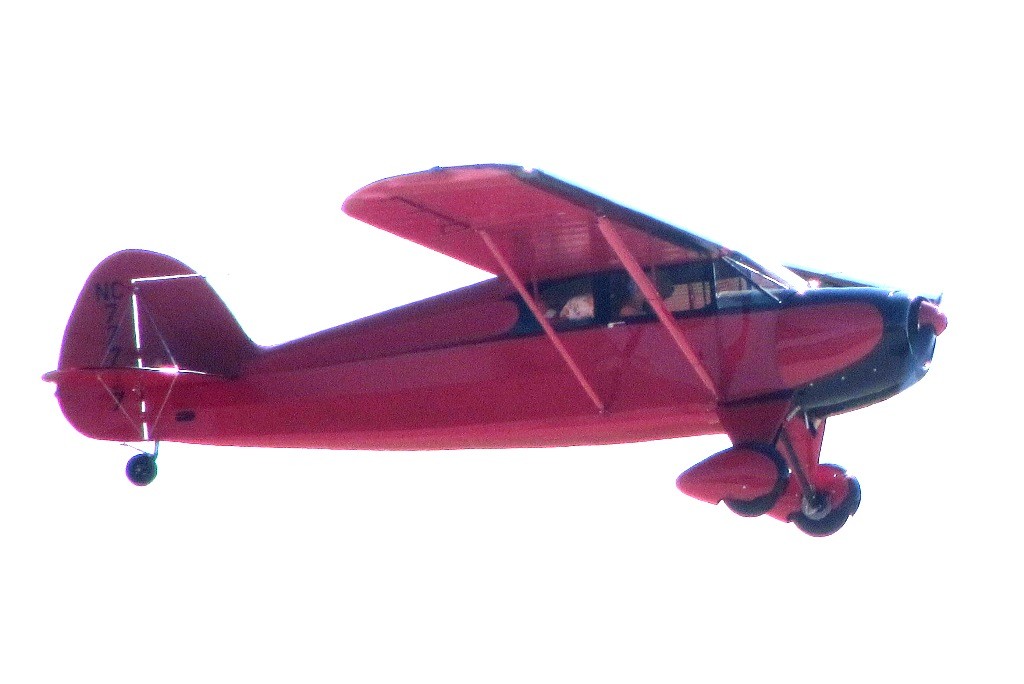
Design Innovation
Twin brothers Howard and Joe Funk revolutionized light aviation by adapting automobile engine technology for aircraft use. Their initial design work began around 1933, drawing from their extensive glider experience to create an affordable alternative to expensive purpose-built aircraft engines. The prototype first flew on July 2, 1934, at Akron Airport, powered by a Székely radial engine that would soon give way to their innovative automotive-derived powerplant.
The Funks' most significant contribution was the Model E engine, a 63-horsepower four-cylinder inline powerplant constructed using Ford Model B automobile components. While this engine suffered from cooling and lubrication issues, it demonstrated that private aviation could be made accessible to middle-class Americans during the Great Depression. The aircraft's mixed construction—combining wood and fabric wings with a steel-tube and fabric fuselage—further reduced costs while maintaining structural integrity.
Manufacturing History
Production began in 1939 under the Akron Aircraft Company, formed by local businessmen to support the Funk brothers' venture. The initial Model B series used the problematic Funk E engine but transitioned to the more reliable 75-horsepower Lycoming GO-145 by late 1940, creating the B-75-L variant. In 1941, the company relocated to Coffeyville, Kansas, and renamed itself Funk Aircraft Company.
World War II interrupted civilian production in 1942, but the company resumed manufacturing in 1946 with the B-85-C variant. This post-war model, also designated F2B or simply "Bee," featured the Continental C-85-12 engine that provided 85 horsepower and significantly improved reliability. Production ceased in 1948 due to the post-war economic slump that devastated the light aircraft industry.
Production Numbers and Variants
Approximately 380 Funk aircraft were manufactured across all variants, with the post-war B-85-C accounting for about 245 units. The relatively modest production run reflected both the economic challenges of the era and competition from established manufacturers who resumed civilian production after the war.
The Continental C-85-12F engine that powered the B-85-C became a standard powerplant for numerous light aircraft manufacturers. This horizontally opposed, four-cylinder, air-cooled engine delivered reliable performance that the earlier automotive-derived engines could not match, enabling the aircraft to achieve a maximum speed of 115 mph at sea level and a service ceiling of 15,000 feet.
Wartime Service
While primarily a civilian aircraft, one Model B-75-L was impressed into U.S. Army Air Corps service in 1942, receiving the military designation UC-92 and serial number 42-79548. The aircraft served in utility and training roles but saw no combat operations. Another example was painted in 1943 Civil Air Patrol markings, reflecting the organization's civilian defense mission during the war.
Performance and Handling
The B-85-C's specifications reflected its role as an entry-level touring and training aircraft. With an empty weight of 890 pounds and a gross weight of 1,350 pounds, it offered a useful load of 460 pounds for fuel, baggage, and a passenger. The aircraft cruised at 100 mph with a range of 350 miles plus 30 minutes reserve fuel, making it suitable for local and regional flights.
Pilots appreciated the aircraft's stable handling characteristics, inherited from the Funk brothers' glider background. The sloping windshield design, inspired by sailplane aesthetics, provided good forward visibility while contributing to the aircraft's distinctive appearance among 1940s light planes.
Legacy and Survivors
Today, between 108 and 150 Funk aircraft remain on the U.S. civil registry, with at least three retaining their original Ford-derived engines as historical curiosities. The type has found homes worldwide, including Australia, where at least one example was imported in 2008 and later modified with a Rotec radial engine.
Notable preserved examples include a 1940 B-75-L displayed at the Maps Air Museum in Ohio, still wearing Civil Air Patrol markings. The aircraft occasionally appears at EAA AirVenture, where restored examples have won awards for their historical significance and craftsmanship.
The Funk's primary legacy lies in demonstrating that innovative engineering could make aviation accessible during economically challenging times. While the company ceased operations in 1948, the aircraft established principles of affordable design that influenced subsequent light aircraft development throughout the post-war boom in general aviation.