
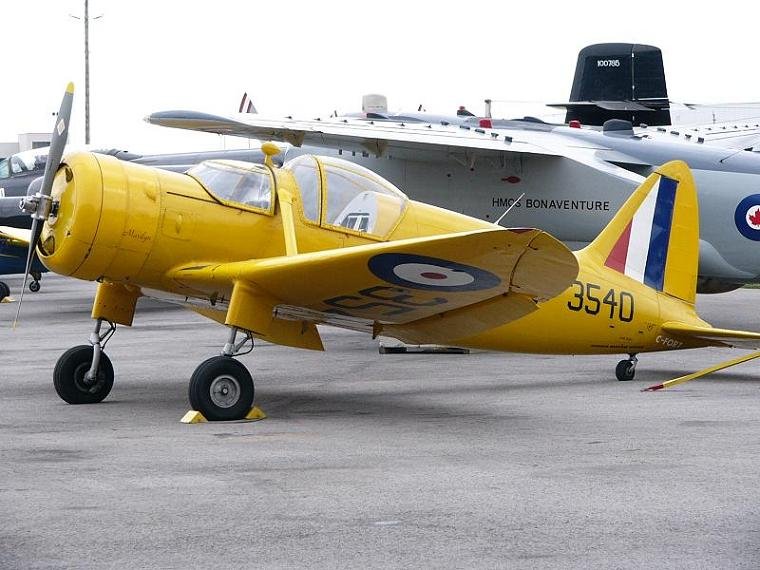
A Uniquely Canadian Design
The Fleet 60 Fort emerged from Fleet Aircraft of Canada's ambitious 1938 private venture to fill a perceived gap in pilot training progression. The company recognized that student pilots needed an intermediate step between basic trainers like the de Havilland Tiger Moth and advanced aircraft such as the North American Harvard. This observation led to the Fort's development as Canada's sole indigenous aircraft design during the Second World War.
The prototype took to the skies on March 21, 1940, at Fort Erie, Ontario, marking the beginning of what would become a brief but historically significant production run. Fleet Aircraft had designed their first all-metal monoplane, featuring an elliptical low wing and an innovative fixed undercarriage system with retractable fairings—a clever compromise intended to familiarize students with gear retraction procedures without the risk of belly landings from pilot error.
Production and Performance
Production commenced slowly in 1941, with the first production aircraft flying on April 18, 1941. Fleet Aircraft delivered just two aircraft in the second quarter of 1941, followed by seven in the third quarter and 19 in the fourth. The pace accelerated dramatically in early 1942, with 57 aircraft delivered between January and March, before concluding with 16 final deliveries in the second quarter of 1942.
Two engine configurations were developed during the Fort's brief production life. The initial variant employed the 250-horsepower Jacobs L-7 radial engine, while a more powerful version featured the 330-horsepower Jacobs L-4MB radial. The higher-powered variant achieved impressive performance figures for its era: a maximum speed of 193 mph, cruising speed of 163 mph, and climb rate of 1,650 feet per minute. With a loaded weight of 2,900 pounds, the Fort could achieve a range of 610 miles.
Service with the Royal Canadian Air Force
All 101 production aircraft entered service with the Royal Canadian Air Force as part of the British Commonwealth Air Training Plan. Initially designated Fort Mk I, these aircraft were intended to bridge the training gap between primary and advanced instruction. However, operational experience quickly revealed a fundamental flaw in the Fort's design philosophy.
Pilots who had mastered basic trainers like the Fleet Finch and Tiger Moth found the Fort surprisingly easy to handle. Rather than providing the intended intermediate challenge, the aircraft proved insufficient preparation for transitioning to operational types such as the Hawker Hurricane. The RCAF discovered that students could progress directly from primary trainers to Harvards without compromising their preparation for combat aircraft.
Conversion to Wireless Training
Faced with an aircraft that failed to fulfill its primary mission, the RCAF found alternative employment for the entire Fort fleet. All 101 production aircraft underwent conversion to wireless operator training aircraft, receiving the new designation Fort Mk II. In this role, the Fort found its true calling, serving effectively at No. 2 Wireless School in Calgary and No. 3 Wireless School in Winnipeg.
This conversion represented a practical solution to the Fort's operational shortcomings while addressing the critical need for radio operator training within the Commonwealth Air Training Plan. The aircraft's stable flight characteristics and two-seat configuration made it well-suited for instructing wireless operators in the complexities of military radio communication.
Fleet Aircraft of Canada
Fleet Aircraft of Canada operated from their Fort Erie, Ontario facility during the 1930s and 1940s, contributing significantly to Canadian aviation during the war years. Beyond the Fort, the company produced the Fleet Finch trainer and manufactured approximately 1,800 Fairchild Cornell trainers under license agreement. The company's decision to develop the Fort as a private venture demonstrated considerable entrepreneurial spirit during a period when most Canadian aircraft production focused on British designs.
Design Innovation and Legacy
The Fort incorporated several notable design features that distinguished it from contemporary trainers. Its elliptical wing configuration provided efficient aerodynamics, while the raised rear cockpit improved instructor visibility. Engineers included a reinforced metal fin designed to support the aircraft's weight in the event of an overturn—a practical consideration for training operations.
The aircraft's most distinctive feature remained its fixed landing gear with retractable fairings. This unique system allowed students to practice gear retraction procedures while eliminating the possibility of gear-up landings, demonstrating Fleet Aircraft's thoughtful approach to training aircraft design.
Historical Significance
Despite its operational limitations and brief service life, the Fleet 60 Fort holds irreplaceable significance in Canadian aviation history. As the only aircraft designed and built by Canadians during World War II, it represents the nation's indigenous aircraft development capabilities during the conflict's critical years.
By 1976, at least one Fort (serial number 3642) was undergoing restoration in Saskatchewan, though the current status of surviving aircraft remains unclear. The Fort's legacy extends beyond its modest production numbers, symbolizing Canadian innovation and the nation's contribution to Allied victory through domestic aircraft development.