
International Success Story
The CM.170 Magister achieved unprecedented success in the global training aircraft market, with 929 total examples delivered to 23 nations between 1956 and the late 1960s. France operated the largest fleet with 397 aircraft, followed by Germany with 250 units produced under license by Messerschmitt. The aircraft's compact design and reliable performance made it the backbone of jet pilot training programs across Europe, the Middle East, and beyond. Finland's Valmet manufactured 80 examples including 62 under license, while Israeli Aircraft Industries built 52 units, demonstrating the design's international appeal and production flexibility.
Combat Operations and Military Variants
While designed as a trainer, the Magister proved capable in light attack roles, particularly with the Israeli Air Force during the 1982 Lebanon War. Israeli examples, designated IAI Tzukit (Thrush) after a 1983 upgrade program, carried two 7.62mm machine guns with 200 rounds each and up to 140 kilograms of ordnance on underwing hardpoints. These hardpoints accommodated bombs, rockets, or Nord SS.11 anti-tank missiles for close air support missions. The French Navy operated 32 examples of the specialized CM-175 Zephyr variant, featuring reinforced landing gear, a tail hook, and other modifications for aircraft carrier operations with the Aéronavale.
Design Innovation and Engineering
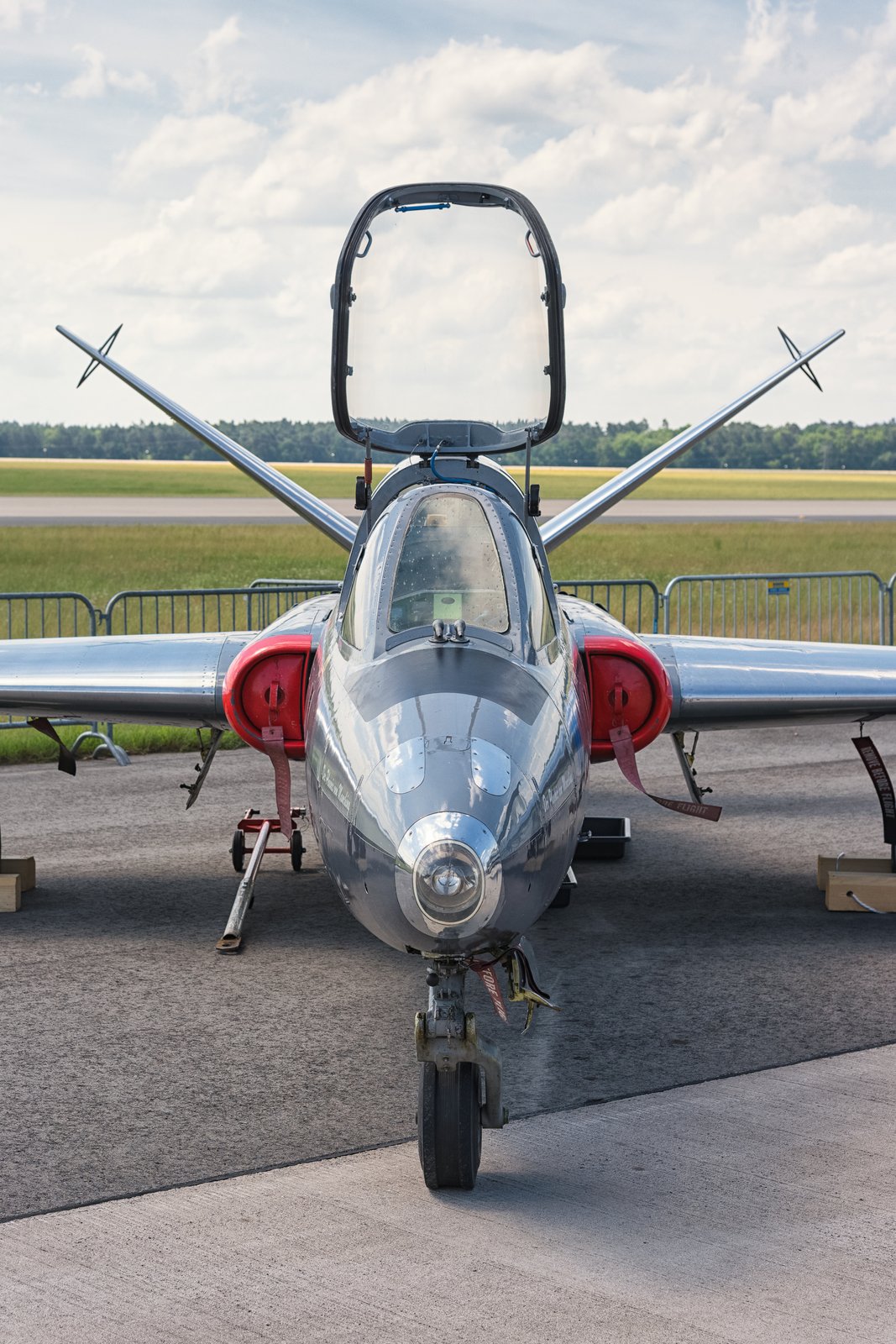
Pierre Mauboussin led the design team at Fouga, creating the Magister in response to a French Air Force requirement for a modern twin-jet trainer in the late 1940s. The aircraft's most distinctive feature was its butterfly tail configuration, derived from Fouga's earlier glider designs and adapted for jet propulsion. This V-tail arrangement provided excellent directional stability while reducing structural weight. The straight wings featured leading-edge sweep and permanent wingtip fuel tanks, while the tandem cockpit utilized clamshell canopies providing excellent visibility for both instructor and student.
Powerplant and Performance
Twin Turboméca Marboré IIA turbojets, each producing 880 pounds of thrust, powered the Magister to a maximum speed of 715 kilometers per hour at 9,000 meters altitude. The engines, manufactured by Turboméca (now part of Safran Aircraft Engines), were specifically selected in 1950 to address underpowering issues in earlier designs. This powerplant combination gave the aircraft a service ceiling of 36,080 feet and a range of 575 miles, with an impressive climb rate of 3,345 feet per minute. The aircraft's empty weight of 4,740 pounds increased to a maximum takeoff weight of 7,055 pounds when fully loaded.
Manufacturing Legacy and Corporate Evolution
Fouga, originally known as Société des Avions Fouga, evolved through several corporate mergers during the Magister's production run. The aircraft carried various manufacturer designations including Potez (Fouga) CM.170, Sud Aviation (Fouga) CM.170, and Aérospatiale (Fouga) CM.170 as the company was absorbed into larger aerospace conglomerates. This corporate evolution ultimately led to Fouga becoming part of Aérospatiale, which later merged to form Airbus, still operating today as one of the world's major aircraft manufacturers.
Continuing Airworthiness and Preservation
Dozens of Magisters remain airworthy today, with notable examples including N492FM (serial number 492) displayed at the Pima Air & Space Museum, N456F (serial number 456) with registration valid through 2029, and N325FR (serial number 325) manufactured in 1961. European preservation efforts include F-GLHF (serial number 406) and aircraft maintained by organizations like the Dutch Historic Jet Association. These surviving examples serve as testament to the aircraft's robust construction and enduring appeal among warbird enthusiasts and aviation museums worldwide, continuing to demonstrate the innovative design that made the Magister a cornerstone of jet age pilot training.