
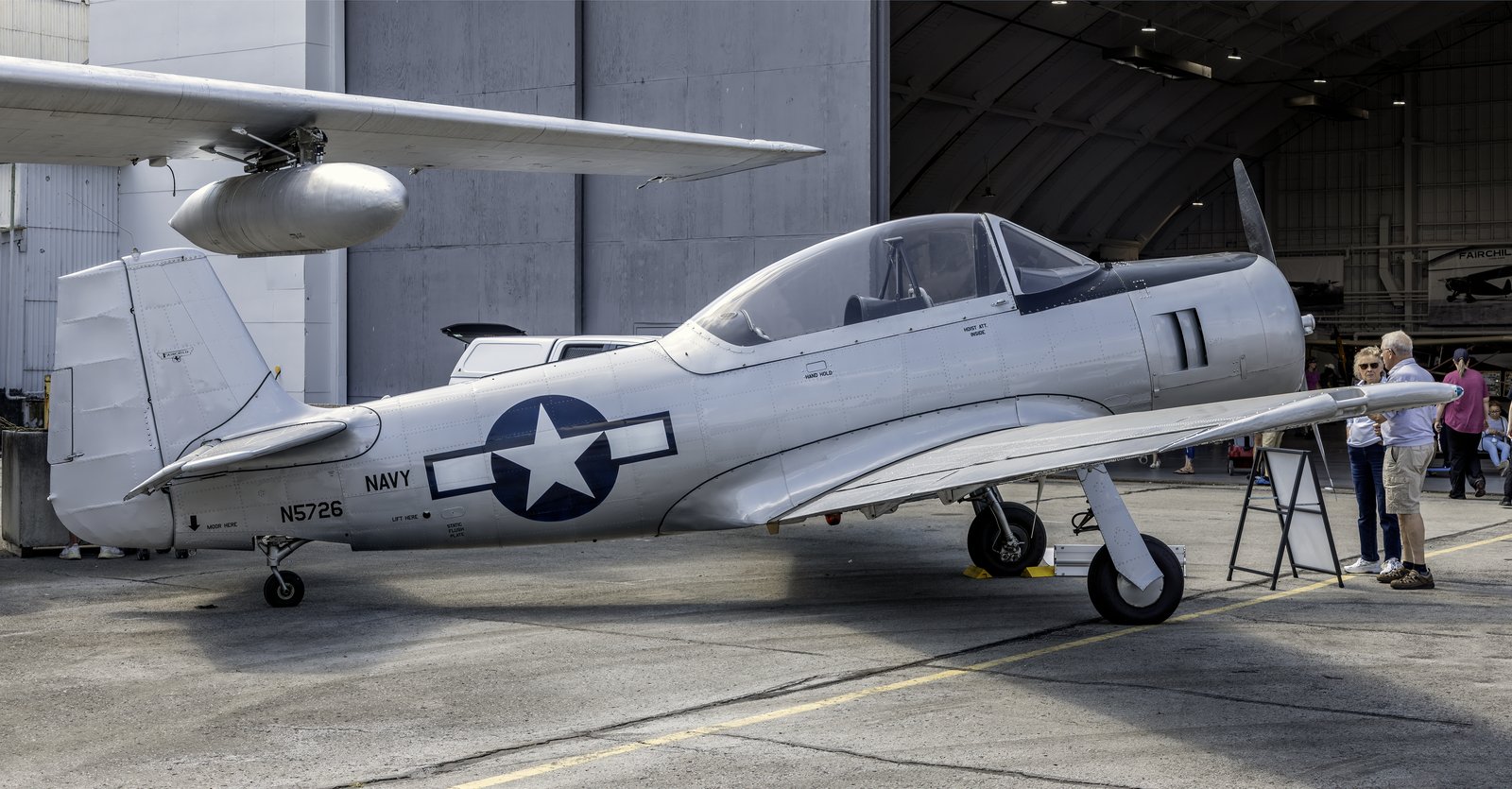
The Fairchild XNQ was developed as a post-war primary trainer intended to replace aging U.S. Navy aircraft such as the Fairchild PT-19, Boeing-Stearman, Vultee BT-13, and North American AT-6 Texan. Designed and built by Fairchild Aircraft at its plant in Hagerstown, Maryland, the XNQ represented an effort to secure trainer contracts for both the U.S. Navy and the U.S. Air Force. Only two airframes were ever completed, identified by U.S. Navy Bureau Numbers (BuNos) 75725 and 75726.
Technically, the XNQ was advanced for its era. It featured all-metal, semi-monocoque construction, though fabric was still used for the rudder, elevators, and ailerons. To improve visibility for the instructor and student, the aircraft utilized a bubble canopy over a tandem two-seat cockpit. Additionally, the XNQ was equipped with electronically retractable landing gear, a significant departure from the fixed-gear configurations common in many World War II primary trainers. The aircraft was powered by a single air-cooled radial piston engine, although specific model and horsepower data were not documented in available records.
Flight testing began in late 1946, with BuNo 75725 making its first flight on October 7, 1946. The second prototype, BuNo 75726, flew from Hagerstown on February 10, 1947. Following these trials, BuNo 75726 was delivered to NAS Anacostia and underwent evaluation at NAS Patuxent River. Despite its modern features, the U.S. Navy rejected the aircraft due to issues with cockpit exhaust gas ingestion. The aircraft was subsequently utilized by the U.S. Naval Test Pilot School.
In 1949, Fairchild modified the design and offered it to the U.S. Air Force as the T-31 (or T-31A) to replace the AT-6 Texan. While the USAF initially placed an order for 100 aircraft, the contract was ultimately cancelled in favor of the Beech T-34 Mentor. Consequently, the XNQ never entered series production. Today, only one airframe survives. After being flown from Texas by pilot Doug Rozendaal, the sole survivor (BuNo 75726) was donated to the Hagerstown Aviation Museum in Maryland.