
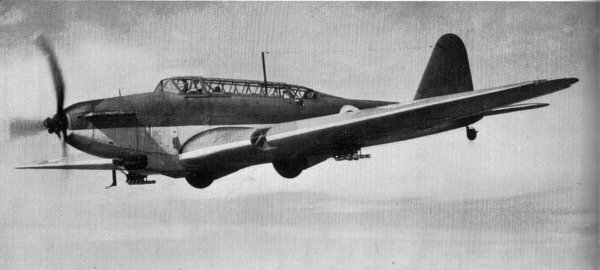
Design and Development
Designed under the leadership of Belgian-born engineer Marcel Lobelle, the Fairey Battle was developed in response to Air Ministry Specification P.27/32 issued in April 1933. The requirement called for a monoplane day bomber capable of delivering a 1,000 lb bomb load over 1,000 miles at a speed of 200 mph to replace the Hawker Hart and Hind biplanes. The resulting aircraft was an all-metal, low-wing monoplane with a stressed-skin layout and an enclosed cockpit for a three-person crew, consisting of a pilot, an observer/bomb-aimer, and a rear gunner. The first prototype flight took place in March 1936.
Production and Manufacturer
The aircraft was produced between 1936 and 1940 by the Fairey Aviation Company Ltd, which had been founded in 1915 by Sir Richard Fairey. Manufacturing was distributed across several sites: Fairey's own plants in Hayes, Middlesex, and Heaton Chapel/Stockport, Cheshire, as well as a shadow factory operated by the Austin Motor Company in Longbridge, Birmingham. A total of 2,185 aircraft were built. The Fairey Aviation Company continued aircraft production until 1960, when it was absorbed by Westland Aircraft.
Technical Specifications
The Battle was powered by a liquid-cooled V-12 piston engine, specifically the Rolls-Royce Merlin. Early production models utilized the Merlin I, while later versions used the Merlin II or III, producing approximately 1,030–1,040 hp. The aircraft reached a maximum speed of roughly 250–260 mph and had a service ceiling of 25,000 ft. Its armament included a fixed forward-firing .303 in Browning machine gun in the starboard wing and a flexible .303 in Vickers K machine gun in the rear cockpit. It typically carried four 250 lb bombs internally, with the capacity for an additional 500 lb on under-wing racks.
Military Service and Legacy
No. 63 Squadron RAF was the first to be equipped with the Battle in June 1937. During the Second World War, the aircraft saw extensive action during the Phoney War and the Battle of France. While Sgt. F. Letchard achieved the RAF's first aerial victory of the war by shooting down a Messerschmitt Bf 109 in a Battle, the type suffered catastrophic losses in May 1940. Between May 10 and 14, 60 out of 118 aircraft were lost during four separate occasions, leading to its withdrawal from front-line bombing roles by the end of 1940.
Following its combat retirement, the Battle served as a trainer, target tug (TT variants), and test-bed. It was used extensively by the Royal Canadian Air Force (RCAF) under the British Commonwealth Air Training Plan, with 739 aircraft sent to Canada starting in August 1939. Other operators included the SAAF, RAAF, RNZAF, and forces from Belgium, Greece, Turkey, and Poland in exile. Today, very few examples survive; one notable survivor is a Fairey Battle IT (serial R7384) preserved at the Canada Aviation and Space Museum.