
Design and Development
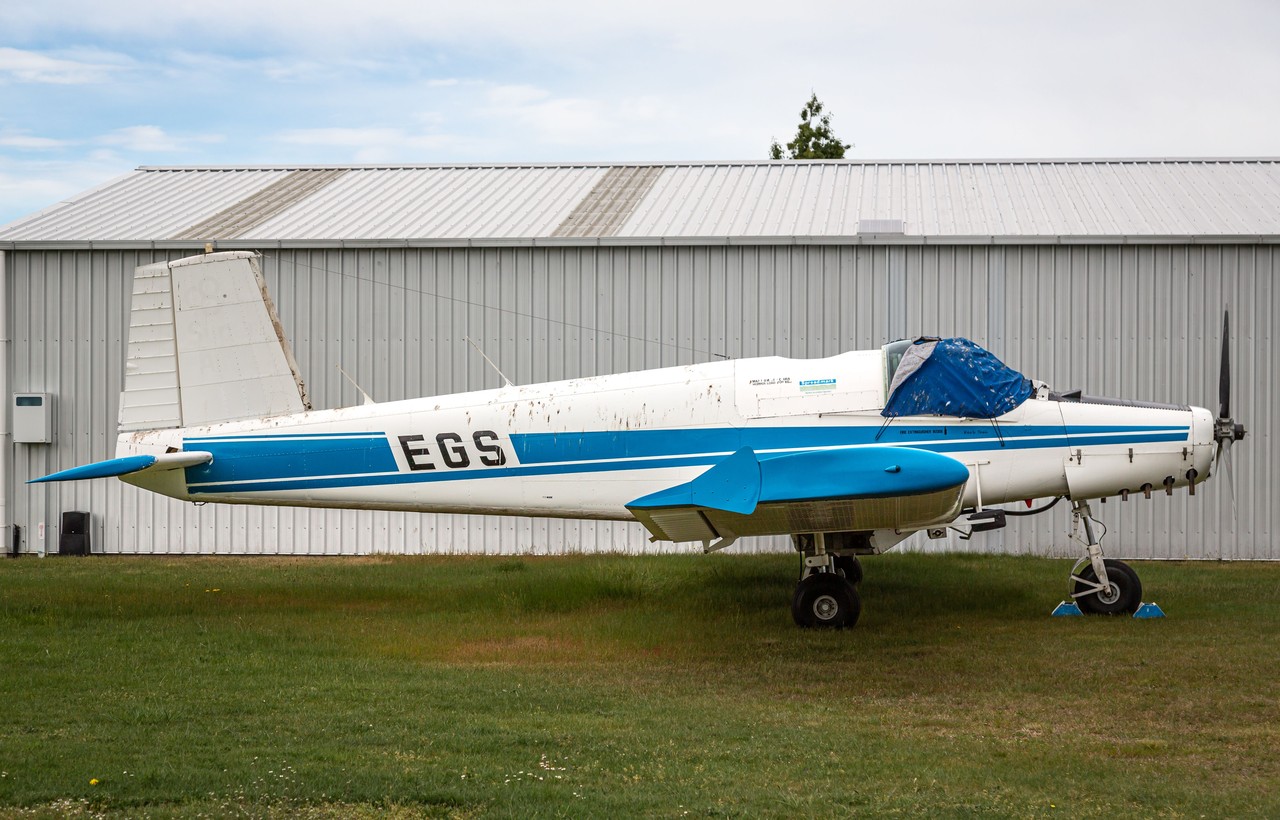
John Thorp conceived the FU-24 design in the early 1950s as a specialized utility aircraft for Fletcher Aircraft Corporation in El Monte, California. Originally designated the Thorp T15, the aircraft addressed a specific need for efficient aerial application of fertilizers across New Zealand's rugged landscape. The prototype, registered N6505C and later ZK-BDS with construction number 1, featured an open cockpit and 225-horsepower Continental engine when it first took to the skies on June 14, 1954.
Following initial flight testing in the United States, the prototype was shipped to New Zealand where pre-production modifications included an enclosed cockpit and more powerful Continental engines ranging from 260 to 310 horsepower. These changes transformed the aircraft into a practical working platform capable of operating in New Zealand's demanding agricultural environment.
Production History
The FU-24 entered commercial production in 1955 following type certification trials, with Fletcher Aircraft Corporation initially manufacturing complete aircraft in California. However, the American company assembled only four complete examples - the prototype plus serial numbers 007, 089, and 102 - before ceasing direct involvement around 1965.
Recognizing the aircraft's potential in New Zealand's agricultural market, local companies began kit assembly operations. James Aviation at Hamilton Airport and Tasman Empire Airways Limited's Mechanics Bay factory initially assembled imported components. In 1961, Air Parts (NZ) Ltd established full manufacturing capabilities in Hamilton, taking over complete production responsibilities.
The manufacturing rights changed hands again in 1965 when Air Parts purchased worldwide production rights. The company later became part of Aircraft Engineering & Services Ltd (AESL) before evolving into Pacific Aerospace Corporation. Production continued sporadically through the decades, with the final batch of five aircraft delivered to Syria in May 1992. Total factory production reached approximately 300 aircraft across serial number ranges 001-297, 2001, and 3001-3003, plus an additional ten aircraft assembled from spare parts by various New Zealand companies.
Engine Evolution
Early FU-24 variants utilized several Continental engine options, including the IO-470-D producing 260 horsepower, the O-470-E generating 225 horsepower, and the more powerful IO-520A and IO-520F models delivering 285 and 300 horsepower respectively. These reliable piston engines proved well-suited to agricultural operations, with the prototype aircraft demonstrating exceptional durability by accumulating 9,480 flight hours, 141,000 takeoffs and landings, and spreading 100,000 tonnes of fertilizer by 1978.
In 1970, the introduction of the FU-24-950 variant marked a significant power increase with the adoption of the Lycoming IO-720 eight-cylinder engine. This powerplant, available in IO-720-A1A or A1B configurations, produced 400 horsepower and enabled the aircraft to carry heavier loads while maintaining its renowned short-field performance. Many earlier 300-horsepower models were subsequently converted to the more powerful Lycoming installation.
Operational Service
The FU-24 found its primary role in agricultural topdressing operations, where its exceptional short takeoff and landing capabilities proved invaluable for accessing remote farm airstrips. New Zealand operators including Wanganui Aerowork, Robertson Air Service Ltd, James Aviation Ltd, and Advance Aviation Ltd utilized the type extensively throughout the country's farming regions.
The aircraft's reputation for reliability and performance led to international sales, with 29 examples registered in Australia by operators such as Airland in Cootamundra, New South Wales, and Pays Aerial Services in Scone. Export customers included Uruguay, which received serial number 089 in 1963, Iraq with 10 aircraft by 1980, Pakistan operating 18 units by the same year, Thailand acquiring five post-954 models, and Syria taking delivery of the final five production aircraft.
The FU-24's design emphasized agricultural efficiency over passenger transport, featuring a large rear hopper door in later models like the FU-24-954 for rapid chemical loading. Most aircraft operated with a single pilot, though dual-control FU-24A and Mark II variants provided training capabilities with accommodation for two crew members.
Performance and Legacy
The FU-24's short-field performance capabilities included a maximum climb rate of 280 meters per minute at sea level, enabling operations from unprepared strips in challenging terrain. This performance characteristic, combined with its robust construction and reliable powerplants, established the aircraft as the backbone of New Zealand's aerial agriculture industry during the crucial expansion period of the 1950s and 1960s.
Today, over 300 FU-24 aircraft remain in service worldwide, many modified with engines producing 400 or more horsepower. Recent modernization efforts have included retrofits with the RED A03-003 diesel engine producing 500 horsepower, developed through collaboration between RED Aircraft of Germany and Diesel Air New Zealand Ltd. The type represents the most successful aircraft produced by Pacific Aerospace and its predecessor companies, with production capabilities maintained for ongoing support and modifications.
The prototype aircraft, ZK-BDS, stands as a testament to the design's durability and continues to represent the FU-24's significant contribution to New Zealand aviation history. The aircraft's cultural impact extends beyond mere statistics, having fundamentally transformed agricultural practices across New Zealand by making aerial application economically viable in previously inaccessible terrain.