
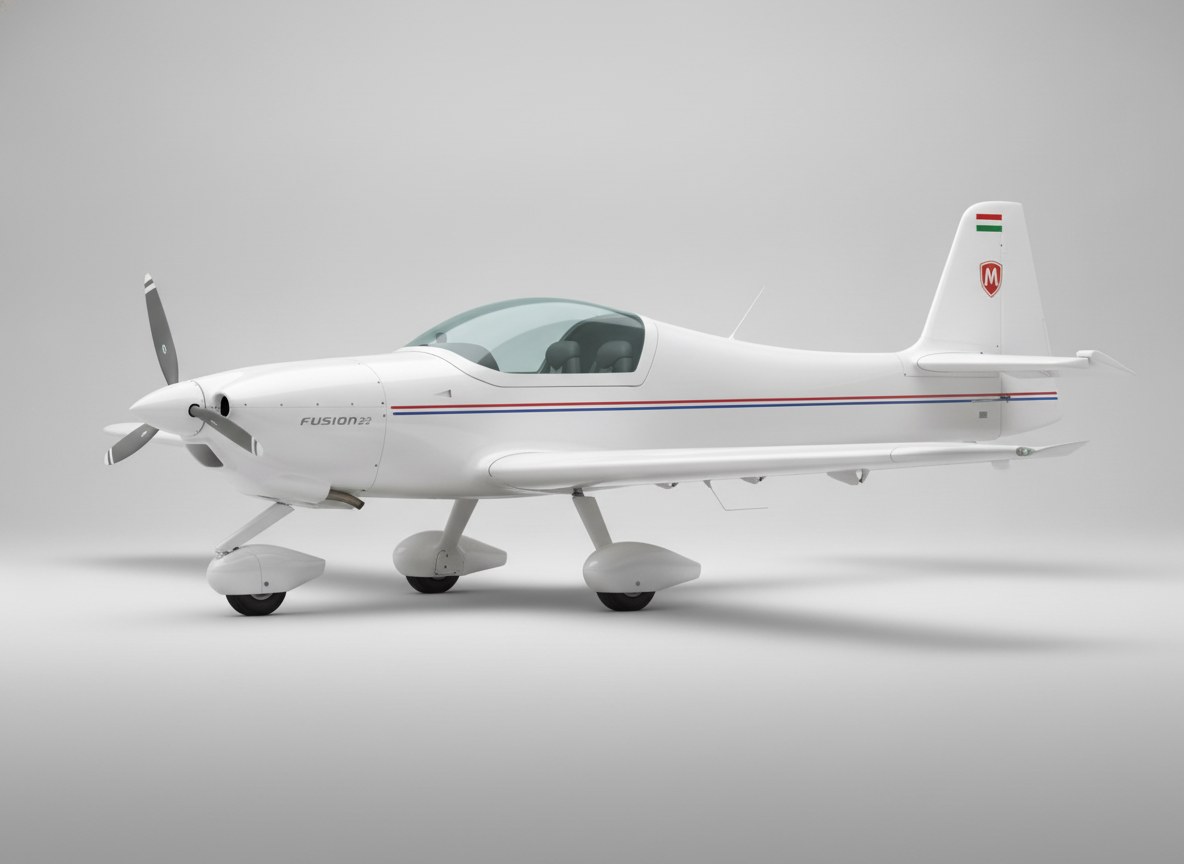
The Magnus MG-11 Fusion (ICAO type code FUSI) is a modern, two-seat light sport and ultralight aircraft produced by the Hungarian manufacturer Magnus Aircraft Zrt. The aircraft's design is derived from the earlier Corvus Fusion, originally developed by Corvus Aircraft in the Czech Republic. Following organizational difficulties at Corvus, the production and development were transitioned through several companies before being adopted by Magnus Aircraft Zrt., which was established in 2011. Magnus began operations in Kecskemét, Hungary, in 2014, and later relocated its primary manufacturing base to Pécs-Pogány Airport (LHPP).
Designed by the engineering team at Magnus Aircraft under the leadership of company founder Gábor Tarány, the Fusion is notable for its advanced carbon-composite structure utilizing a PVC foam core. This construction allows the aircraft to maintain a low mass of 410 kg in its ultralight configuration while offering structural integrity comparable to heavier aircraft in the 750 kg category. Engineered to aerobatic standards, the airframe is capable of withstanding structural load limits of +6 to −3 G, a feature uncommon for aircraft in the light sport category.
Technical specifications for the Fusion 212 variant include a wingspan of 8.44 meters and a length of 6.62 meters. It is typically powered by a 100 hp (75 kW) Rotax 912 ULS 2 four-cylinder, horizontally-opposed, liquid and air-cooled piston engine. Alternative powerplants, such as the Power 260, are also compatible. The aircraft is capable of reaching a maximum speed of 241 km/h and a cruise speed of 215 km/h, with a maximum range of 1,100 km. For safety, the airframe can be equipped with a ballistic recovery system, such as the Junkers Magnum series.
In civil service, the Fusion is marketed as a special light sport aircraft (SLSA) for recreational flying and flight training. Magnus has expanded its utility roles to include agricultural operations, wildlife management, and aerial surveillance via the "Sentinel" edition. In military application, the Nigerian Air Force ordered 20 composite-bodied Fusion aircraft to support counter-insurgency operations against Boko Haram. These aircraft serve in two primary roles: as two-seat pilot trainers and as reconnaissance and mapping platforms equipped with advanced camera systems.
Production remains active as of 2023, with Magnus Aircraft Zrt. expanding its capacity at Pécs. While total production numbers are not fully disclosed, the company reported selling more than 20 Fusion 212 aircraft by July 2018, with a production rate of approximately two aircraft per month at that time.