
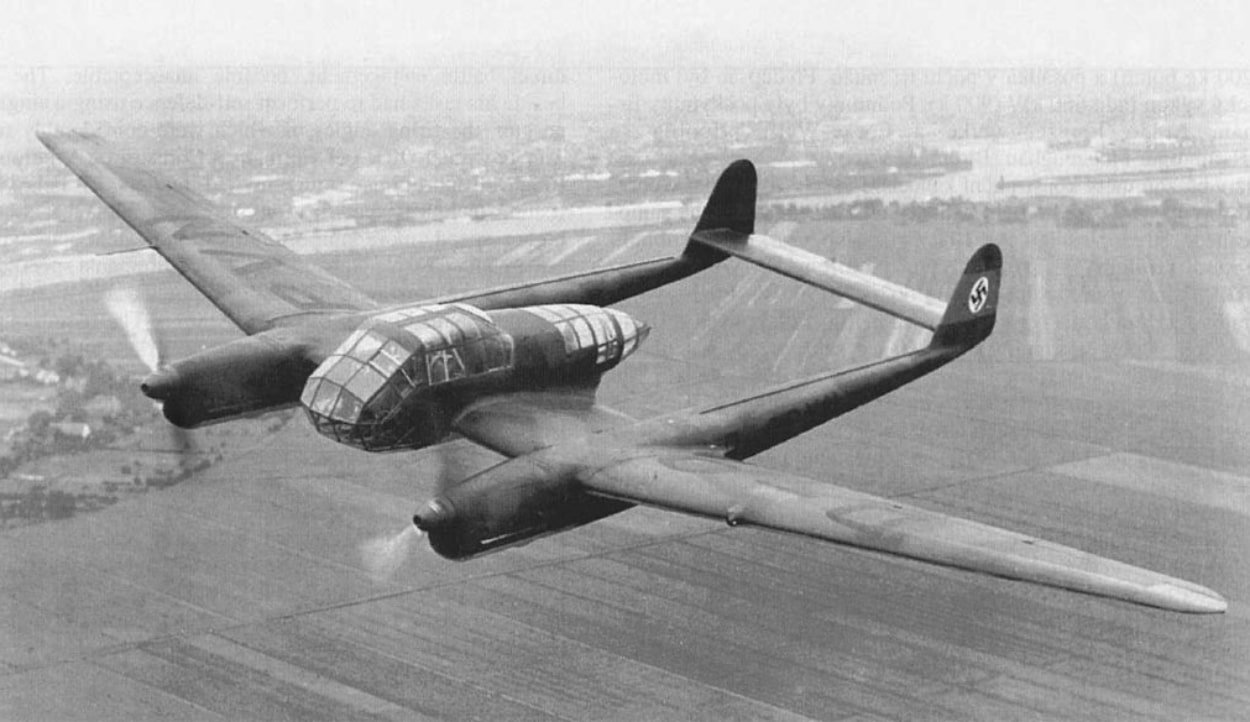
The Focke-Wulf Fw 189 Uhu was developed in the late 1930s to meet a Reichsluftfahrtministerium (RLM) requirement for a new short-range reconnaissance aircraft. Designed under the leadership of Focke-Wulf's chief designer, Kurt Tank, the aircraft featured a distinctive twin-boom layout with a central, three-seat glazed gondola. This configuration provided the crew—consisting of a pilot, observer/navigator, and rear gunner—with outstanding all-round visibility, earning the aircraft the nickname "Fliegendes Auge" (Flying Eye). The prototype first flew in 1938, and serial production commenced in the spring of 1940 with the Fw 189A-0 pre-series aircraft.
Production was distributed across three primary facilities: the Focke-Wulf factory in Bremen, Germany; the Bordeaux-Mérignac factory in occupied France; and the Aero Vodochody factory in Prague. Approximately 864 aircraft were completed between 1940 and mid-1944, at which point production was terminated to prioritize the manufacture of fighter aircraft. The Fw 189 was powered by two Argus As 410 A-1 inverted-V 12-cylinder air-cooled piston engines, each producing roughly 465 PS (459 hp) for takeoff, driving two-bladed variable-pitch propellers.
While the Luftwaffe began training on the type in early 1940, it was introduced gradually and did not reach large operational numbers until the summer of 1942. By September 1942, 172 aircraft were operational on the Eastern Front, where they became the primary short-range reconnaissance assets for German forces. Beyond its primary role in army co-operation and artillery spotting, the Uhu served as a light bomber—carrying up to four 50 kg bombs—and was even adapted as a night fighter to intercept Soviet Polikarpov Po-2 bombers. Other operators included the air forces of Bulgaria, Hungary, Romania, and Slovakia, with captured examples later used by the Royal Norwegian Air Force.
Technically, the Fw 189A-1 reached a maximum speed of 344 km/h at 2,500 meters and had a service ceiling of 7,000 meters. Its armament typically included two fixed 7.92 mm MG 17 machine guns in the wing roots and a 7.92 mm MG 15 (or MG 81) in a dorsal position. Today, surviving airframes are extremely rare; however, one example built by Aero in Prague in early 1941 has been restored to an airworthy condition.