
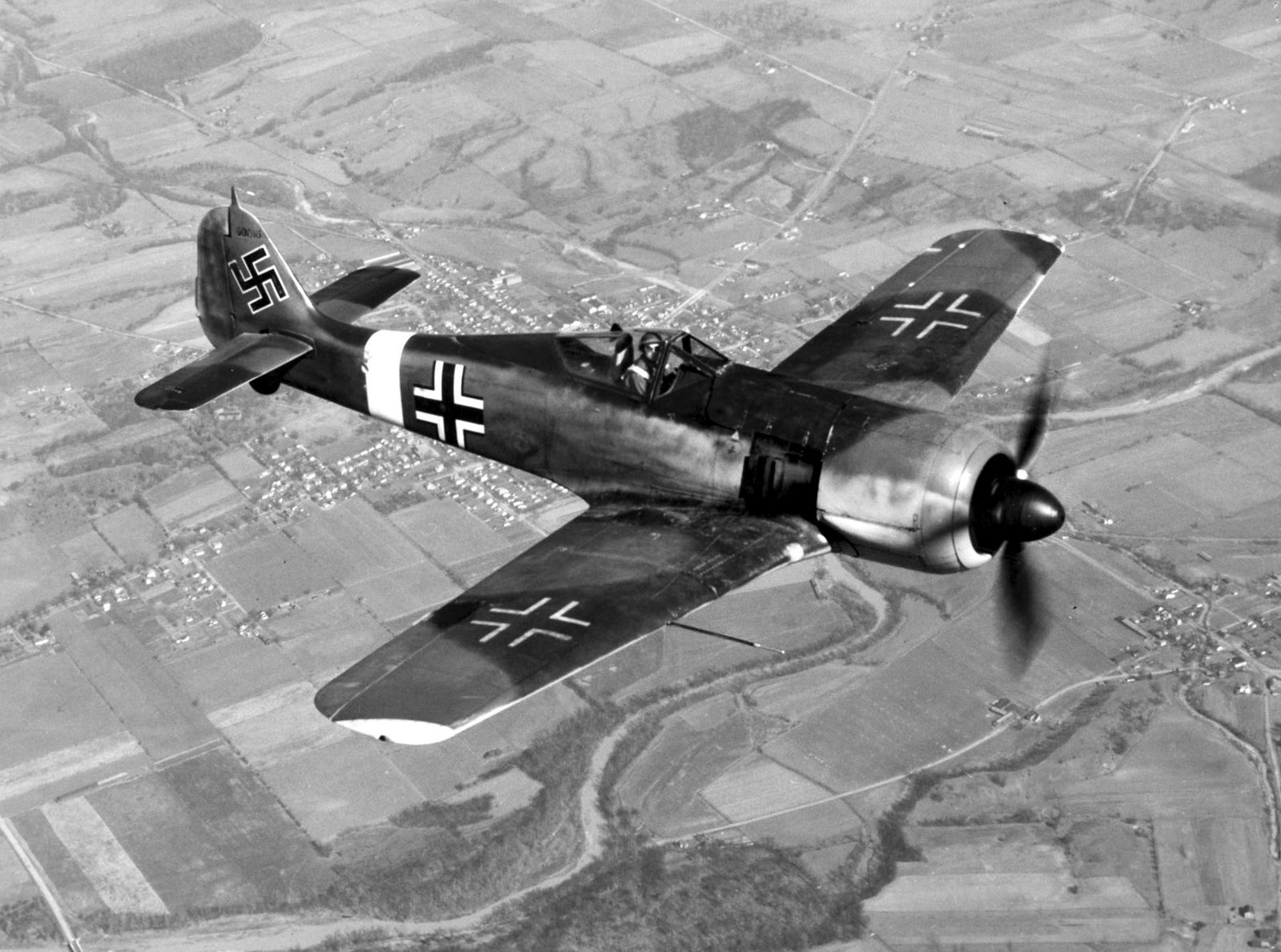
Designed by Kurt Tank at Focke-Wulf Flugzeugbau in the late 1930s, the Fw 190 was conceived as a robust alternative to the Bf 109. The aircraft first flew in 1939 and entered operational service in August 1941. A defining characteristic of Tank's design was the selection of a radial piston engine at a time when liquid-cooled inline engines were the industry standard for European fighters. This choice contributed to the aircraft's durability and high performance at low and medium altitudes.
Production ran from 1941 to 1945, with total numbers estimated between 20,000 and 20,500 aircraft, though some sources suggest a figure as high as 23,823. Manufacturing was dispersed across several German plants, including Focke-Wulf's main facilities in Bremen, Norddeutsche Dornier-Werke, and Oschersleben. The aircraft's versatility allowed it to serve in nearly every combat capacity, including air superiority, night fighting, and as a fighter-bomber. The 'F' variant was specifically developed for ground-attack missions, while the 'Sturmböcke' were specialized bomber destroyers equipped with heavy-caliber cannons and underwing rockets.
Operationally, the Fw 190 served on all major German fronts. Upon its introduction over France in August 1941, it proved superior to the Spitfire Mk V in most respects except for turn radius. It made its Eastern Front debut in late 1942 and was later utilized by specialized ground-attack wings known as Schlachtgeschwader starting in October 1943. Notable operations included the 1942 Dieppe Raid and Operation Bodenplatte on January 1, 1945. In the latter, Leutnant Theo Nibel of 10./JG 54 flew a Fw 190D-9 that became the first intact example of that variant captured by Allied forces after a bird strike forced a belly landing.
Technical specifications varied by model, but a representative configuration features a length of 29 ft 4 in and a wingspan of 32 ft 6.5 in. While original wartime engines were radial piston types, a surviving example at the Military Aviation Museum utilizes a 1,900 hp Shvetsov ASh-82FN 14-cylinder radial engine, achieving a maximum speed of 408 mph and a service ceiling of 37,400 ft. Today, the Fw 190 is remembered as one of the finest fighters of the era, with original airframes preserved at institutions such as the American Heritage Museum and the Tri-State Warbird Museum.