
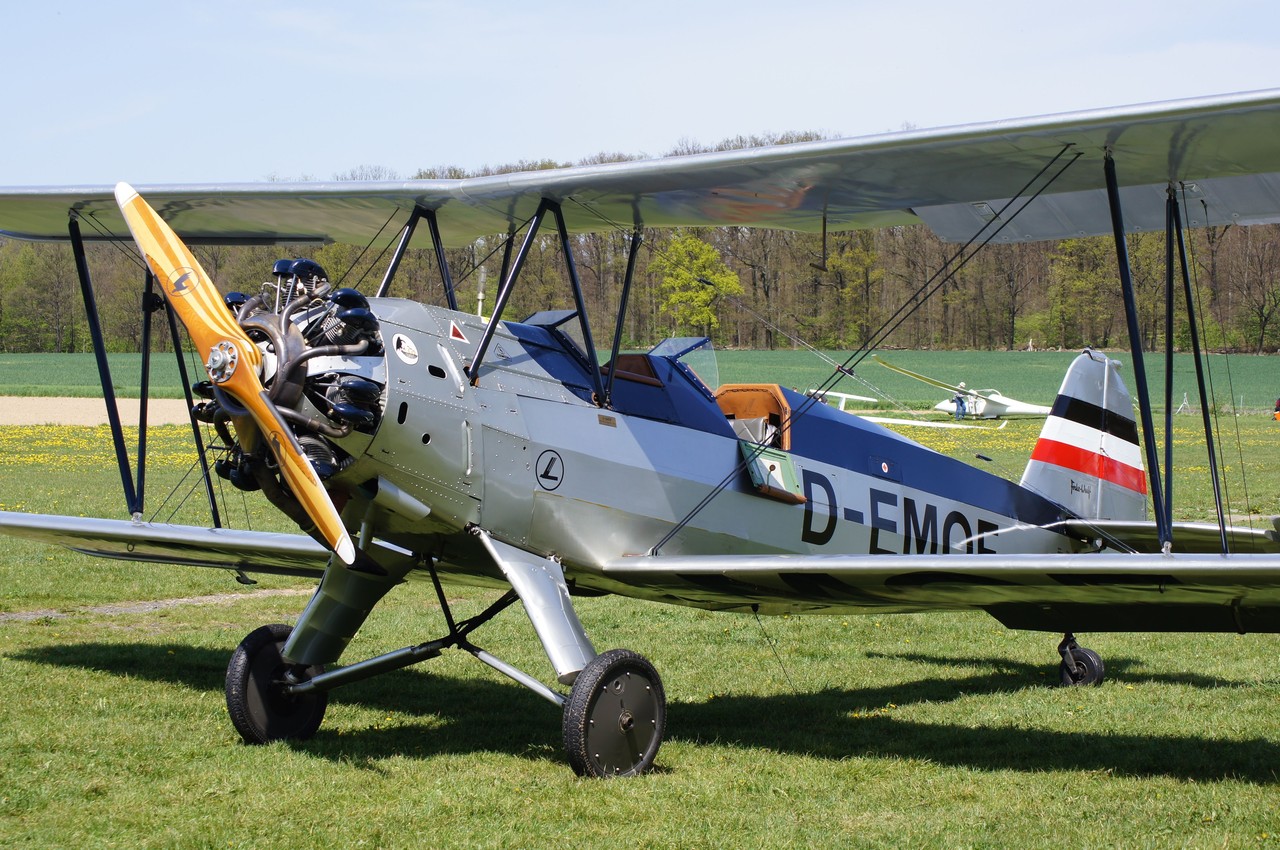
Service History
The Fw 44 Stieglitz dominated German pilot training throughout the critical pre-war and wartime periods. By May 30, 1940, the Luftwaffe operated 1,385 Fw 44s across its training establishment, equipping all 50 A/B Schulen (primary flying schools) by 1939. The aircraft's excellent spin recovery characteristics and forgiving handling made it ideal for converting civilian pilots into military aviators during Germany's rapid rearmament.
In competitive evaluations against the Heinkel He 72, the Fw 44 proved superior, earning 1,588 orders compared to just 768 for its rival by late 1938. This success stemmed from the Stieglitz's superior aerobatic capabilities and more predictable stall characteristics, essential qualities for primary training aircraft.
International Operations
The Fw 44's influence extended far beyond Germany through extensive export programs. Sweden operated 85 aircraft designated Sk 12, manufacturing 57 locally at CVV workshops in Västerås from 1939, with the type serving until 1963. Finland received 30 Fw 44Js between May and August 1940, using them throughout World War II.
Argentina became the largest foreign operator, with Fábrica Militar de Aviones assembling 213 Fw 44Js from German-supplied components starting in 1937. The final 23 Argentine aircraft rolled off the production line around 1950, making Argentina the last nation to manufacture the Stieglitz. Additional export customers included Brazil, Bolivia, Chile, China, Czechoslovakia, Romania, and Switzerland.
The Manufacturer
Focke-Wulf Flugzeugbau AG emerged from humble beginnings in 1923 when Heinrich Focke and Georg Wulf established their company in Bremen. The Fw 44's commercial success transformed the small firm into a major aircraft manufacturer, necessitating the construction of a second factory to meet demand. This expansion positioned Focke-Wulf to develop more advanced designs, including Kurt Tank's legendary Fw 190 fighter.
The Nazi government nationalized the company in 1938, restructuring it as Focke-Wulf Flugzeugbau GmbH. Wartime consolidation eventually absorbed the firm into larger state-controlled entities, ending its independent existence by 1945. Post-war remnants reorganized as Weserflug and other successor companies, with some activities eventually becoming part of modern Airbus through the Deutsche Airbus lineage.
Design and Development
Chief designer Kurt Tank, who joined Focke-Wulf in 1931, led the Fw 44's development team, though the basic biplane configuration drew from earlier design influences. The team prioritized affordability and training effectiveness, creating an equal-span staggered biplane with exceptional stability and spin recovery characteristics.
The aircraft featured a welded steel-tube fuselage covered in fabric, with the pilot and instructor seated in tandem cockpits. This robust construction proved ideal for the rigors of training operations, while the staggered wing arrangement provided excellent visibility and predictable handling characteristics essential for novice pilots.
Engine and Performance
The definitive Fw 44C and Fw 44J variants utilized the Siemens-Halske Sh 14, a seven-cylinder radial engine producing 150 horsepower. This air-cooled powerplant proved exceptionally reliable in training service, requiring minimal maintenance while providing adequate performance for aerobatic maneuvers.
Earlier Fw 44B and Fw 44E variants employed the Argus As 8, a four-cylinder inverted inline engine generating 120 horsepower. While less powerful, the Argus installation offered a slimmer nose profile that improved aerodynamics and forward visibility. The aircraft achieved a maximum speed of approximately 185 kilometers per hour, optimized for training rather than outright performance.
Production Legacy
Total Fw 44 production reached an estimated 2,000 to 3,000 aircraft, making it one of the most numerous training aircraft of its era. Focke-Wulf's Bremen factory produced 867 examples by March 1938, while subcontractors contributed significantly to overall output. Klemm (later Siebel) in Halle built 515 aircraft, AGO in Oschersleben manufactured 121, Bücker in Berlin produced 85, and ČKD in occupied Prague assembled 81 Fw 44Js between November 1939 and June 1940.
This distributed production system enabled rapid expansion of training capacity while providing valuable manufacturing experience to German industry. The licensing agreements with Sweden and Argentina demonstrated the design's international appeal and technical maturity.
Current Status
Approximately 20 Fw 44s remain airworthy as of 2021, representing various production sources. Three Focke-Wulf-built examples still fly, along with eight Swedish-manufactured aircraft, three Argentine machines, and six Czech-built examples originally delivered to Finland. Notable survivors include D-EQAX, a 1936 German-built aircraft owned by Claus Cordes at Hungriger Wolf airfield in Itzehoe, and Swedish-registered SE-BWM from 1939.
These surviving aircraft serve as flying reminders of an era when Germany rebuilt its air power from virtually nothing, with the humble Stieglitz training the pilots who would later fly in history's largest air war.