
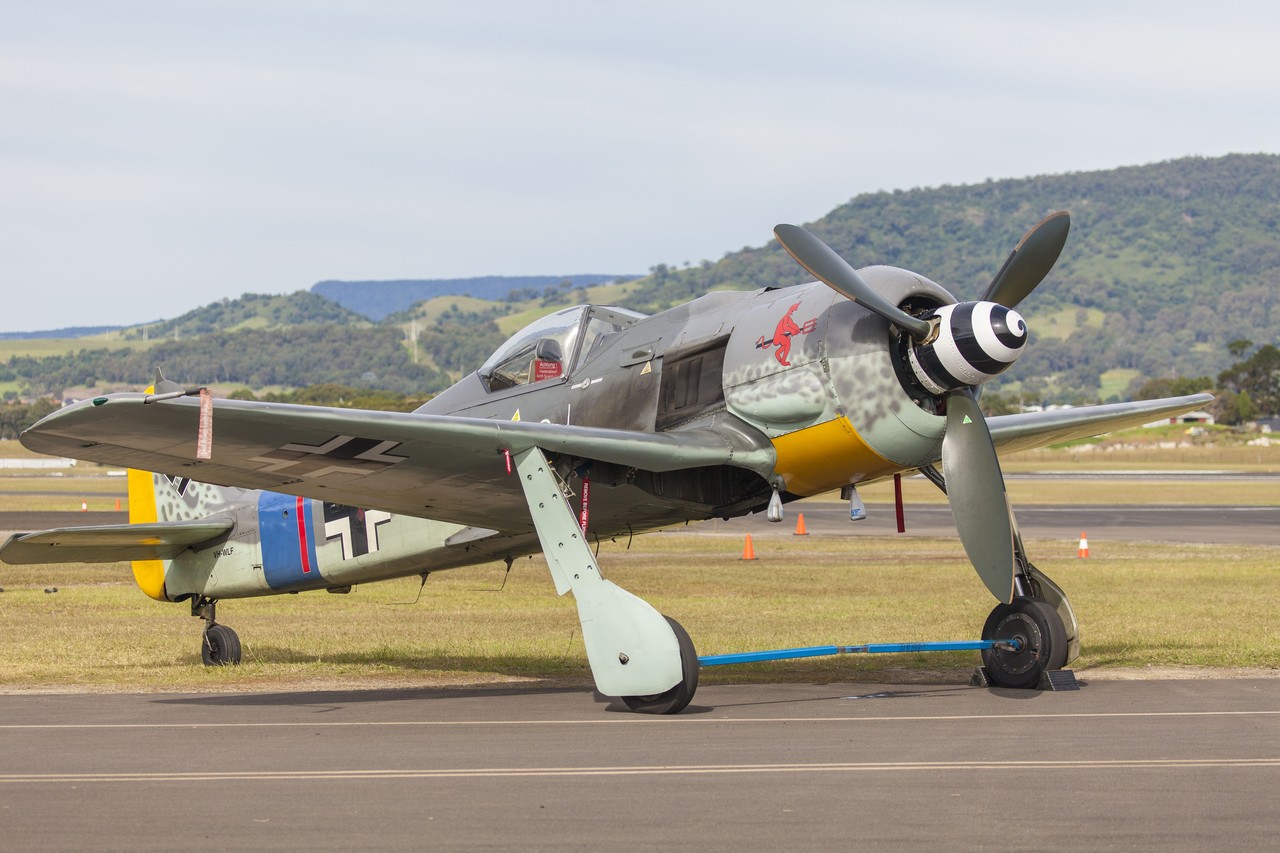
Combat Legacy and Original Service
The original Fw 190 established itself as the German Luftwaffe's premier fighter-bomber from 1943 to 1945, with approximately 20,000 aircraft produced across six major manufacturing facilities. German pilots considered the Fw 190D variant superior to the P-51D Mustang, capable of reaching 692 kilometers per hour at 11,300 meters altitude. The aircraft's combat effectiveness came at a cost—Fighter Group JG-2 alone suffered 40 percent losses with 250 fighters destroyed during the war.
Leutnant Rudi Linz of JG5 exemplified the aircraft's operational history, scoring his 70th aerial victory in a Fw 190 before being shot down and killed on February 9, 1945, during combat with RAF Mustangs and Beaufighters. By April 1945, fuel shortages had become so severe that when JG-6 received 150 D-9 variants, only four aircraft could fly simultaneously.
Design Innovation and Technical Excellence
Kurt Tank led the original design effort under a contract issued to Focke-Wulf in fall 1937. The company submitted designs for both air-cooled radial and liquid-cooled inline engines before receiving approval for the radial configuration in mid-1938. This decision proved prescient—the Fw 190 became the only completely successful piston-engine fighter introduced by the German Luftwaffe after World War II began.
The production variants featured two distinct engine configurations. The early Fw 190A series used the air-cooled BMW 801-series radial engine, while the superior Fw 190D variant employed the liquid-cooled Junkers Jumo 213A 12-cylinder inline engine. This powerplant generated 1,776 horsepower, boosted to 2,240 horsepower with water-methanol injection—previously exclusive to bomber aircraft.
Modern Reproduction Program
Flug Werk GmbH has undertaken the most comprehensive Fw 190 reproduction program, constructing 21 replica aircraft configured as both Fw 190A-8 and the "long-nosed" Fw 190D-9 "Dora" variants. These modern reproductions utilize period-appropriate construction techniques while incorporating contemporary safety improvements, including the Shvetsov ASh-82FN fourteen-cylinder radial engine producing 1,900 horsepower.
The replica specifications closely match original performance parameters: cruising speed of 298 mph, maximum speed of 408 mph, and service ceiling of 37,400 feet. With an empty weight of 7,055 pounds and loaded weight of 10,800 pounds, these reproductions maintain the original's distinctive flight characteristics while providing modern reliability.
Manufacturing Heritage
Focke-Wulf Flugzeugbau AG originally operated from Bremen, Germany, throughout World War II before ceasing operations in 1945. The original production network included facilities at Marienburg, Marz, Cottbus, Kassel-Waldau, Oschersleben, and Bernburg, collectively producing variants ranging from 13,250 fighters to 6,250 fighter-bomber versions, though some sources indicate total production reached 23,823 aircraft.
The original Fw 190D-9 carried formidable armament: two 20mm Mauser MG-151/20 cannon in the wings with 250 rounds per gun, plus two 13mm Rheinmetall MG-131 cannon mounted above the engine with 475 rounds per gun. This firepower made it exceptionally effective against both air and ground targets.
Museum Preservation and Educational Value
The National Air and Space Museum in Washington, D.C., houses an original Fw 190 D-9 (factory number 601088) that underwent flight testing by the USAAF Air Materiel Command at Wright Field in 1946. This aircraft has remained on loan to the U.S. Air Force Museum at Wright-Patterson AFB since 1975, serving as a primary reference for modern reconstruction efforts.
The Military Aviation Museum maintains Flug Werk-built replicas in flying condition, allowing contemporary audiences to experience the aircraft's performance characteristics firsthand. These reproductions serve crucial educational purposes, preserving not only the physical design but also the flying qualities that made the Fw 190 one of Germany's two most recognizable piston-engine fighters alongside the Messerschmitt Bf 109.
The replica program ensures that future generations can study and appreciate the engineering excellence that characterized this pivotal World War II fighter, maintaining both historical accuracy and operational capability for demonstration purposes.