
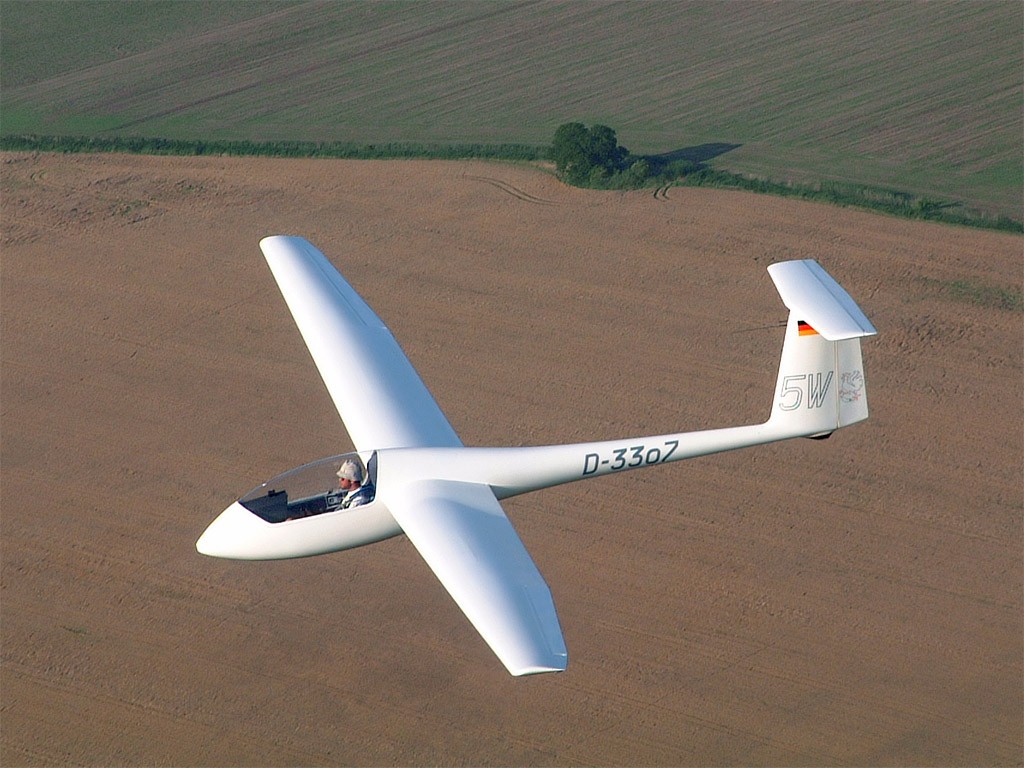
Revolutionary Club Glider Design
The G 102 Astir CS emerged from Burkhart Grob's vision to democratize high-performance gliding. In the early 1970s, composite sailplanes remained expensive and primarily served competition pilots, while most club operations relied on aging wooden designs. Grob recognized an opportunity to bridge this gap by creating an affordable fiberglass glider that would deliver modern performance without the premium pricing that kept clubs flying outdated equipment.
Design work began in 1973 under Burkhart Grob's direct leadership at his German facility. The team prioritized ease of handling over outright performance, recognizing that club pilots needed forgiving flight characteristics more than razor-sharp competition capabilities. The resulting aircraft featured an unusually roomy cockpit for extended comfort during long soaring flights, wing-mounted water ballast tanks for performance optimization, and a distinctive T-tail configuration that improved control authority at low speeds.
Production Success and Variants
Production commenced in July 1975, with the original Astir CS remaining in manufacture through 1977. The initial success prompted rapid development of improved variants, including the CS77 introduced in 1977 with refinements based on operational feedback. Grob continued evolving the design throughout the early 1980s, producing the Standard II and III variants that incorporated progressive improvements in construction techniques and aerodynamic efficiency.
The CS Jeans variant, launched during this period, targeted budget-conscious buyers with simplified construction and fixed landing gear, earning 248 sales by eliminating retractable mechanisms that added cost and maintenance complexity. This approach proved prescient, as many club operations preferred the reliability and lower operating costs over the modest performance penalty.
Total production reached 1,241 aircraft across all variants: 536 original Astir CS models, 244 CS77 variants, 248 CS Jeans, 61 Club/Standard Astir II aircraft, and 152 Club/Standard Astir III gliders. These numbers excluded the related G104 Speed Astir, which featured flaps and targeted more performance-oriented applications.
Technical Innovation
The Astir CS incorporated several design innovations that influenced subsequent glider development. Its composite construction utilized fiberglass and resin throughout the primary structure, delivering durability advantages over traditional wood and fabric designs while maintaining reasonable manufacturing costs. The large wing area provided exceptional low-speed handling, with a stall speed of just 59 km/h without airbrakes deployed.
Performance specifications reflected the design priorities, with a maximum maneuvering and aerotow speed of 170 km/h balanced against a conservative never-exceed speed of 250 km/h. These figures emphasized safety margins over absolute performance, acknowledging the aircraft's intended role in training and recreational applications where pilot experience levels varied widely.
An unusual feature was the tail dolly system, which fitted into a vertical hole and detached automatically during takeoff. This innovation simplified ground handling while eliminating the weight and complexity of conventional tail wheel arrangements.
Record-Breaking Achievement
Despite its club-oriented design philosophy, the Astir family achieved remarkable altitude performance. On February 17, 1986, Robert Harris piloted a Standard Astir III to 49,009 feet, establishing a world absolute altitude record for gliders that stood until 2006. This achievement demonstrated that the design's fundamental aerodynamics could support extreme performance applications when operated by skilled pilots in appropriate conditions.
The record-setting aircraft now resides in the Steven F. Udvar-Hazy Center of the National Air and Space Museum, serving as a permanent testament to the type's capabilities and historical significance in soaring achievements.
Global Operations and Legacy
Astir variants found homes with gliding clubs and private owners across multiple continents, with registrations appearing in FAA records (such as N102GB), British Gliding Association logs, and Australian aviation databases. The type's international success validated Grob's market assessment and established the company's reputation for practical, well-engineered designs.
The manufacturer, originally known as Burkhart Grob Flugzeugbau, evolved into Grob Aircraft AG and continues operations today, though current focus has shifted toward powered aircraft including the G120TP trainer. The Astir represented the company's first original sailplane design after licensing the Schempp-Hirth Standard Cirrus, establishing their independent design capabilities.
Many examples remain active in contemporary operations, with at least one US-registered aircraft maintaining valid certification through 2029. The type's durability and continued airworthiness after nearly five decades demonstrate the soundness of its original engineering and construction quality, ensuring that Burkhart Grob's vision of accessible high-performance soaring continues serving pilots worldwide.