
Revolutionary Composite Construction
The G-115 A represented a watershed moment in aviation manufacturing, becoming the world's first production trainer to receive full certification using advanced composite materials. When Grob Aircraft achieved FAA certification in 1987, the design validated composite construction for the demanding aerobatic training environment, proving that glass fiber reinforced plastics could withstand the stresses of repeated inverted flight and high-G maneuvers.
Development built upon Grob's earlier trainer concepts, following the limited-production G-110 that first flew in 1982 and the G-112 prototype of 1984. The G-115 incorporated lessons learned from these predecessors while introducing innovative manufacturing techniques including single-piece fuselage construction and integrated wing spars that eliminated traditional metal joints.
Production and Variants
Production commenced following the prototype's maiden flight in November 1985, with both G-115 and G-115A variants manufactured at Grob's German facilities until 1990. During this initial production run, approximately 110 aircraft rolled off the assembly line before manufacturing temporarily ceased. Production resumed in late 1992 with improved models, though the original G-115A line concluded in late 1993 as focus shifted to enhanced variants.
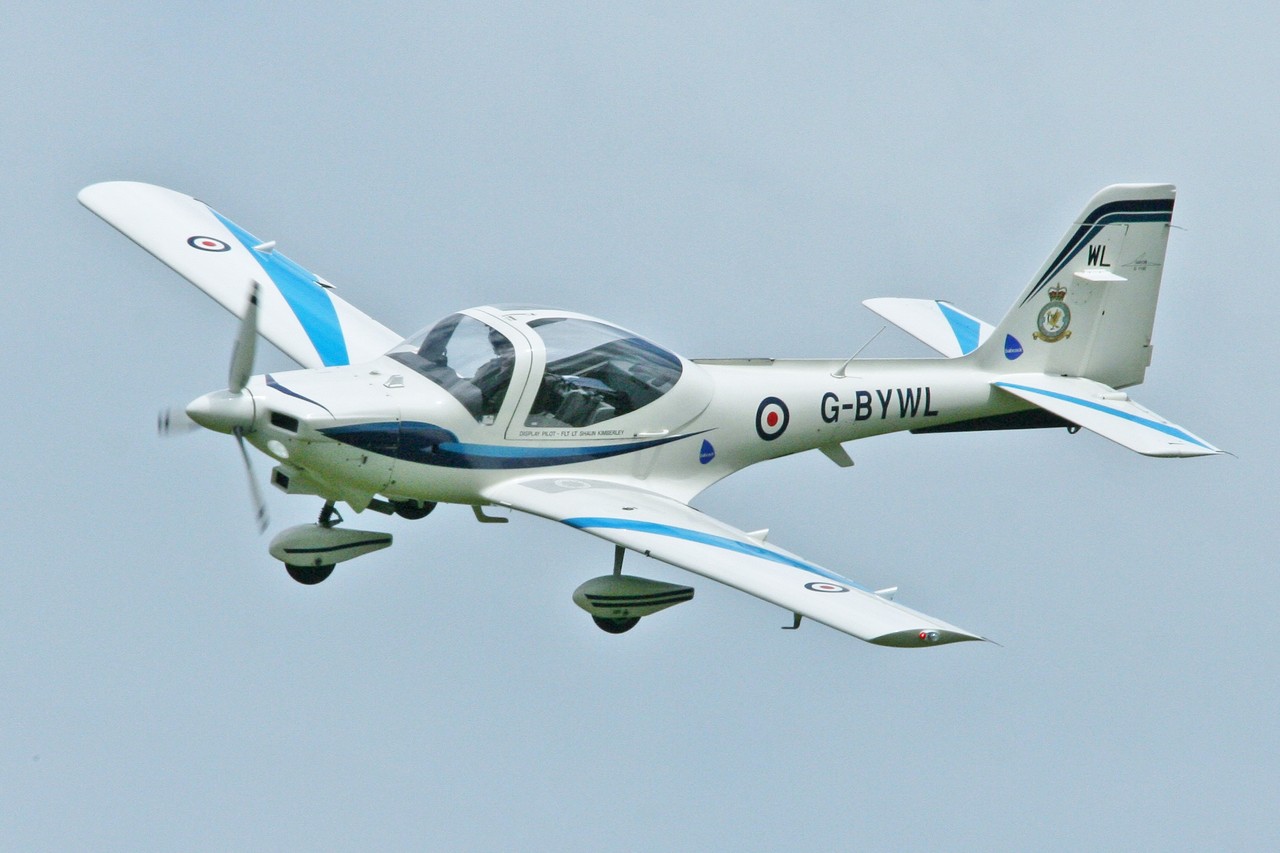
The aircraft featured a fixed tricycle undercarriage with distinctive spat-covered wheels, tapered wings optimized for aerobatic performance, and a notably wide canopy that provided exceptional visibility for training operations. The broad greenhouse-style cockpit became a signature feature, allowing instructors and students unprecedented situational awareness during flight maneuvers.
Powerplant Evolution
The G-115 A utilized Lycoming's proven O-360-A1B6 engine, a four-cylinder air-cooled horizontally-opposed powerplant producing 139 kW (180 horsepower). This engine choice provided the reliability essential for intensive training operations while delivering sufficient power for full aerobatic capability including sustained inverted flight. The installation featured a specially designed inverted oil system, later redesigned in 2013 to improve lubrication during extended aerobatic sequences.
Paired with three-blade constant-speed propellers, typically the Hoffmann HO-V343K-V/183GY with its 1.83-meter diameter, the powerplant combination delivered a maximum cruise speed of 135 knots and a service ceiling of 20,000 feet. The aircraft demonstrated impressive climb performance at 1,500 feet per minute, with takeoff and landing distances of 460 and 380 meters respectively.
The Grob Legacy
Grob Aircraft's heritage traced back to 1926 when Dr. Ernst Grob began manufacturing internal combustion engines, transitioning to glider production in the 1970s with licensed Cirrus models and original designs like the Astir. Formally established as Grob Aircraft in 1971, the company had delivered over 4,500 airframes by the time G-115 production began, establishing expertise in both sailplane and powered aircraft manufacturing.
The company underwent several transformations, operating as Grob Aerospace until January 2009 before reverting to Grob Aircraft under the H3-Aerospace umbrella. Despite facing financial challenges including periods of insolvency, Grob's engineering achievements in composite construction influenced an entire generation of aircraft manufacturers.
Military Applications
While designed primarily for civil flight training, the G-115 found military applications in elementary pilot instruction programs. The Royal Air Force adopted later variants as basic trainers, alongside the Royal Navy and Army Air Corps for flying grading assessments preceding formal flight training. The Finnish Air Force also incorporated the type into their training syllabus, recognizing its effectiveness for developing fundamental flying skills.
The military G-115E variant and the specialized G-115D2 (designated "Heron") served these air arms effectively, though production numbers remained modest compared to civilian training versions. Six G-115D2 Herons were built, with surviving examples operated by Tayside Aviation and private owners, demonstrating the type's durability and continued utility decades after manufacture.
Training Excellence
The G-115 A's side-by-side seating configuration proved ideal for flight instruction, allowing natural communication between instructor and student while maintaining individual control accessibility. Seats were adjustable through cushioning systems and rudder pedal positioning, accommodating pilots of varying sizes within the compact cockpit.
With its 520 nautical mile range and docile handling characteristics combined with full aerobatic capability, the aircraft bridged the gap between basic trainers and high-performance aerobatic machines. This versatility made it valuable for both ab-initio training and advanced aerobatic instruction within a single airframe.
Contemporary Status
Of the approximately 200 G-115 family aircraft produced across all variants, survivors continue operating in training roles worldwide. The type's significance extends beyond its production numbers, representing a pivotal moment when composite construction transitioned from experimental technique to certified standard practice. Modern aircraft manufacturers continue utilizing construction methods pioneered by the G-115 program, making it a foundational aircraft in contemporary aviation manufacturing.