
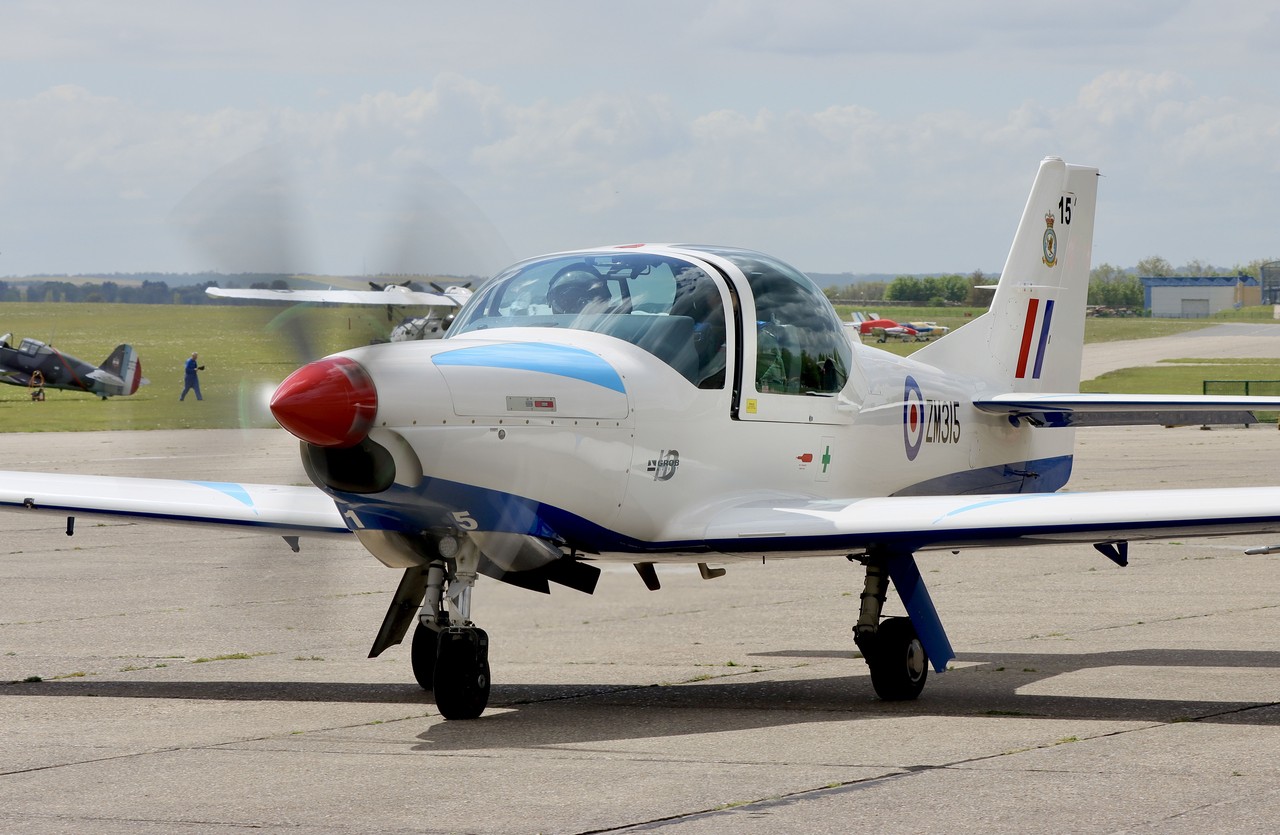
Development and Design Innovation
The G-120 emerged from Grob Aircraft's engineering team as an evolution of the company's earlier G-115TA design, specifically targeting the demanding requirements of modern airline pilot training and military instruction programs. The prototype, registered D-ELHU, completed its maiden flight in January 1999, marking the beginning of a new generation of composite trainers. Grob's engineers incorporated cutting-edge materials and systems, including a carbon fiber reinforced plastic airframe stressed to withstand +6/-4g aerobatic loads, electronic flight instrument systems (EFIS), and dual thrust levers mimicking commercial airliner controls.
Technical Excellence
Powering the G-120A is the Textron Lycoming AEIO-540-D4D5, a flat-six, air-cooled, fuel-injected piston engine delivering 194 kilowatts (260 horsepower). This aerobatic-rated powerplant, part of Lycoming's renowned O-540 family that has exceeded 35,000 units produced since the 1950s, provides reliable performance for high-stress training operations. The engine's electronic fuel injection system ensures smooth power delivery during both normal flight and aerobatic maneuvers, critical for student pilot training scenarios.
The aircraft's innovative design extends beyond its powerplant. Engineers incorporated an adjustable cockpit capable of accommodating helmeted military students, air conditioning for extended training flights, and a service life exceeding 15,000 hours. These features represented significant advances in composite trainer aircraft durability and training efficiency when the G-120 entered service.
Military Service Excellence
The Israeli Air Force became the G-120's most prominent military operator, designating their 17 aircraft as G-120A-I "Snunit" (meaning Swallow or Cyclone). Operated by Cyclone Aviation, an Elbit Systems subsidiary, these trainers entered service in October 2002 with the first three aircraft delivered to Hatzerim Air Force Base on October 27. By mid-2003, the Israeli Air Force had received 22 aircraft for pilot screening and primary training operations.
Additional military customers demonstrated the aircraft's international appeal. The French Air and Space Force acquired 18 units, while the German Air Force procured six aircraft for pilot training programs. The Kenya Air Force operates six G-120s, and Canada's KF Defence Programs utilized 14 aircraft until 2013. These military operators employed the G-120 exclusively for pilot training roles, from elementary instruction through aerobatic training, with no combat variants or roles developed.
Commercial Training Applications
Lufthansa Flight Training (LFT) recognized the G-120's potential for commercial pilot instruction, ordering seven aircraft in January 2001 for their Airline Training Center Arizona (ATCA) facility at Goodyear, near Phoenix. Deliveries commenced in February 2002 with aircraft N861AF, marking the type's entry into ab initio training programs for German armed forces pilots. This commercial application highlighted the aircraft's capability to bridge military and civilian pilot training requirements.
The Grob Aircraft Story
Grob Aircraft's journey with the G-120 reflects the broader challenges facing specialized aircraft manufacturers. Founded by Burkhard Grob in 1971, the company originally specialized in composite aircraft and gliders before expanding into powered trainers. Financial difficulties led to insolvency in 2007, but the company was acquired by Euro Engineering GmbH (later Eviation AG) and continued operating under the Grob Aircraft name. Qatar's investment in 2021 for the G-120TP turboprop program ensured the company's continued focus on trainer aircraft development.
Performance and Specifications
The G-120A demonstrates impressive performance capabilities for a primary trainer. Maximum speed reaches 235 kilometers per hour (127 knots), while the service ceiling extends to 5,486 meters (17,999 feet). The aircraft achieves a climb rate of 6.501 meters per second (1,280 feet per minute) and requires 707 meters (2,320 feet) for takeoff operations. With 378 liters of fuel capacity, the G-120 provides sufficient endurance for extended training flights while maintaining the agility required for aerobatic instruction.
Production Legacy
Production of the G-120 series totaled approximately 215 units, manufactured at Grob Aircraft facilities in Germany through the early 2000s. The first production aircraft entered service in July 2002, following three years of development and testing after the prototype's initial flight. This production run established the G-120 as a significant player in the modern trainer aircraft market.
Continuing Influence
Many of the 215 G-120s produced remain in active service today, with military fleets including the 17 Israeli Snunit and 18 French Air and Space Force aircraft continuing operations. The design's influence extends to the G-120TP turboprop variant, which achieved certification in 2013 and secured orders including 24 aircraft delivered to the Bangladesh Air Force between 2021 and 2022. This evolution demonstrates the enduring relevance of the G-120's basic design philosophy in modern pilot training applications, bridging the gap between traditional primary trainers and contemporary commercial aviation requirements.