
Service History
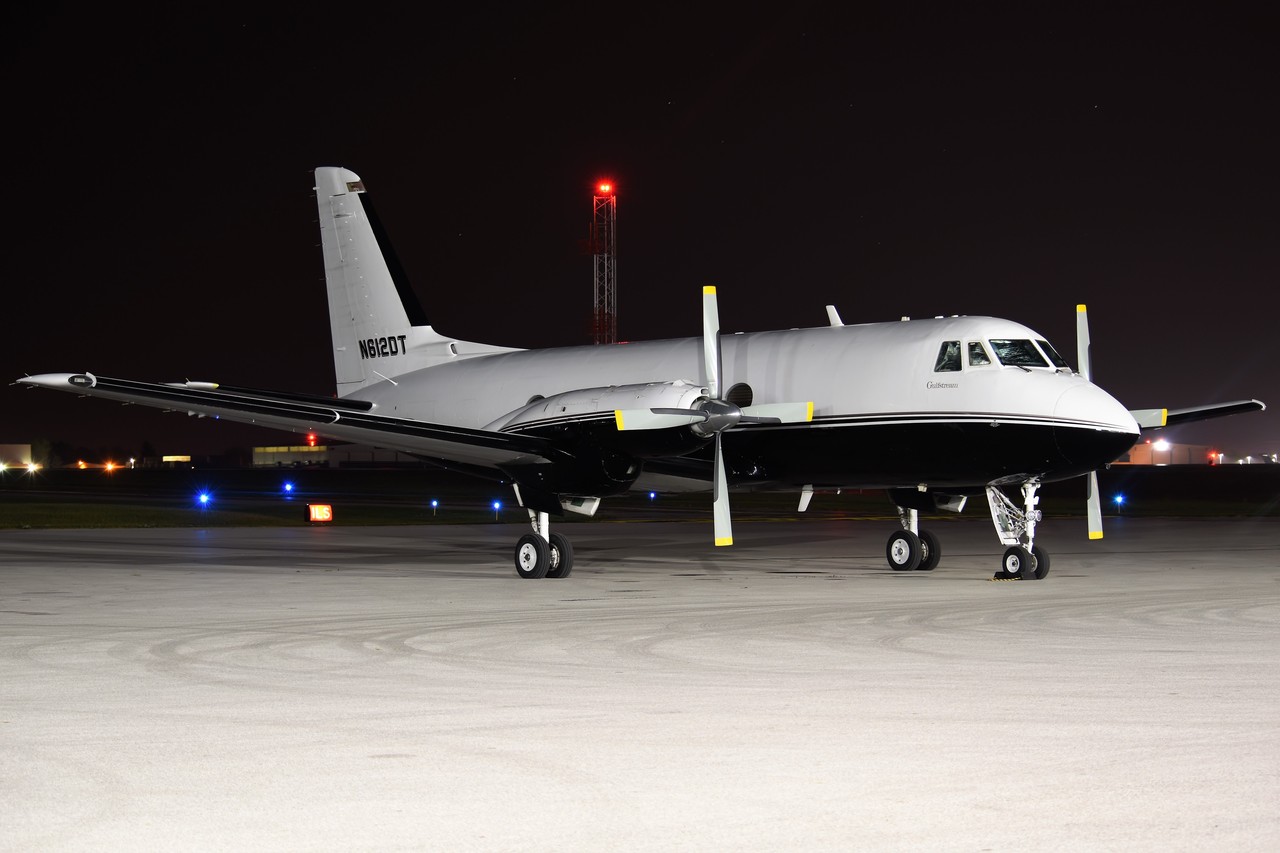
The Gulfstream I revolutionized corporate aviation by proving that turboprop technology could deliver airline-like performance with executive comfort. From its first delivery in May 1959, the aircraft became the standard for high-end business transportation, operated by major corporations including Conoco, which flew N708G from September 1959 until after 1981. The Walt Disney Company operated N732G from 1963 to 1967, while Petro Canada and numerous other corporations recognized the aircraft's ability to efficiently connect distant business locations.
Five stretched G-159C variants were built starting in November 1980, configured for 37 passengers and operated by Air North, later known as Brockway Air. These commercial variants demonstrated the design's versatility beyond pure corporate use, though the vast majority of the 200 aircraft built served as executive transports throughout their careers.
Military Applications
While primarily a civilian aircraft, the Gulfstream I found limited military application in specialized roles. The U.S. Coast Guard received one VC-4A variant in 1963 for VIP transport duties. The U.S. Navy's proposed TC-4B navigator trainer was canceled, but nine TC-4C Academe variants were delivered in 1966 for the Navy and Marine Corps.
The TC-4C aircraft served as bombardier and navigator trainers for A-6 Intruder crews, featuring simulated A-6 cockpits and specialized radomes. One TC-4C was last observed in 2018 at Davis-Monthan Air Force Base's Aircraft Maintenance and Regeneration Group facility. The Hellenic Air Force operated one aircraft from 1963 to 1995, initially serving as VIP transport for the Greek King before transitioning to government and staff transportation duties.
The Manufacturer
Grumman Aircraft Engineering Corporation, founded in 1929, built its reputation as a premier naval aircraft manufacturer throughout the 1930s and 1940s. The company produced legendary World War II fighters including the F4F Wildcat and F6F Hellcat, later developing the iconic F-14 Tomcat. The Gulfstream I represented Grumman's strategic expansion beyond military contracts into the emerging business aviation market.
In 1994, Grumman merged with Northrop to form Northrop Grumman, but the business jet division was sold to a management-led group that became Gulfstream Aerospace. This new entity continues operations today, building upon the foundation established by the original Gulfstream I to become the dominant force in luxury business aviation.
Engine and Technical Innovation
The aircraft was powered by two Rolls-Royce Dart Mk.529 or Mk.529-8E/8X turboprop engines, each producing 2,190 shaft horsepower and driving four-bladed Rotol constant-speed propellers. The Dart engine series, which entered production in 1947 and continued for over 30 years with approximately 20,000 units built, provided the reliability and fuel efficiency essential for business operations.
Grumman's engineering team finalized the design in June 1957 after rejecting a Grumman Trader-based concept in favor of an entirely new low-wing configuration with stand-up cabin capability. Key innovations included a cantilever monoplane design with semi-monocoque aluminum construction, retractable tricycle landing gear, and a forward hydraulically operated airstair that eliminated ground support equipment requirements. The spacious cabin could accommodate various configurations while maintaining the aerodynamic efficiency necessary for transcontinental range.
Performance and Pilot Experience
The Gulfstream I operated with a two-person crew and delivered performance that bridged the gap between existing piston-engine aircraft and pure jets. With maximum speeds exceeding 300 mph and range capabilities surpassing 2,000 miles, the aircraft could efficiently connect distant business locations while carrying substantial fuel loads of 1,550 gallons. The twin-engine configuration provided the redundancy essential for business operations over extended routes.
The aircraft's handling characteristics and operational flexibility made it attractive to corporate flight departments seeking reliable, efficient transportation. The combination of turboprop power with executive appointments created a new category of business aircraft that established benchmarks for comfort, range, and operational capability.
Production Legacy
Grumman manufactured all 200 Gulfstream I aircraft at its Bethpage, New York facility between 1959 and 1969. FAA type certification was achieved on May 2, 1959, enabling immediate commercial deliveries. The aircraft succeeded in proving the viability of turboprop business aviation and launching what would become the Gulfstream family of business jets.
Today, examples of the original Gulfstream I can be found at aviation museums including the Pima Air & Space Museum in Tucson, Arizona. While the exact number of airworthy aircraft remains unknown, the type's significance extends beyond its operational service to its role in establishing the modern business aviation industry and proving that specialized corporate aircraft could deliver both performance and luxury in a single platform.