
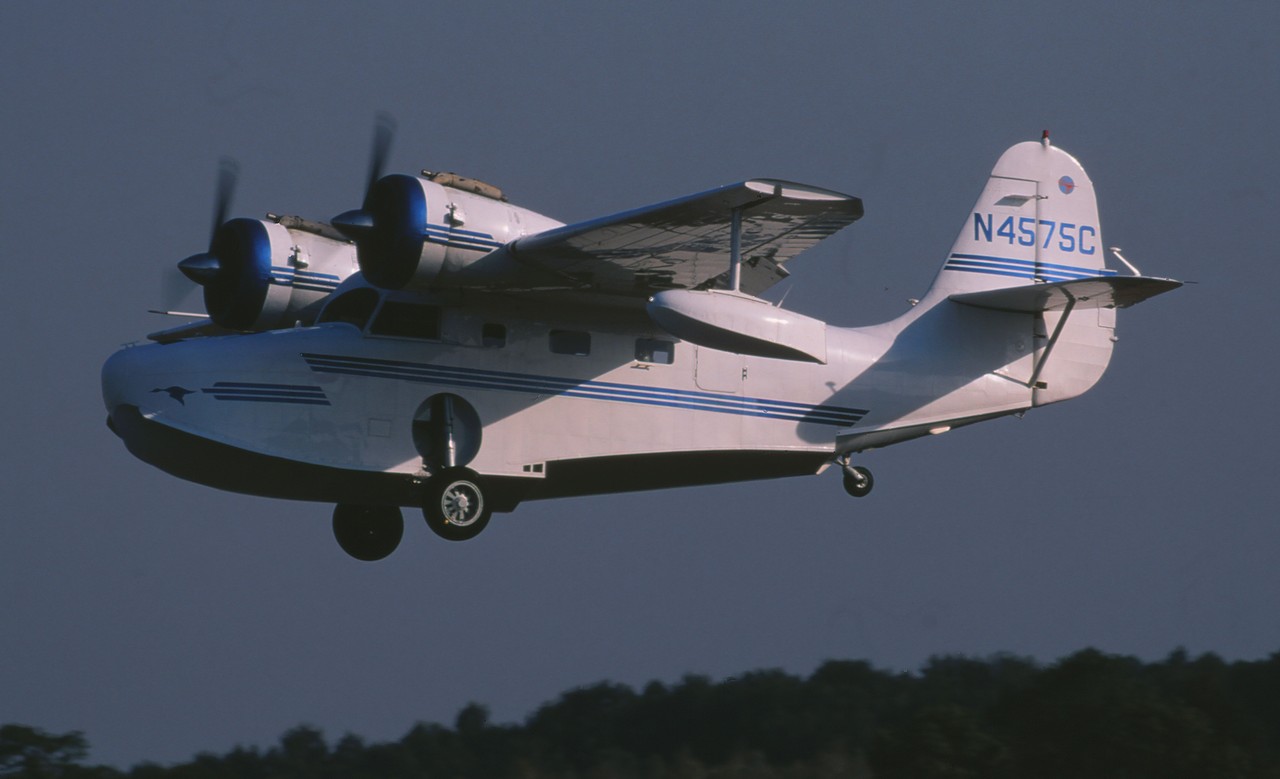
Revolutionary Design Origins
The G-21A Goose emerged from an unusual commission in 1936 when wealthy Long Island residents, including railroad magnate E. Roland Harriman, approached Grumman Aircraft Engineering Corporation for a luxurious amphibious transport. These affluent commuters wanted an elegant solution for traveling between their Long Island estates and New York City offices, spurning conventional ground transportation for the freedom of flight over water.
Grumman's design team created their company's first monoplane, first twin-engine aircraft, and first type to enter commercial service. The prototype took its maiden flight on May 29, 1937, with test pilots Robert L. Hall and Bud Gillies at the controls, logging 6 hours and 10 minutes of flight time over three days before attempting its first water landing. Remarkably, production aircraft number two was delivered just 35 days later, demonstrating Grumman's efficient manufacturing capabilities.
Wartime Transformation
World War II transformed the gentleman's flying yacht into a military workhorse. The U.S. Navy adopted the design as the JRF series, while the U.S. Army Air Corps designated it the OA-9, later redesignating impressed civilian aircraft as OA-13A variants. The U.S. Coast Guard also operated significant numbers for patrol and rescue missions along America's coastlines.
International operators included Canada, Great Britain, Japan, Argentina, Bolivia, Brazil, Peru, Portugal, and Cuba, utilizing the Goose for utility transport, patrol duties, and training missions. The JRF variants comprised the majority of military production, with aircraft like JRF-5 Bu 84791 serving the Coast Guard in Biloxi from 1946 to 1948 before transferring to Alaska, where it operated until damaged on August 10, 1950.
Grumman Aircraft Engineering Corporation
Founded in 1929, Grumman Aircraft Engineering Corporation established its reputation building rugged naval aircraft from their Bethpage, New York factory on Long Island. The company pioneered monocoque fuselage construction and became synonymous with carrier-based fighters like the F4F Wildcat. The G-21A represented Grumman's first venture into commercial aviation, demonstrating the versatility that would characterize the company throughout its 65-year independent existence.
Grumman operated as an independent manufacturer until 1994, when it merged with Northrop Corporation to form Northrop Grumman Corporation, which continues operations today as a major aerospace and defense contractor.
Technical Excellence
Two Pratt & Whitney R-985 Wasp Junior engines powered the G-21A, each nine-cylinder air-cooled radial producing 450 horsepower. These reliable powerplants, mounted on the wing's leading edges, enabled the Goose to achieve a best cruise speed of 166 knots, climb at 1,300 feet per minute, and reach a service ceiling of 22,000 feet. The aircraft consumed 53 gallons per hour at 75 percent power settings while delivering a practical range of 695 nautical miles.
The Pratt & Whitney R-985, which entered production in 1930 and continued through the 1950s, proved exceptionally reliable for utility operations. Later Goose variants would replace these radials with more modern powerplants, including Lycoming GSO-480-B2D6 pistons in 1958 conversions and Pratt & Whitney Canada PT6A-20 turboprops in 1968 modifications.
Commercial Aviation Pioneer
Initial G-21A models served as executive "flying yachts," luxuriously appointed for two to three passengers with amenities including bars and toilets. Early commercial operators included the Venezuela Oil Development Branch of Asiatic Petroleum Company, which took delivery of their aircraft on December 10, 1938. Alaska Coastal Airlines operated Goose aircraft until merging with Alaska Airlines on February 3, 1968.
The Goose pioneered amphibious commuter service, establishing routes from Long Island to New York City and later expanding to serve Alaska's remote communities, Caribbean islands, and South American destinations. Some aircraft operated in Ecuador until 1951, demonstrating the type's international commercial viability.
Production and Legacy
Grumman manufactured exactly 345 G-21A Goose aircraft between May 1937 and October 1945 at their Bethpage facility. This eight-year production run established the type as the most successful pre-war amphibious aircraft design, confirming Grumman's reputation for building durable aircraft capable of serving diverse roles across multiple decades.
Today, approximately 30 Goose aircraft remain airworthy from the roughly 60 still carried on civil registries worldwide, with many others having been lost to accidents or deterioration. Notable museum examples include the National Air and Space Museum's 1938 G-21A, formerly operated by Venezuela Oil, the American Heritage Museum's JRF-5, and the National Naval Aviation Museum's JRF variant.
The Goose's cultural significance extends beyond its technical achievements, representing the golden age of aviation when wealthy individuals could commission custom aircraft designs and small manufacturers could successfully enter commercial aviation markets. Its versatility in bridging civilian executive transport and military utility roles exemplified the adaptability that characterized successful aircraft designs of the late 1930s.