
The Conversion Specialist
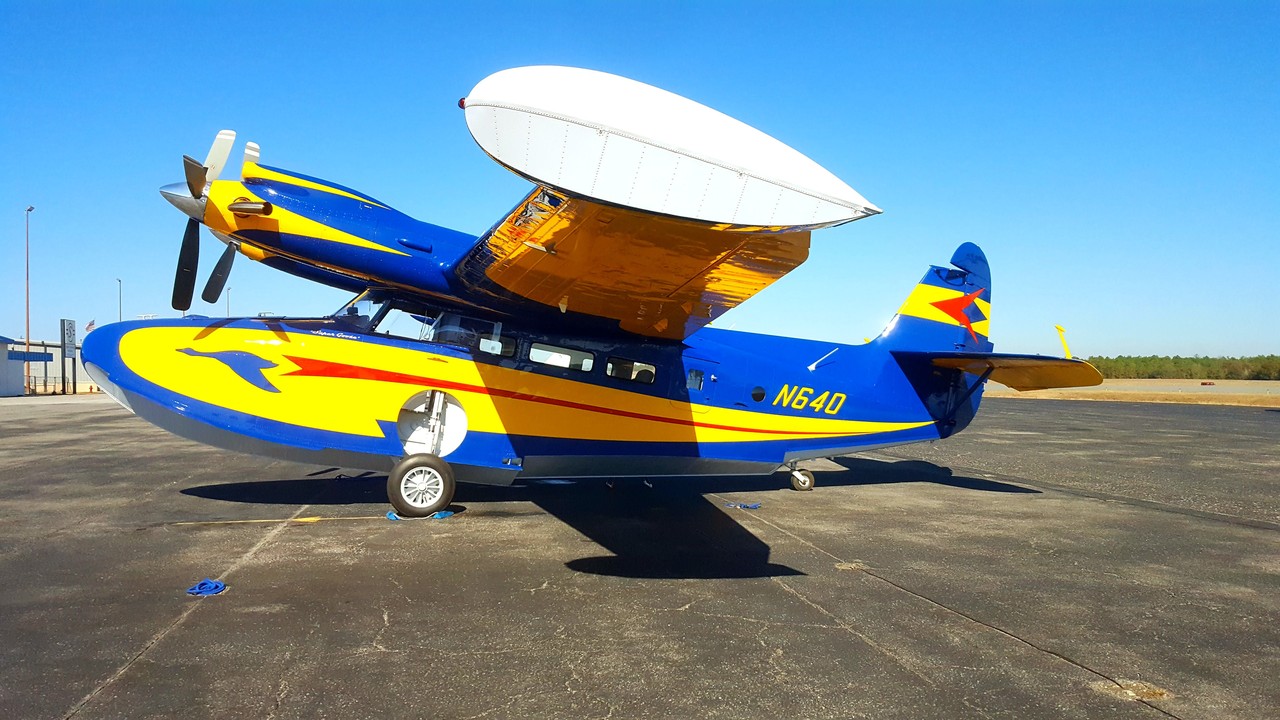
McKinnon Enterprises carved out a unique niche in aviation by breathing new life into surplus Grumman G-21 Goose amphibians. Based in Sandy, Oregon, the company began conversion work in 1956, initially experimenting with horizontally-opposed engines and even four-engine configurations before settling on turboprop power for their most ambitious project. The company systematically worked through a series of airframes with construction numbers 1211 through 1225, developing increasingly sophisticated modifications that culminated in the G-21E variant.
The prototype G-21E conversion utilized former Grumman G-21A construction number 1013, assigned McKinnon serial number 1211 and registered as N121H. This aircraft underwent its transformation between 1966 and 1967, emerging with two 550-horsepower Pratt & Whitney Canada PT6A-20 turboprops replacing the original quartet of 340-horsepower Lycoming GSO-480-B2D6 piston engines. The Federal Aviation Administration granted approval for the conversion in July 1969, certifying the aircraft at a maximum gross weight of 10,500 pounds.
Limited Production Reality
Despite the promising performance improvements offered by turboprop power, the G-21E remained an extremely limited conversion program. Only one aircraft received official G-21E certification, highlighting the specialized nature of McKinnon's work and the economic challenges of converting vintage amphibians. The company did complete a related conversion of construction number 1211 as a G-21E variant in May 1970, but the overall program never achieved the scale McKinnon had envisioned.
This scarcity reflected broader market realities facing amphibious aircraft in the late 1960s. While the original Grumman factory had produced 345 G-21 Goose aircraft between 1937 and August 1945, the post-war market for converted amphibians proved far more limited. Many potential customers found new turboprop aircraft more attractive than expensive conversions of aging airframes.
Turboprop Innovation
The heart of the G-21E conversion lay in its powerplant selection. Pratt & Whitney Canada's PT6A-20 engines represented cutting-edge technology for their era, part of a revolutionary turboprop family that entered production in 1963. These free-turbine engines offered exceptional reliability and power-to-weight ratios that made them ideal for aircraft conversions. By 2023, the broader PT6A series had accumulated more than 55,000 engines produced, testament to the fundamental soundness of the design McKinnon selected.
The PT6A-20 engines provided substantially more power than the original piston powerplant while reducing maintenance requirements and improving high-altitude performance. This combination proved particularly valuable for operators working in remote locations where maintenance support was limited and reliable operation was paramount.
Corporate Aviation Service
The converted aircraft found homes with corporations requiring reliable amphibious capability. The prototype N121H operated for Halliburton Company, photographed at New Orleans Lakefront Airport in January 1985. The aircraft's service history included previous ownership by J.P. Bickell and McIntyre-Porcupine Mines, suggesting its value for reaching remote locations inaccessible to conventional aircraft.
Another converted airframe, construction number B-62 (originally Bureau Number 37809), followed a more international path. After serving the U.S. Navy during World War II, this aircraft was sold to Peyton Hawes of Portland, Oregon, before eventually reaching Sea Bee Air in New Zealand, where it operated as ZK-ERX beginning in December 1980.
Manufacturing Legacy
McKinnon Enterprises operated through the 1970s, developing multiple Goose variants including the G-21C (approved November 7, 1958), G-21D (1960), and G-21G alongside the G-21E. However, the company eventually ceased operations under that name, reflecting the limited market for expensive amphibian conversions. The original manufacturer, Grumman Aircraft Engineering Corporation, evolved through multiple corporate transitions, becoming Grumman Aerospace in 1976 before merging with Northrop in 1994 to form Northrop Grumman.
Surviving Examples
Today, the G-21E represents one of the rarest variants of an already uncommon aircraft type. With only one officially certified conversion completed, N121H stands as a unique example of 1960s conversion technology. Of the 345 original Grumman Goose aircraft produced, approximately 30 remain airworthy today from the 60 still carried on various registries, making any surviving McKinnon conversion exceptionally valuable to collectors and operators seeking amphibious capability.
The G-21E program highlighted both the potential and limitations of aircraft conversion work, demonstrating that even excellent engineering and proven engines could not overcome market realities and the challenges of modifying aging airframes for modern operations.