
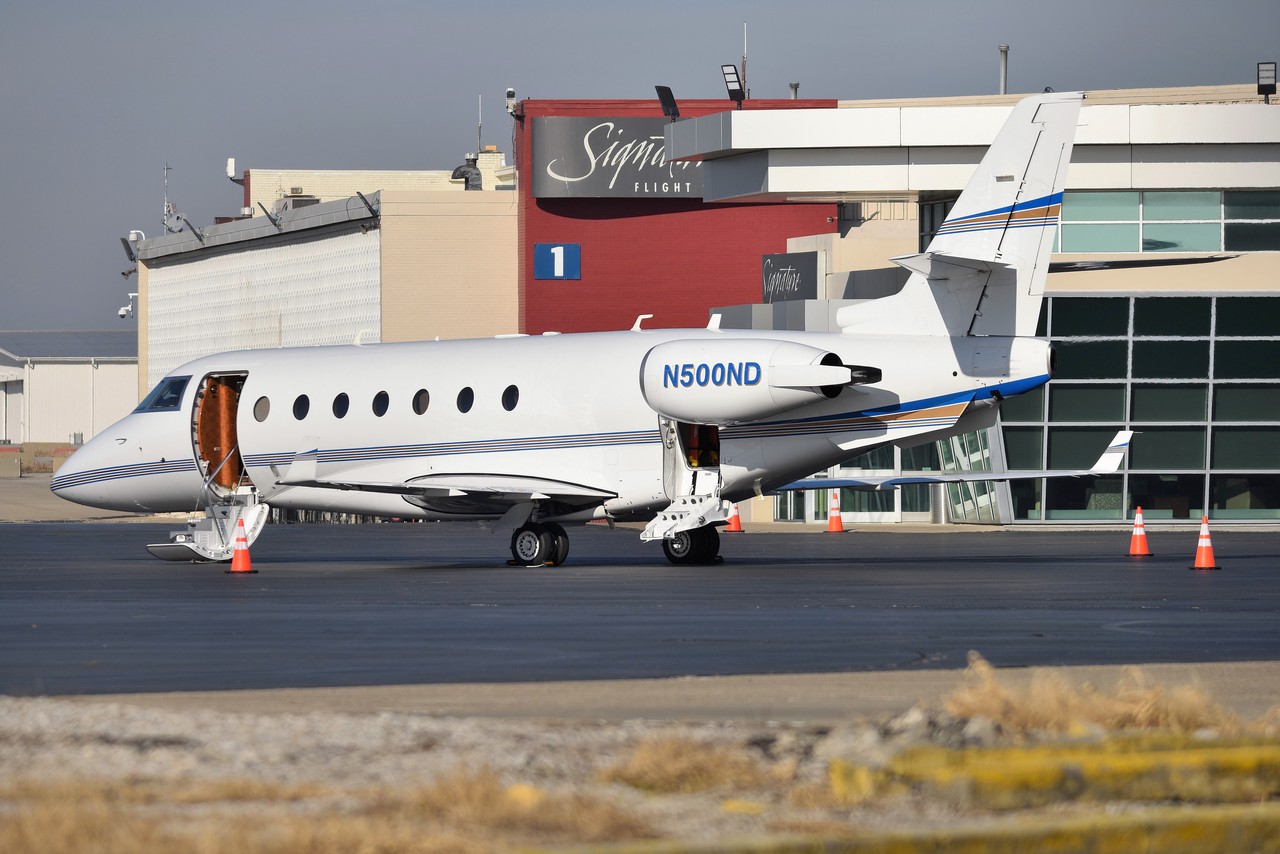
International Manufacturing Partnership
The G250 represented a unique manufacturing approach for Gulfstream Aerospace, marking the company's first major collaboration with Israel Aerospace Industries (IAI). Development began internally around 2005, three years before the official program announcement in October 2008. The aircraft's wing design was frozen by 2006, and the critical design review was completed in late 2007, demonstrating the extensive engineering timeline required for this ambitious project.
Production utilized a trans-Atlantic assembly line, with fuselage and wing assembly occurring at IAI's facility at Ben Gurion Airport in Israel. Wings were manufactured by Spirit AeroSystems in Wichita, Kansas, the former Boeing facility. After initial assembly in Israel, aircraft were shipped to Gulfstream's Savannah, Georgia facilities for final completion, painting, and interior installation. The first aircraft rolled out on October 6, 2009, just two months before its maiden flight.
The Gulfstream Legacy
Gulfstream Aerospace traces its origins to 1958, when Grumman Aircraft Engineering Corporation's civil division began producing business jets with the original Gulfstream I. The company's dedicated Savannah facility opened in June 1967 for Gulfstream II production and was officially dedicated on September 29, 1967. Through multiple ownership changes, including American Jet Industries in 1978, Chrysler Corporation in 1985, and finally General Dynamics in 1999, Gulfstream has maintained its position as a premier business jet manufacturer.
By the time the G250 program launched, Gulfstream had produced over 2,000 aircraft across its various models. The company expanded its Savannah facilities in 2006 with a $400 million investment, preparing for increased production capacity that would support programs like the G250.
Design Excellence and Performance
The G250's design team focused on creating a super-midsize business jet that could outperform existing category competitors in range, altitude capability, and cabin space. Extensive wind tunnel testing at multiple global facilities optimized the swept-wing configuration for both high-speed cruise and low-speed handling characteristics. The aircraft was engineered to achieve an initial climb to 41,000 feet with a service ceiling of 45,000 feet, while maintaining takeoff performance from runways shorter than 5,000 feet.
The cabin design prioritized passenger comfort with dimensions exceeding those of traditional super-midsize competitors. Standard configurations accommodate 10 passengers in executive seating, though maximum capacity reaches 19 passengers depending on interior layout. The two-pilot flight deck incorporates modern avionics systems standard for business jets of this era.
Certification and Market Entry
Following its December 2009 first flight, the G250 underwent comprehensive flight testing and certification programs. The aircraft received certification in 2011, with first deliveries occurring the same year. This relatively quick certification timeline reflected both Gulfstream's experience with regulatory processes and the fundamental soundness of the aircraft's design.
The G250 was later renamed the G280, though it retained the same ICAO designation G250. This nomenclature change aligned with Gulfstream's broader model designation strategy while maintaining operational continuity for air traffic control and airport operations.
Production Success
By 2026, over 200 G250/G280 aircraft had been manufactured, establishing the type as a successful addition to Gulfstream's product line. The aircraft remains in active production, serving corporate and private operators worldwide. Unlike airline transports, the G250 operates exclusively in the business aviation market, providing point-to-point transportation for executives, high-net-worth individuals, and specialized charter operations.
The aircraft's 3,400 nautical mile range at Mach 0.80 enables transcontinental flights in the United States and intercontinental routes such as New York to London or Los Angeles to Hawaii. This capability positioned the G250 as a category leader, offering airline-like range performance in a more economical super-midsize platform.
Current Operations
Today, G250/G280 aircraft operate from business aviation airports worldwide, contributing to the global fleet of over 2,000 Gulfstream aircraft in service. The type has established itself as a reliable performer in the super-midsize category, validating Gulfstream's decision to pursue the international manufacturing partnership with Israel Aerospace Industries. As business aviation continues to grow globally, the G250 represents Gulfstream's successful adaptation to market demands for longer-range, larger-cabin aircraft in the super-midsize segment.